

Subject Area 21 — Bridge procedures & standards — is one of seventeen subject areas the Dry Bulk Centre of Excellence (DBCE) flags as a DryBMS priority area, on the grounds that it carries a higher potential impact for injury to people and damage to the environment than the other thirteen.
It’s also the subject area where DryBMS sets its most demanding requirement for a DryBMS navigation assessment — a specific, resourced practice, not a line on a checklist. That priority flag makes no difference to the company’s overall score, either way. DryBMS says so directly: priority subject areas “make no difference to the overall score of a company,” and a company “may wish to focus on improvements” to them ahead of the rest, purely at its own discretion.
That’s worth sitting with before going any further, because it inverts the instinct most ship managers bring to a self-assessment framework. The subject area DryBMS itself identifies as carrying the highest risk to people and the environment is scored exactly the same as HR recruitment or contractor management.
Nothing about the scoring mechanism pushes a company toward getting bridge procedures right first. What does push a company there is reading what DryBMS actually expects at each level of Subject Area 21 — because the four levels aren’t a gentle slope. They describe four genuinely different systems, and the gap between what most fleets already do and what “Excellence” requires is larger than the level names suggest.
The Four Levels Are Four Different Systems, Not Four Grades of the Same One
Basic asks for what most SMS documents already have: navigational procedures for each stage of the passage, references, and checklists for coastal waters, narrow waters and TSS, restricted visibility, heavy weather and ice. Bridge organisation procedures — composition of the bridge team, lookout, familiarisation, handovers, master-pilot exchange — sit here too. None of this should surprise anyone running a compliant fleet.
Intermediate adds two things that change the character of the requirement. First, the procedures now need to reference specific systems by name — VDR procedure, AIS use and limitations, BNWAS operation, bridge access and distraction prevention. Second, and more significantly, “the master carries out a navigation audit to ensure compliance with company procedures” — once a year, per vessel, in a format the company sets. This is a self-check, done by the ship, on the ship.
Advanced is where DryBMS splits navigation oversight into two separate systems that most fleets tend to run as one. The first is a navigation audit on passage — a compliance check, carried out by the company across all vessels within a four-year cycle (two years if there’s been a navigational incident). The second is a DryBMS navigation assessment on passage, run roughly every two years, with a distinct and different purpose: to “verify its navigation standards and the effectiveness of its BRM programme,” with action plans covering training needs.
An audit checks whether procedures are being followed. An assessment checks whether the bridge team is actually good at what the procedures ask of them. DryBMS treats these as two different disciplines requiring two different systems — which matches how I’d separate them from the assessor’s chair, but is not how most SMS documents currently structure it.
What a DryBMS Navigation Assessment Actually Requires at Excellence
Excellence doesn’t introduce a third system. It takes the Advanced-level DryBMS navigation assessment and specifies exactly how it has to be resourced:
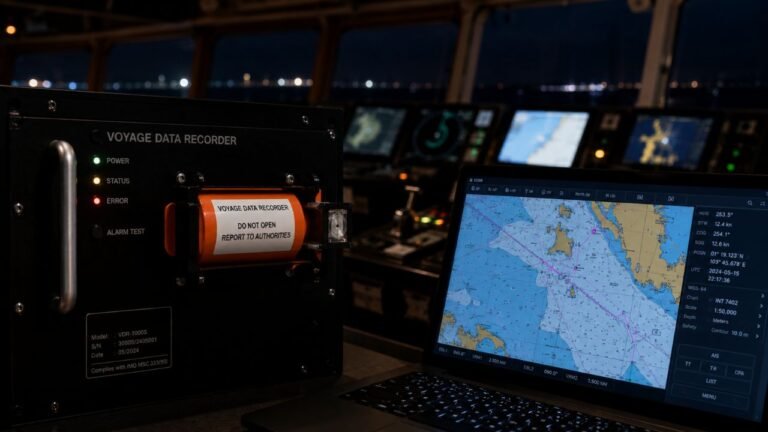
“The company has a programme for navigation assessments on passage by suitable 3rd party assessors, supplemented by remote navigational assessments using VDR downloads and other data. Installation of VDR software in the ship manager’s office.”
Two details here get missed on a fast read. The first is “3rd party assessors” — Excellence requires the periodic assessment to be conducted by someone independent of the company, not an in-house superintendent marking the company’s own homework. The second is “supplemented by” — remote, VDR-based assessment isn’t offered as a cheaper substitute for the physical assessor visit. DryBMS positions it as an additional layer that sits between those visits, not a replacement for them.
A fleet running a 3rd-party assessment every two years and nothing in between is not, on this reading, doing what Excellence describes. The gap between assessments is exactly where “installation of VDR software in the ship manager’s office” is meant to do its work — giving the office an ongoing, evidence-based view of how the bridge team is actually operating, rather than a single snapshot once every two years.
That’s a materially different capability from what most ship managers currently have in place. It requires VDR data to be pulled and reviewed on a routine cycle, not just downloaded after an incident or ahead of a scheduled assessment — and it requires someone qualified to read what the data is actually showing, which is a narrower skill than it sounds. Passage plans, checklists and BRM refresher records are straightforward to audit from a desk.
Judging whether a bridge team’s actual watchkeeping, lookout discipline and pilotage conduct meet the standard from raw VDR audio, radar and helm data is a different exercise entirely, and it’s the one DryBMS puts at the top of the scale for this subject area.
Why the Priority Flag and the Excellence Bar Point the Same Way
Come back to where this started. DryBMS’s own priority-area logic and its own Excellence-level requirement for Subject Area 21 are both saying the same thing about where risk actually concentrates on a bulk carrier — they just say it through different mechanisms. The priority flag says it explicitly, then immediately declines to back it with score weighting.
The Excellence-level expectation says it implicitly, through what a DryBMS navigation assessment actually requires: a standing, evidence-based capability rather than a periodic paper check.
A company chasing the numerical score has no incentive from the scoring rules to treat Subject Area 21 differently from any other. A company reading what DryBMS actually describes at Excellence — third-party assessment supplemented by a routine, office-based VDR review capability — is being told, in detail, what a serious approach to bridge risk looks like on a bulk carrier.
Those are two different documents to read, and only one of them is the scoring table.
DryBMS isn’t the only framework moving in this direction — the same evidence-first logic runs through TMSA and DryBMS compliance more broadly, and RightShip’s own inspection questionnaire is already tracking DBCE subscription, as covered in The RISQ DryBMS Question Nobody Has to Verify — Yet.
More from the VDR Series
→ Explore our VDR Navigational Audit Service — Book a VDR Navigational Audit
- The VDR Audit Guide: What the Bridge Data Shows, and Where to Start
- The VDR Audit Report Isn’t Just Good Practice. SIRE 2.0 Question 3.2.4 Asks For It By Name.
- The VDR Playback Software Is There. The Procedure That Covers It May Not Be.
- ECDIS in Tidal Ports: The Alarm That Stops Working When You Need It Most
- The Lookout During Port Approach Is on the Manning Matrix. The VDR Shows Whether Anyone Was Standing It.
- When Risk Becomes Routine, the Bridge Goes Quiet
- The First VDR Audit Your Fleet Runs Should Be Announced. Here’s Why.
- The Anchor Is Down. The VDR Doesn’t Know That.
- The VDR Track Shows More Than Where the Pilot Boarded
- The Radar Is Running. The VDR Shows Whether It’s Doing Its Job.
- When VDR Data Works For You, Not Against You
- Tug Bollard Pull, Ship Fittings, and the Conversation That Doesn’t Happen
- The Master Pilot Exchange: What the VDR Hears, and What Most Ships Leave Unsaid
- The Port Approach Is Already on Film. Most Managers Don’t Know It.
- The Radar Log Says Done. The VDR Says Otherwise.
- Passage Planning Mistakes Ships Make — And What the VDR Reveals
- Ghost Fix: What the Bridge Team Does When the Auditor Has Gone Home
- VDR Navigational Audits: What They Are, Why They Matter, and When to Do One
- How a VDR Navigational Audit Works — A Step-by-Step Guide for Ship Managers