
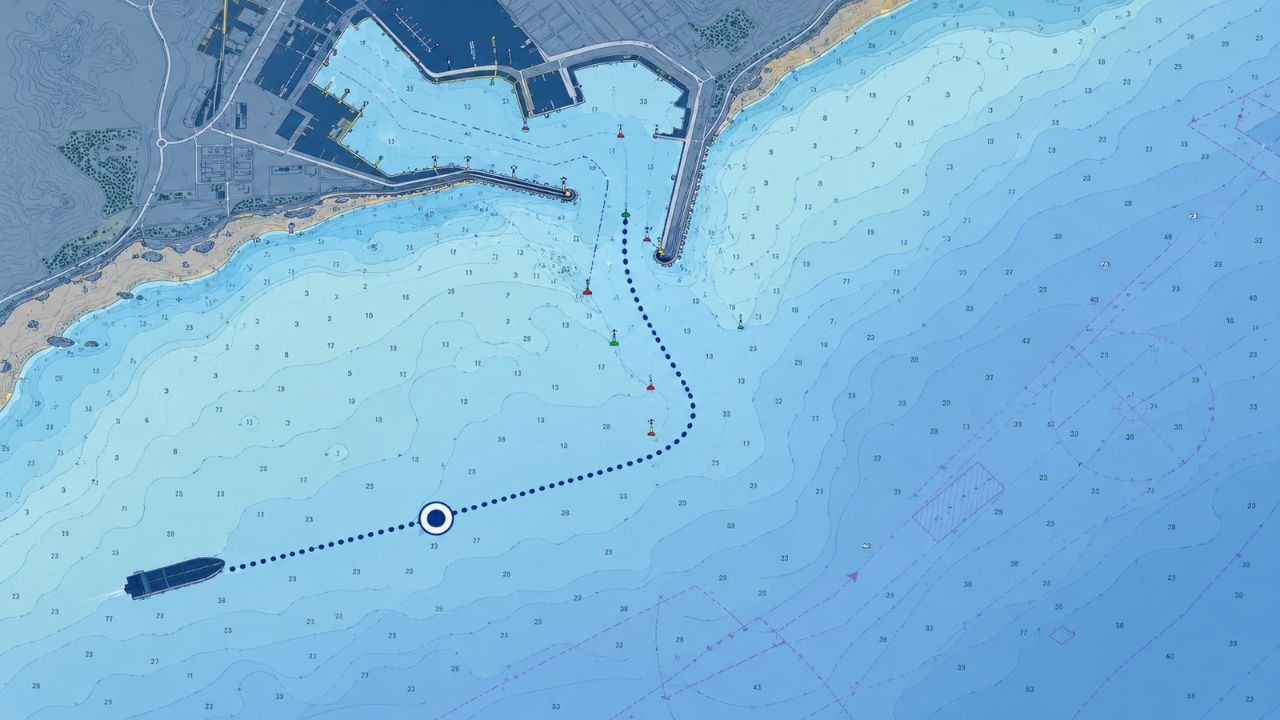
When I review a VDR audit for a port approach, one of the first overlays I look at is position at time of pilot boarding. Not because I expect to find a problem every time, but because the position tells me something about the decisions that preceded it.
A significant number of vessels I have audited are already past the designated pilot boarding ground when the pilot climbs the ladder. In most cases, this is not documented anywhere as a deviation. There is no entry in the logbook. No annotation on the passage plan. No discussion on the VDR audio that suggests the bridge team treated it as a departure from plan.
The pilot requested it, or the pilot was delayed and the ship kept moving, and the Master judged the waters clear enough to continue. Neither of those judgements is unreasonable on its own. But the question worth asking is whether the implications of that movement were actually considered before the ship passed the mark — and in my experience, they rarely are.
What the Pilot Boarding Ground Is Actually For
The pilot boarding ground is a charted designation. It defines the area where, under the prevailing hydrographic and navigational conditions of that port approach, it is considered safe and practicable for a vessel to slow, manoeuvre, and transfer a pilot. The designation accounts for sea room, traffic separation, water depth, swell exposure, and — critically — the vessel’s ability to hold a safe position or abort inbound if something goes wrong.
It is not a line that indicates where your ship is guaranteed to fit. It is a line that indicates where the chartmaker and port authority consider the margin sufficient for the operation being conducted.
IMO Resolution A.960(23), which governs operational procedures for maritime pilots, is explicit on this point. The pilot boarding point must be positioned at sufficient distance from the commencement of pilotage to allow safe boarding conditions, and — critically — must provide sufficient time and sea room to conduct the Master–Pilot information exchange. That is the IMO’s own definition of what the point is for. Moving past it does not simply change position; it removes the conditions the designation was built around.
When a ship moves beyond that line, it does not enter unsafe water necessarily. But it does systematically reduce several margins that the plan was built around. Specifically three.
Three Margins That Reduce When You Move Past the Mark
The time available for a meaningful MPX
The Master–Pilot Exchange is not a formality. It is the mechanism by which the Pilot is handed situational context: vessel characteristics, manoeuvring data, any defects, UKC calculations, tidal window, intended approach, abort positions. Done properly, it takes time — and it should, because the Pilot is about to assume the conn of a vessel they have never stood on.
Every mile the ship travels past the pilot boarding ground before the pilot boards is a mile that reduces the runway available for that exchange. The Pilot boards further into the approach. The first alteration or critical point is now closer. In ports with tight tidal windows or constrained channels, the margin between a proper MPX and a reactive one can be the distance between planned and improvised.
The VDR audio captures this clearly. When a vessel is already past the pilot boarding ground, the MPX is often shorter, denser, and less systematic than it would otherwise be. The Pilot has less time to absorb what he’s been told before the first decision is already on him.
The ability to abort
The passage plan for any port approach should include an abort position — the last point at which the vessel can safely turn around or stand off without committing to the final approach. This position is calculated in open water, with sea room, against the vessel’s manoeuvring data.
Now consider a scenario that happens more often than most companies plan for: the pilot cannot board. The boarding boat turns back due to swell. A crew member is injured during the transfer. The pilot falls ill at the ladder. The boarding operation is abandoned.
If the vessel is at or near the pilot boarding ground, the abort is straightforward. There is sea room, there is time, and the options are clear. If the vessel has proceeded significantly beyond it, the abort is a different exercise entirely. Sea room may be reduced. Traffic may be converging. The manoeuvre that was planned for open water now has to be executed in more constrained conditions.
The question I ask during audits is simple: was the possibility of the pilot not boarding considered in the risk assessment, and does the documented abort position still apply if the vessel is two miles past the pilot boarding ground? In most cases, the answer to both parts is no.
The Transportation Safety Board of Canada’s investigation into the grounding of a bulk carrier at Belledune in October 2017 documents the consequence with precision. The vessel was approaching its pilot boarding station — which was not marked on any chart — when the pilot boarded with the vessel already 0.9 nautical miles from the pier. The Master–Pilot exchange was brief. The pilot’s first words on reaching the bridge were a helm order: hard to starboard. The vessel was already too close for a normal approach. The recovery that followed — a full circular manoeuvre with tugs made fast fore and aft, multiple course and speed alterations — was not enough. The vessel ran aground at three knots. The pilot checked the radar for the first time shortly after impact.
The manoeuvring space required to create a lee
Boarding a pilot requires the vessel to slow, adjust heading, and position itself so that the pilot boat can operate in a reasonable sea state on the lee side. That manoeuvre requires space. The heading adjustment required to create an effective lee may not be the heading the vessel would otherwise be on. At the pilot boarding ground, that space is available by design. Inside it, depending on the port, it may not be.
This is particularly relevant in approaches with channels, shallow shoulders, or converging traffic. The manoeuvre you execute at the pilot boarding ground in open water is not necessarily the manoeuvre you can execute half a mile inbound from it.
A 2019 CHIRP Maritime Advisory Board insight article on pilot boarding ground operations describes the lee creation and transfer as essentially a narrow window in time, position and weather — a synchronised operation requiring the Master on the bridge wing, bridge team situational awareness fully maintained, and coordination with the pilot launch executed as a single movement.
IMPA’s 2024 guidance on pilot transfer operations reinforces this, outlining the operational limits and risk assessment requirements that govern a safe boarding. Those limits are calibrated for the designated boarding ground, not for wherever the vessel happens to be when the pilot boat arrives.
Why Ships Move Past It
In the majority of VDR audits where I find this pattern, one of two things has happened. Either the pilot station advised the vessel to continue while the boat was readied, and the Master complied; or the pilot was delayed and no one on the bridge made the decision to hold position or reduce speed sufficiently.
The first case is worth examining honestly. A pilot station requesting a vessel to continue inbound is, in most circumstances, asking for the ship’s schedule over the vessel’s navigational margin. The Master’s authority to decline that request is absolute. SOLAS does not diminish it. Neither does the company’s commercial relationship with the port agent.
But in practice, Masters are reluctant to push back. Holding position at the pilot boarding ground when the pilot station has said to come in can feel, from the bridge, like being obstructive. It requires the Master to explicitly assert navigational authority over a request from the shore — and in the moment, with the schedule running and the port agent monitoring, that can be a harder call than it looks on paper.
I am not suggesting Masters are unaware of their authority. I am saying the social pressure in that moment is real, and it is not adequately addressed by a passage plan that simply marks the pilot boarding ground as a waypoint and moves on.
The SMS, in most companies, does not help. What I consistently find is that the pilotage section of the navigational policy says nothing specific about what the vessel should do if the pilot is delayed or requests the vessel to proceed. The passage planning guidance addresses the pilot boarding ground as a position to mark, not a limit to hold. There is no explicit statement that the vessel should not proceed past it without the pilot on board, and no guidance on what to do if the pilot requests otherwise.
I have seen some companies whose SMS explicitly prohibits proceeding beyond the pilot boarding ground without the pilot embarked, and which provides clear guidance on holding position and communicating with the port. My reasonable assumption is that guidance was written in response to something that happened. That is how most meaningful operational procedures come to exist.
What the VDR Shows About This Pattern
When I overlay the VDR track against the charted pilot boarding ground, the position of boarding is precise. What the recording cannot tell me directly — but what the audio and subsequent manoeuvring data often suggest — is whether the implications were discussed or simply absorbed into the approach without comment.
What I look for is whether the MPX covers the adjusted situation. If the vessel is past the pilot boarding ground, has the Pilot been told the abort position is now different? Has the bridge team recalculated the time available before the first critical alteration? Is there a record — in the audio, in the logbook, anywhere — that the deviation from plan was treated as a deviation and managed accordingly?
Mostly, it is not. The ship moved past the mark, the pilot boarded, the MPX happened as planned for a different position, and the approach continued. Nothing went wrong, and so nothing was recorded or learned.
That is the pattern. The VDR captures it with precision. What it cannot do is retrospectively restore the margin that was given away.
A Straightforward Position for Fleet Managers
There is nothing technically complex about holding a vessel at the pilot boarding ground. The manoeuvre is within the competence of any Master. The decision to hold is within his authority. The risk of complying with a request to proceed is manageable if it is managed — if the abort position is reassessed, if the MPX is given adequate time, if the possibility of a failed boarding has been part of the planning.
What is missing, in most cases, is the SMS provision that makes that decision simple. If the navigational policy is explicit — the vessel does not proceed past the pilot boarding ground without the pilot embarked, except with the Master’s documented approval and a reassessed plan — the Master is not obstructing anyone. He is following procedure. That changes the conversation with the pilot station entirely.
Pilots, for their part, are generally aware of where the boarding ground is. They would rather board a vessel that is where it is supposed to be than one that has compressed the approach. If the company position is clear, and the Master communicates it clearly, most pilots will accommodate it.
The practical mechanism exists. What most companies are waiting for, apparently, is the incident that makes writing it into the SMS feel necessary.
More from the VDR Series
→ Explore our VDR Navigational Audit Service — Book a VDR Navigational Audit
- The VDR Audit Guide: What the Bridge Data Shows, and Where to Start
- The VDR Audit Report Isn’t Just Good Practice. SIRE 2.0 Question 3.2.4 Asks For It By Name.
- Bridge Procedures Is a DryBMS Priority Area. It Still Doesn’t Move Your Score.
- The VDR Playback Software Is There. The Procedure That Covers It May Not Be.
- ECDIS in Tidal Ports: The Alarm That Stops Working When You Need It Most
- The Lookout During Port Approach Is on the Manning Matrix. The VDR Shows Whether Anyone Was Standing It.
- When Risk Becomes Routine, the Bridge Goes Quiet
- The First VDR Audit Your Fleet Runs Should Be Announced. Here’s Why.
- The Anchor Is Down. The VDR Doesn’t Know That.
- The Radar Is Running. The VDR Shows Whether It’s Doing Its Job.
- When VDR Data Works For You, Not Against You
- Tug Bollard Pull, Ship Fittings, and the Conversation That Doesn’t Happen
- The Master Pilot Exchange: What the VDR Hears, and What Most Ships Leave Unsaid
- The Port Approach Is Already on Film. Most Managers Don’t Know It.
- The Radar Log Says Done. The VDR Says Otherwise.
- Passage Planning Mistakes Ships Make — And What the VDR Reveals
- Ghost Fix: What the Bridge Team Does When the Auditor Has Gone Home
- VDR Navigational Audits: What They Are, Why They Matter, and When to Do One
- How a VDR Navigational Audit Works — A Step-by-Step Guide for Ship Managers