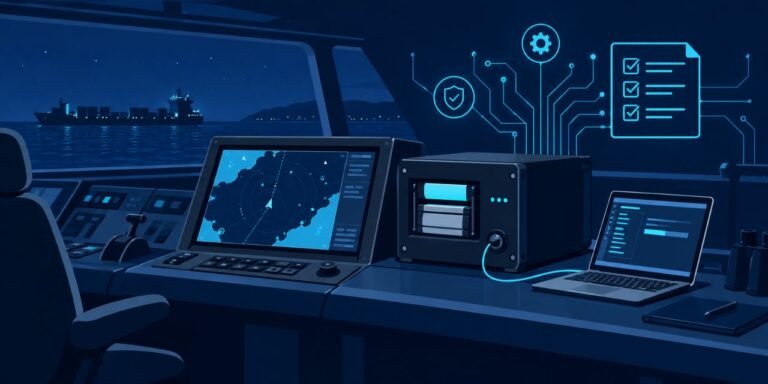

On 18 June 2026, IMO issued MSC-MEPC.5/Circ.17, Guidance on assessments and applications of remote surveys, ISM Code audits and ISPS Code verifications — approved jointly by MSC 111 and MEPC 84 in concurrence, and developed by the Sub-Committee on Implementation of IMO Instruments (III 11) over 2025. It’s the first harmonised guidance covering remote methods across three separate regimes at once: statutory surveys under the Harmonized System of Survey and Certification (HSSC), ISM Code audits, and ISPS Code verifications.
The Guidance grew directly out of the pandemic. Flag Administrations expanded emergency remote-survey arrangements during COVID-19 travel restrictions, on the understanding that these were temporary. What MSC-MEPC.5/Circ.17 does is take the lessons from that period and turn them into a permanent, bounded framework — one built around a single test that runs through all three parts: can a remote method achieve a level of compliance verification equivalent to in-person attendance, item by item, not as a blanket substitution.
What the Remote Survey and Audit Guidance Actually Does
The annex is structured in four parts: Part A sets common principles across all three regimes; Parts B-I, B-II and B-III give regime-specific rules for HSSC surveys, ISM Code audits, and ISPS Code verifications respectively. Two ideas from Part A carry through everything that follows.
First, eligibility is item-by-item, not activity-wide. Paragraph 2.3 splits survey/audit/verification items into two broad categories: eligible items — review of records and documents, tests of safety sensors and alarms, and verification that equipment is present without needing to assess its condition — and non-eligible items, which require substantial verification of an item’s actual condition (the Guidance gives the example of examining a fire pump). A non-eligible item can become eligible if it’s been physically examined or serviced by an approved service supplier within the survey’s time window — the remote check then confirms that work, rather than substituting for it.
Second, a “substantial verification” (defined in para 3.4) is any item that, done remotely, would not achieve equivalence to in-person attendance — and where that’s the case, the Guidance is explicit that the activity simply isn’t credited toward completing the survey/audit/verification until it’s done in person.
What This Means for HSSC Surveys
Part B-I sets out the survey-specific rules. The key limits:
Initial and renewal surveys are excluded from remote methods, other than documentary and data checks. Passenger ship surveys for the SOLAS safety certificate and Load Lines certificate are excluded from remote survey entirely, including deficiency follow-up, again except for documentary checks.
Risk factors govern eligibility beyond the item itself. The Guidance requires a risk assessment considering the ship and company’s history of serious deficiencies, PSC and flag State detention history, and — specifically — vessel age: remote surveys should not, under normal circumstances, be carried out on cargo ships, gas carriers, MODUs, and LNG-fuelled vessels over 20 years old, or on oil tankers and bulk carriers subject to the Enhanced Survey Programme (ESP) over 15 years old.
Once a specific survey item has been done remotely, it shouldn’t be done remotely again at the following survey (para 1.2.5) — the hybrid model in practice means alternating remote and in-person coverage of the same item over time, not defaulting to remote indefinitely. A certificate endorsed on the basis of an accepted remote survey carries the same validity as one endorsed after an in-person survey.
Table 1 in the annex gives worked examples: an oil-pollution-prevention records check is eligible; examining ventilators/air pipes and closing appliances under the Load Lines Convention is not; examining a bulk carrier’s structure against its Ship Construction File is not.
What This Means for ISM Code Audits
Part B-II draws a sharper line than most operators might expect between shipboard audits and company (DOC) audits.
Shipboard audits — interim, initial, intermediate, renewal and additional — should not be fully replaced by remote methods. The Guidance requires physical attendance on board for a general examination of the ship’s condition and observation of crew activity, drills included. Within that, though, specific activities can go remote: the annex marks document review, interviews, examination of documents, and the opening/closing meeting as eligible, while observation of on-board conditions and of shipboard operations/emergency preparedness stay non-eligible. Additional audits triggered by a downgraded major non-conformity should always be conducted on board, no exception.
Company (DOC) audits are more restrictive by default, then carve out two specific exceptions. Initial, renewal, interim and additional DOC audits should always involve the auditor’s physical attendance — except for interim audits adding a new ship type to an existing Document of Compliance, and annual audits falling between the five-year issuance/renewal cycle, where remote methods may be considered.
Interviews and document review can go remote inside a shipboard ISM audit. Observing the ship’s actual condition and crew activity cannot — that part still needs a person on board, every time.
What This Means for ISPS Code Verifications
Part B-III is the most restrictive of the three, and for a specific reason stated in the text: unlike HSSC and ISM, there is currently no Assembly resolution or mandatory instrument governing remote ISPS verification at all — this Guidance is filling that gap from scratch, and does so cautiously given the sensitivity of security information.
Under normal circumstances, remote ISPS methods should not be permitted at all. Initial and renewal shipboard verifications should never be conducted remotely, full stop. Interim, intermediate and additional verifications should involve some on-board attendance, with remote methods considered only under extraordinary circumstances — the text names natural disasters, warfare, pandemic or epidemic outbreak, strike, riot, crime, or sudden legal change as examples — assessed case by case by the flag Administration, and only for the purpose of a permitted postponement, an intermediate verification, or an additional verification under ISPS Code section A/19. Where an additional verification follows a significant security breach or failure, remote attendance for verifying the fix is specifically discouraged.
The appendix table breaks the ISPS elements down item by item, and the pattern is telling: records, contact lists, and documentation checks are mostly marked eligible (“YES”); anything touching physical security hardware or access control — the Ship Security Alert System, CCTV, restricted-area checks, visitor access control, master key management — is marked not eligible (“NO”) almost without exception. A handful of items sit in an “ADMIN” category, left to the flag Administration’s own case-by-case judgement.
The Common Thread: Approval Sits With the Flag Administration
Across all three parts, one structural point doesn’t vary: none of this is self-authorising. Every remote survey, audit or verification requires a documented plan submitted in advance, reviewed and accepted by the flag Administration (or its RO/RSO acting under delegated authority), describing exactly which items will be done remotely, the ICT arrangements to be used, and the criteria for dropping back to in-person attendance if the required equivalence isn’t being achieved mid-activity. Confidentiality and data-security requirements run throughout — the Guidance ties its ICT provisions directly to resolution MSC.428(98) on maritime cyber risk management and MSC-FAL.1/Circ.3/Rev.3 — and recording interviews is treated as normally prohibited, not a default option.
The Practical Line for Ship Managers
- A remote survey, ISM audit, or ISPS verification is never something a Company decides to have — it’s the flag Administration (through its RO or RSO) that authorises it, against a submitted plan, and that plan is what should be reviewed if there’s a question about what’s eligible.
- Initial and renewal activity is the one constant across all three regimes: it stays largely or entirely in-person, whatever the method used for periodic or annual activity in between.
- Passenger ship SOLAS safety and Load Lines surveys, and any ISPS verification under normal circumstances, are the two hardest exclusions in the Guidance — don’t expect either to be offered as a remote option.
- Vessel age and ESP status matter for HSSC survey eligibility independently of the survey item itself — an older ship in a covered category faces a higher bar even for items that would otherwise be eligible.
- A remote activity accepted this survey cycle isn’t a standing arrangement — the same item reverts to in-person consideration at the next survey.
More from the Amendment Log
- MSC.1/Circ.1704: What the New Bridge Software Maintenance Guidelines Cover, and What They Don’t
- SOLAS Pilot Transfer Arrangements 2028: What Ship Managers Need to Know
- ECDIS Performance Standards 2026: What MSC.530(106)/Rev.1 Actually Changes
- The PFOS Ban Is in Force. The Survey Clock Is Already Running.
- Your STS operations manual references a guide that no longer exists in its old form
- The Ballast Water Management Plan Has Three New Requirements. Is Yours Current?
- The Lifting Appliances Manual: What the Regulation Requires, and What Actually Gets It Through Survey
- SOLAS II-1/3-13: What Ship Managers Need to Know About the New Lifting Appliance Requirements