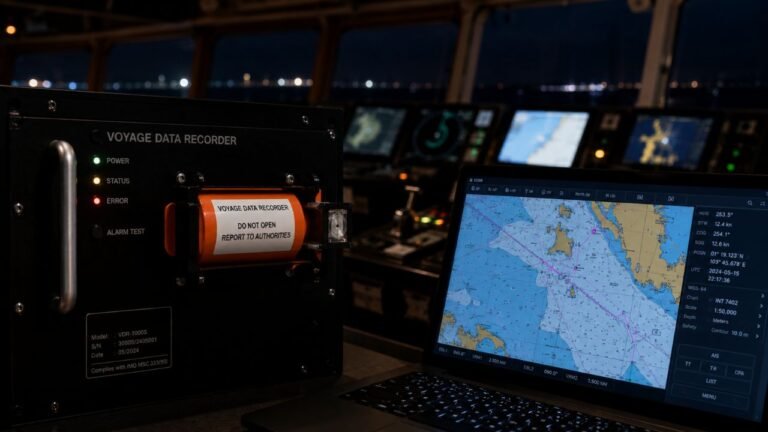

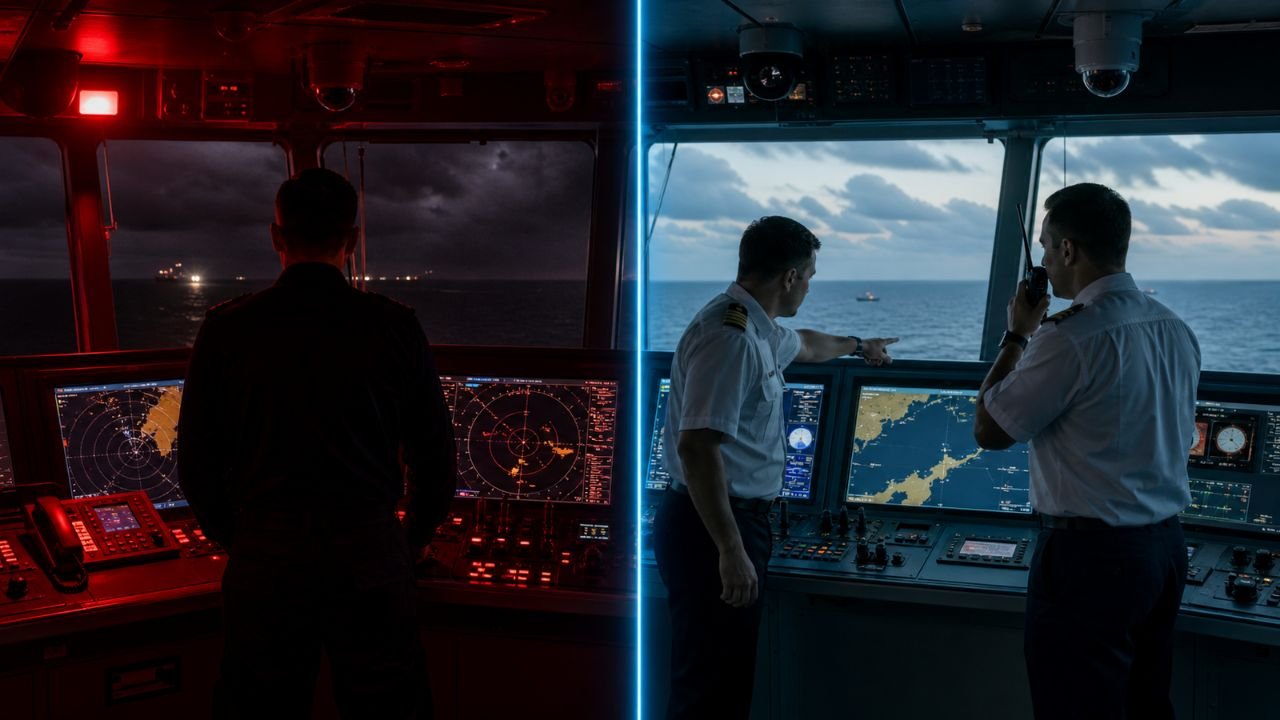
VDR incident investigation is not a theoretical risk. Every VDR records continuously, and every recorded passage is, in principle, available for formal review. The question that rarely gets asked before something goes wrong is: if an investigator pulled that data today, what would they find?
I have conducted over 300 VDR navigational audits. That question is the reason this work matters.
The VDR Was Designed as an Investigation Tool
That is not a criticism — it is simply what the regulation intended. SOLAS requires VDRs to be fitted so that, following an incident, investigators have access to the data needed to establish what happened. The 30-day protected memory in the capsule exists precisely for that purpose.
The consequence of that design is straightforward. In most cases, the first person to formally review your VDR data is not you. It is a Port State Control inspector, a flag state investigator, a P&I surveyor, or — in the worst cases — a prosecutor. They are not reviewing it to find out what went well.
Britannia P&I, writing from the claims side, puts it plainly: VDR data becomes the focus of intense scrutiny by clubs, lawyers, and marine experts on both sides of a dispute.
The VDR does not know the difference between a routine watch and an incident. It records everything with equal fidelity. The question is whether what it recorded helps you or works against you.
What a VDR Incident Investigation Actually Examines
There is a common misconception that VDR incident investigation focuses on the final minutes before a collision, grounding, or near-miss. In a thorough investigation it does not work that way.
A competent investigator looks back further. They look at the passage as a whole. What was the bridge team discussing? Were navigational decisions being verbalised? Was the OOW engaging with the radar and ECDIS, or was the track being monitored passively? Was there clear, professional communication — or were there conversations on the bridge that had no bearing on navigation?
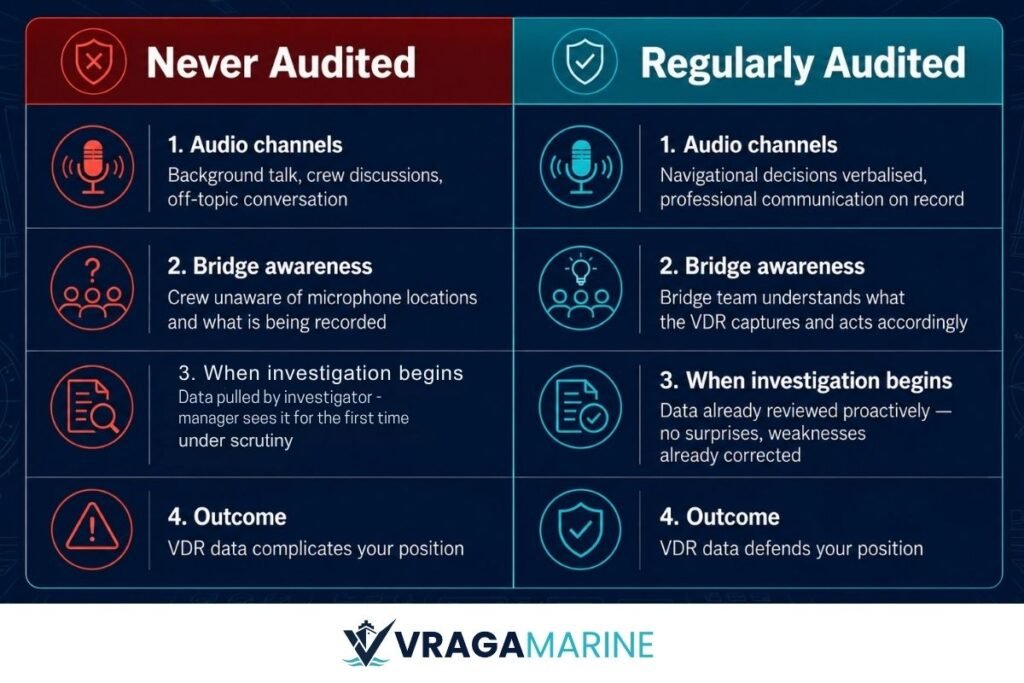
The audio channels are where inexperienced teams are most exposed. The microphones on a modern VDR capture everything within range of the bridge — not just the conning position. In unaudited ships, what those channels routinely contain is not navigational communication. It is background conversation: crew grievances, personal discussions, commentary that has no place on the bridge of a vessel underway. None of it is evidence of negligence on its own. But in the context of a VDR incident investigation, it shapes the picture of a bridge that was not focused.
What a Regularly Audited Bridge Team Looks Like
Over time, I have noticed a consistent difference between ships that have been audited regularly and those receiving their first audit.
On regularly audited ships, the bridge team understands the VDR in a way that goes beyond compliance. They know where the microphones are positioned. They know which conversations need to be on the record. When a navigational decision is made, it is verbalised — not because an auditor is watching, but because verbalising decisions has become the default. When conditions deteriorate, the Master is called and the communication is clear. When an alteration is made, the reason is stated.
This is not performance. It is habit formed through repetition.
On ships receiving their first audit, the audio channels tell a different story. Not necessarily a dangerous one — the navigation may be entirely competent. But the bridge culture has not been shaped by the awareness that the record exists and that it matters.
The difference is not ability. It is habit. And habit is built through regular exposure to the standard, not through a single inspection.
The Drill Analogy
Every ship manager understands the logic of emergency drills. We do not drill fire response because we expect a fire tomorrow. We drill because the moment a fire occurs, we need the response to be instinctive — the right actions taken in the right sequence, without hesitation. The drill creates the muscle memory that a real emergency requires.
A VDR navigational audit works on the same principle.
When a bridge team has been audited — when they have seen their own data reviewed, when specific findings have been brought back to them with the recording as evidence — they carry that experience into every watch that follows. They know what proper bridge discipline looks like on record. They know what a VDR incident investigation would find, because they have already seen what an auditor found.
In the event of an incident, that preparation matters enormously. The data does not just show what happened in the critical moments — it shows the pattern of professional, communicative, properly documented bridge management that preceded it. That record is not a liability. It is a defence.
The Two Ships
Consider two vessels. Similar age, similar trade, similar flag. Both have an incident — a near-miss in a traffic separation scheme, the kind that generates a PSC report and a P&I notification.
On the first ship, the VDR has never been reviewed proactively. When the VDR incident investigation begins, the data is pulled by the investigator. What the audio reveals is a watch that was being conducted with less than full attention. Nothing catastrophic — but not what you want on record at the moment your insurer is deciding how to respond to a claim.
On the second ship, VDR audits have been conducted twice a year for three years. The bridge team has been through their own data. Specific habits have been corrected. The audio, when pulled, shows a watch team that communicated, verbalised decisions, and called the Master when conditions warranted it. The incident was genuine — a third vessel behaved unpredictably — and the data shows that clearly.
Same incident type. Very different position to be defending from.
The Inversion
Most ship managers who have not commissioned a VDR audit think of VDR data as something that can be used against the ship. That instinct is understandable — it comes from the regulatory origin of the instrument.
What regular auditing does is invert that relationship. The bridge teams I work with on an ongoing basis do not fear what the VDR shows. They know what it shows, because we have reviewed it together. They have course-corrected where they needed to. They have built the habits that the data will confirm.
If an incident occurs on one of those ships — and in a global fleet, eventually something will — the VDR incident investigation does not find an unprepared crew. It finds a professional record of a bridge team doing their job correctly under difficult circumstances.
That is what proactive auditing is for.
Is your VDR data ready for scrutiny?
Most ship managers only find out when it is too late to prepare. A proactive audit reviews the same data before anyone else does — and gives you time to act on what it shows.
More from the VDR Series
→ Explore our VDR Navigational Audit Service — Book a VDR Navigational Audit
- The VDR Audit Guide: What the Bridge Data Shows, and Where to Start
- The VDR Audit Report Isn’t Just Good Practice. SIRE 2.0 Question 3.2.4 Asks For It By Name.
- Bridge Procedures Is a DryBMS Priority Area. It Still Doesn’t Move Your Score.
- The VDR Playback Software Is There. The Procedure That Covers It May Not Be.
- ECDIS in Tidal Ports: The Alarm That Stops Working When You Need It Most
- The Lookout During Port Approach Is on the Manning Matrix. The VDR Shows Whether Anyone Was Standing It.
- When Risk Becomes Routine, the Bridge Goes Quiet
- The First VDR Audit Your Fleet Runs Should Be Announced. Here’s Why.
- The Anchor Is Down. The VDR Doesn’t Know That.
- The VDR Track Shows More Than Where the Pilot Boarded
- The Radar Is Running. The VDR Shows Whether It’s Doing Its Job.
- Tug Bollard Pull, Ship Fittings, and the Conversation That Doesn’t Happen
- The Master Pilot Exchange: What the VDR Hears, and What Most Ships Leave Unsaid
- The Port Approach Is Already on Film. Most Managers Don’t Know It.
- The Radar Log Says Done. The VDR Says Otherwise.
- Passage Planning Mistakes Ships Make — And What the VDR Reveals
- Ghost Fix: What the Bridge Team Does When the Auditor Has Gone Home
- VDR Navigational Audits: What They Are, Why They Matter, and When to Do One
- How a VDR Navigational Audit Works — A Step-by-Step Guide for Ship Managers