
This silence is a symptom — one often associated with the normalisation of deviance in shipping.
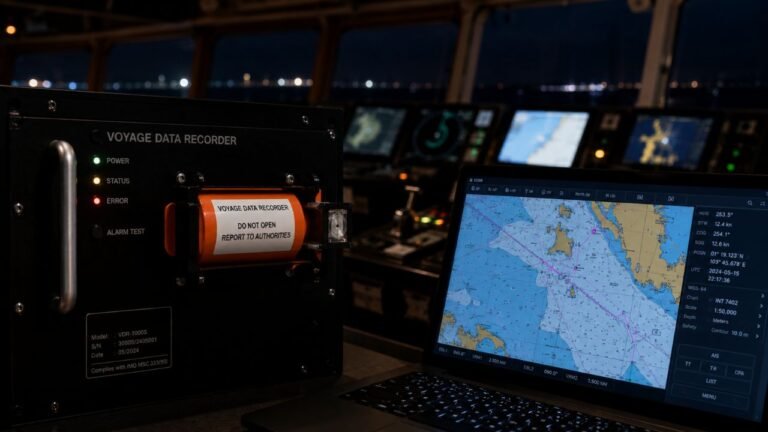
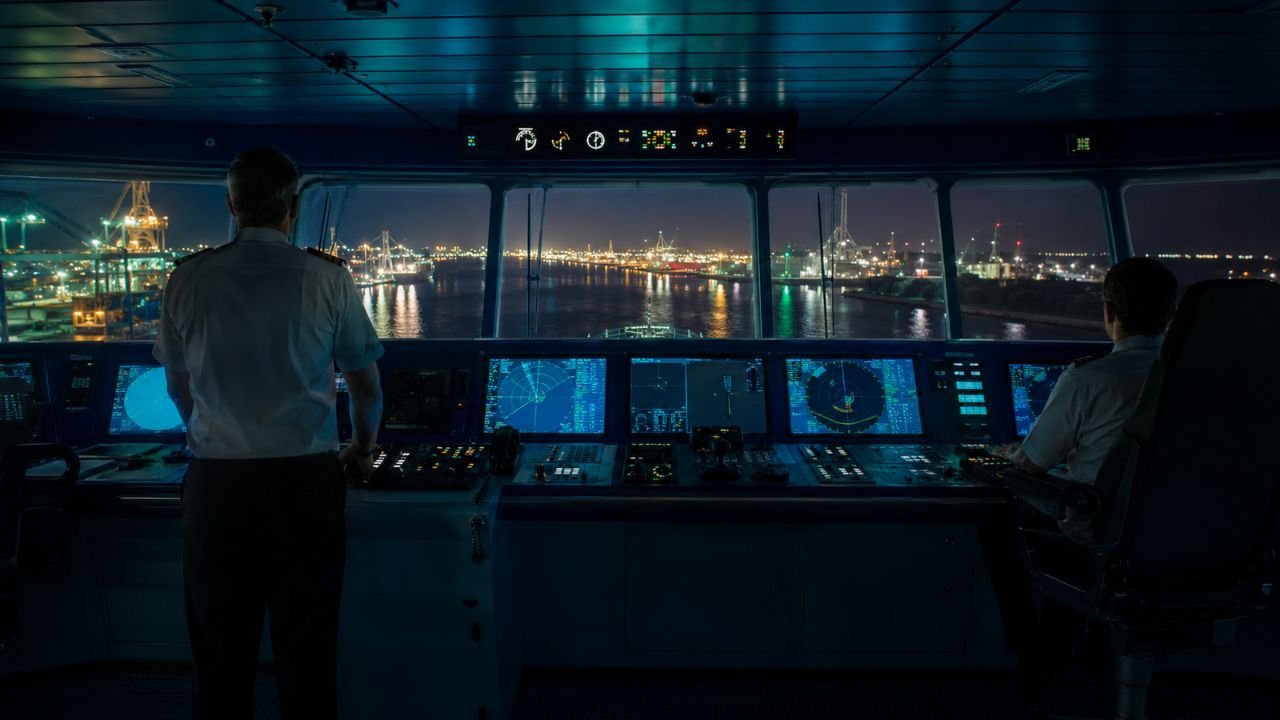
When I pull up a VDR audio file for a port approach on a well-run vessel with an experienced Master, this is often what I hear: engine room on standby, pilot on board, tugs made fast — and then, for stretches of several minutes at a time, almost nothing. Occasionally the OOW reads off a bearing or a speed. The Master acknowledges. The helmsman responds to orders. That is it.
No discussion of the CPA developing on the radar. No comment on the cross-traffic. No mention of the depth contour coming up on the ECDIS. Just competent, practised silence.
This is not negligence. These are experienced professionals doing a job they have done hundreds of times before. The Master knows the channel. He knows the traffic pattern. He does not need to narrate what he is doing — and his team, reading the room correctly, does not ask.
What the VDR Sounds Like on Ships That Have Been Audited Before
The audio track sounds different on vessels with a history of proactive VDR audits.
I have listened to enough of both to notice the pattern. On vessels where audits have been conducted regularly over time, you begin to hear genuine operational dialogue between the Master and the OOW. The OOW calls out a target closing on an unfavourable CPA before the Master has turned to look. The Master asks for confirmation of the next waypoint distance. Someone mentions the depth contour coming up on the ECDIS. It is not formal. It is not scripted. But it is a team, operating as one.
That does not happen because of a training course. It happens because the bridge culture on that vessel has been shaped, over time, by the expectation that someone will listen to what was said — and that expectation changes how people behave.
The Normalisation of Deviance in Shipping
In 1996, sociologist Diane Vaughan published her landmark study of the Space Shuttle Challenger disaster. What she found was not a group of reckless decision-makers. What she found was something far more uncomfortable: a gradual, almost invisible drift in which a known risk, repeatedly encountered without immediate consequence, stopped being perceived as a risk at all. She called it the normalisation of deviance.
Her definition is precise and worth holding onto: a long incubation period before a final disaster, with early warning signs that were either misinterpreted, ignored, or missed completely.
The bridge audio track I described at the outset is that incubation period made audible.
The Master on a well-run vessel has brought ships through that approach dozens, perhaps hundreds of times. The silence between him and his OOW has never produced an incident. The team has functioned well enough, by every measurable standard, for years. And so the silence — which was once a deviation from the intended bridge culture — has simply become the culture. Not through negligence. Not through any single decision anyone made. Through the same quiet process Vaughan documented at NASA: repeated exposure to a condition without catastrophic consequence, until the condition itself became invisible.
The split-second decisions a Master makes in a congested waterway draw on a depth of experience no simulator can replicate. When I review a VDR file from a desk, with full positional data in front of me and no tide under the keel, I am working with the luxury of hindsight. The Master did not have that. What I am looking for is not whether his decisions were right. It is whether the team around him was still part of the picture when he made them.
What a Training Matrix Cannot Tell You
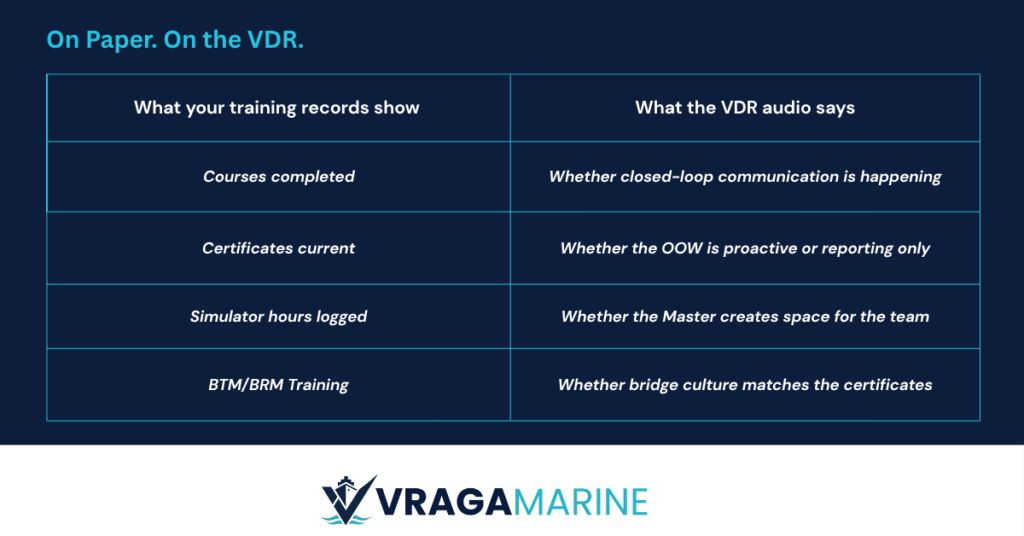
A training matrix tells you what your Masters know. It tells you which courses they have completed, when certificates were last renewed, and whether they have had classroom exposure to bridge resource management theory.
It does not tell you what culture they have built on the bridge. Those are different documents entirely.
On why training alone cannot be the barrier, see You can’t train your way out of human error. On what to do when a whole fleet deviates the same way, see desire paths and ship procedures.
Vaughan’s work was clear on this point: normalisation of deviance is not an individual failure. It is what organisations and teams do over time, embedded in workplace culture, invisible from the outside until something goes wrong. The NASA engineers who signed off on O-ring waivers were not careless people. They were experienced professionals operating within a culture that had, incrementally, redefined acceptable.
The vessel where the VDR audio carries plenty of social conversation but almost no operational dialogue is not necessarily a vessel with poor training records. Often the opposite is true. The paperwork is clean. The certificates are current. The drills are completed on schedule.
The audio answers a different question: not what your Masters know, but whether the bridge culture they have built — through accumulated routine, through the same approach repeated until it no longer feels demanding, through the natural authority gradient of a vessel where one person has seen everything before — still functions as a team in the moments that matter.
That is not something you can read from the office without an independent record.
The Audit as the Check Inside the Incubation Period
A proactive VDR audio review is not conducted to catch a Master making a wrong decision. That is not what responsible auditing looks like, and it is not how a ship manager should receive the findings.
What it provides is a check inside the incubation period — before the long, quiet drift produces the outcome that Vaughan’s framework predicts. It tells you whether the bridge culture on your vessels is functioning as intended, or has settled into a pattern so familiar that no one on board can see it any more.
Normalisation of deviance cannot be reversed by sending a Master on another course. A Master who no longer perceives a familiar approach as demanding cannot be instructed back into treating it as one. But he can operate within a programme that interrupts the drift — that asks, periodically, whether the team around him is still in the conversation.
That is what the audio record shows. And it is the one thing about your fleet’s bridge culture that you cannot determine from the office without it.
More from the VDR Series
→ Explore our VDR Navigational Audit Service — Book a VDR Navigational Audit
- The VDR Audit Guide: What the Bridge Data Shows, and Where to Start
- The VDR Audit Report Isn’t Just Good Practice. SIRE 2.0 Question 3.2.4 Asks For It By Name.
- Bridge Procedures Is a DryBMS Priority Area. It Still Doesn’t Move Your Score.
- The VDR Playback Software Is There. The Procedure That Covers It May Not Be.
- ECDIS in Tidal Ports: The Alarm That Stops Working When You Need It Most
- The Lookout During Port Approach Is on the Manning Matrix. The VDR Shows Whether Anyone Was Standing It.
- The First VDR Audit Your Fleet Runs Should Be Announced. Here’s Why.
- The Anchor Is Down. The VDR Doesn’t Know That.
- The VDR Track Shows More Than Where the Pilot Boarded
- The Radar Is Running. The VDR Shows Whether It’s Doing Its Job.
- When VDR Data Works For You, Not Against You
- Tug Bollard Pull, Ship Fittings, and the Conversation That Doesn’t Happen
- The Master Pilot Exchange: What the VDR Hears, and What Most Ships Leave Unsaid
- The Port Approach Is Already on Film. Most Managers Don’t Know It.
- The Radar Log Says Done. The VDR Says Otherwise.
- Passage Planning Mistakes Ships Make — And What the VDR Reveals
- Ghost Fix: What the Bridge Team Does When the Auditor Has Gone Home
- VDR Navigational Audits: What They Are, Why They Matter, and When to Do One
- How a VDR Navigational Audit Works — A Step-by-Step Guide for Ship Managers