

The Master Pilot Exchange has a box for tug bollard pull. In most cases the comparison gets made — if the tug bollard pull exceeds what the ship’s fittings can carry, the instruction goes to the tug master: be easy, work within limits.
That part of the conversation happens. What follows is where the gaps appear.
Across more than 300 audits, I have seen three distinct patterns — and none of them tell the full story.
Three Patterns. One Consistent Gap.
In some cases the Pilot Card doesn’t carry the ship’s fitting SWL at all. The bollard pull figure arrives with the pilot. There is nothing on the ship’s side to compare it against. If a mismatch exists, it cannot be identified — one of the two numbers is absent.
In others, the MPX checklist is ticked. Tug bollard pull — checked. Ship SWL — checked. The record shows the comparison was made. The VDR shows no discussion with the pilot. The audio from the bridge at the time the box was ticked is either silent or shows a conversation that never reached the actual figures or what they meant in practice.
And in some cases the discussion happens properly — the comparison is made, the tug master is briefed, the reasoning is audible on the VDR. This happens. It is not universal.
Some masters do this well. The audit data shows that too. The problem is consistency, not capability.
That is the first gap. There is a second, which concerns the number itself. And a third, which I have never heard resolved on a VDR — not once, across any fleet.
What the MPX Is Actually Asking
IMO Resolution A.960(23), Section 5.4 is clear. The master pilot exchange should include information on berthing arrangements, tug use, and the characteristics and capabilities of those tugs. The ICS Bridge Procedures Guide, Section 6.6.2, is more specific — the number of tugs, how they will operate, and their capabilities and limitations should all form part of the discussion.
The word is capabilities. Not just how many tugs. Not just the tug bollard pull as a headline figure. The capability of each tug in the context of the specific operation being undertaken — including what it can and cannot safely do given the ship’s own fittings.
That is what the MPX is designed to surface. In a significant number of the audits I have reviewed, it does not.
The Number on the Fitting May Not Be the Right Number
When a master or officer looks at the figure stamped on a Panama chock or closed fairlead and compares it to the tug’s bollard pull, they are typically reading the Safe Working Load — the SWL. What is less widely understood is that the SWL is a mooring figure, not a towage figure.
IMO MSC.1/Circ.1175/Rev.1 — the revised guidance on shipboard towing and mooring equipment — draws a formal distinction between two separate values. The SWL is the safe load limit for mooring operations. The TOW is the safe load limit for towing. They are calculated differently and they are not interchangeable.
The requirement to mark both figures on shipboard fittings applies only to vessels constructed on or after 1 January 2024. For the overwhelming majority of ships currently trading — built before that date — only the mooring SWL is marked on the fitting.
This matters because the mooring SWL is derived from the ship design minimum breaking load of the mooring lines, calculated for a standard mooring configuration. The towage loading profile is different — direction, dynamic loading, and the angle of pull all behave differently when a tug is working a ship in a current compared to a vessel lying at a berth. So when the master says the SWL is 40 tonnes and the tug is 45 tonnes bollard pull — and the instruction goes to the tug to work easy — both parties may be operating against a figure that was never designed for the load case they are actually managing.
The number stamped on the fitting is a mooring figure. The operation being conducted is a towage operation. For most ships currently in service, no separate towing load limit is marked on the fitting. The comparison being made in the MPX may be between a tug’s bollard pull and a number that was never intended to define its limit.
The Conversation That Stops Too Early
Assume the comparison is made correctly and the instruction to the tug master is appropriate. The conversation still stops at the wrong point.
Nobody works through what the tug will do if an emergency develops mid-manoeuvre.
A ship moving towards a jetty. A current taking hold faster than anticipated. A bow swing that needs to be arrested in seconds. At that point, the pilot’s objective and the master’s objective converge on one answer: full power, stop the ship, deal with the fitting afterwards. Avoiding a collision or allision is the overriding priority. That hierarchy is correct.
But the tug master has been briefed to stay easy. He is operating in good faith, and in some cases in accordance with his own company’s procedures. If he honours the earlier instruction at the moment the pilot needs full power, the ship does not respond as intended — and the constraint that caused that was passed during the MPX, before the approach began.
There is a further consequence that is equally absent from most MPX discussions. When a powerful tug has to reduce its output significantly to stay within the ship’s fitting limits — a common situation in ports where tug fleets are composed primarily of large ASD tugs that also handle smaller vessels — its response time is lengthened. The tug operating at reduced power cannot react as quickly to a helm order or a shift in conditions. The instruction to be easy does not only create a ceiling that may need to come off in an emergency. It reduces the margin available throughout the approach.
The pilot’s preference and the master’s priority converge in an emergency: full power, stop the ship. The tug master is the one caught between them, holding an instruction that has not been updated and operating at reduced power that has lengthened his response time. That situation is created in the MPX, before the approach begins. It can only be resolved there.
Two Investigations. Same Outcome.
I have conducted two investigations where this sequence moved from theoretical to structural.
The first was on a river berth approach with a strong beam current. A tug was made fast aft to assist. The tug did not apply active power — it held position. The current did the rest. As the ship swung, the tug drifted aft relative to the vessel, load built passively in the towline, and before anyone called for slack, the Panama chock failed.
The VDR audio showed no discussion at any point in the MPX of what the tug was to do if loads built unexpectedly. The bollard pull figure was confirmed. The conversation stopped there.
The second incident followed the same finding from a different direction. A tug applied emergency power to control a bow swing. The load exceeded what the fitting could carry. Same outcome.
In both cases the tug did what it should have done. The fitting failed because the scenario — load building beyond capacity under emergency conditions — had not been worked through before the approach. The MPX record showed the bollard pull figure. It showed no discussion of what happened if that figure became relevant.
Learning From the Record
It is a cliché because it is true: it is better to learn from someone else’s mistake than your own. In the maritime industry, the margin for recovery from a serious error is small.
The Nautical Institute MARS database exists precisely for this reason. Report 201407 — titled “Tug 1, Fairlead 0” — documents a structural failure during a port manoeuvre that makes the arithmetic visible.
A tug with a bollard pull of 60 metric tonnes was made fast through a Panama fairlead on the main deck. The main deck fittings carried an indicated SWL of 24 metric tonnes. The ship’s forward and aft mooring fittings were rated at 45 metric tonnes — but the tug was not made fast to those. It was made fast to a fitting rated at less than half its bollard pull. The fitting failed. Structural damage to the mooring deck, deck plating, accommodation structure, and adjacent hull plating followed.
The report’s root causes include failure to follow pilot instructions and incorrect use of equipment. But it also identifies inadequate supervision — specifically, that the officer on deck should have recognised that the tow rope’s rendering capacity significantly exceeded the SWL of the fitting it was running through, and alerted the master. That recognition — fitting location, fitting rating, tow rope capacity — was available before the tug made fast. It required someone to look.
The report has been in the public domain for over a decade. The arithmetic it contains — 60 tonnes against 24 — is not a nuanced risk assessment. It is a comparison that could be made in thirty seconds with the tug assignment sheet and the ship’s mooring plan.
What the Audit Data Shows
The findings from my own audit work are consistent across fleets and vessel types.
In some reports, tug bollard pull handling is commended as good practice — the master engaged the pilot properly, the figures were compared against the ship’s fitting limits, the tug master was briefed, and the approach was conducted with a clear understanding of the operating envelope. Those reports exist. The standard is achievable.
In others, the tug bollard pull is missing from the MPX entirely. In one case, the ship’s fitting SWL was absent from the Pilot Card — the pilot provided the tug’s bollard pull figure, but there was nothing on the ship’s side to compare it against.
In others, the MPX checklist carries a tick against tug bollard pull and ship SWL. The VDR audio shows no discussion of either figure with the pilot. The record says it was done. The VDR says otherwise.
And in none of the audits I have reviewed — across multiple fleets and vessel types — has the emergency protocol been addressed. Not what the tug should do if an emergency develops. Not who authorises the shift from easy to full power. Not what the tug master should do if he cannot raise the bridge in time.
The Mismatch Is a Risk Signal. Treat It as One.
When a master sees a powerful tug coming alongside — and confirms during the MPX that its tug bollard pull significantly exceeds the towing limits of his ship’s fittings — that is not simply information to be noted and filed. It is a risk indicator. It changes the profile of the approach.
The correct response is not only to brief the tug to work easy. It is to treat that mismatch as a trigger for a mental risk assessment: what happens if this tug applies full power? Under what conditions would that become necessary? What would the consequence be for the fitting it is made fast to? Is the officer on deck aware of which fitting the tug is working through, and what it is rated for?
These questions take a minute to work through. They do not require a formal process. They require a master who has seen the number in the MPX and understood what it means — not just for the checklist, but for how he monitors the next thirty minutes.
A significant bollard pull mismatch should make a master more alert, not less. More attentive to swing rate. More focused on the tug’s position relative to the fitting it is working. More ready to intervene early, before a developing situation requires the tug to apply the power the fitting cannot safely carry.
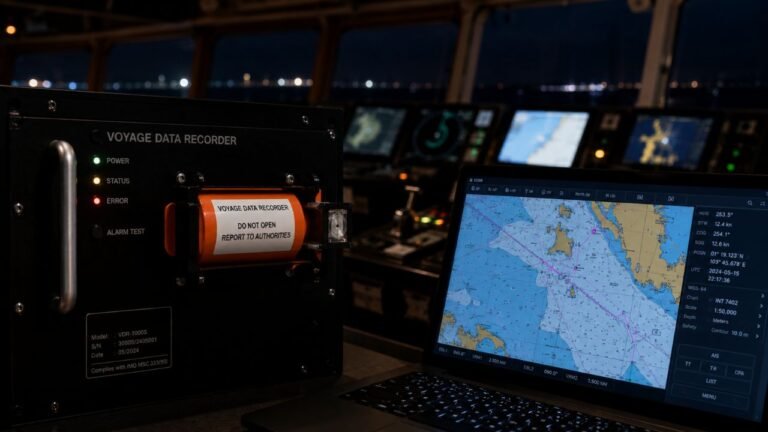
The VDR records whether that alertness was present. It captures heading rate, speed changes, helm orders, tug communications, and bridge audio throughout the approach. It shows whether the master was watching or managing.
In the cases I have investigated where the mismatch was known and the fitting subsequently failed, the VDR showed the same thing each time. The bollard pull figure was in the MPX. The conversation stopped there.
More from the VDR Series
→ Explore our VDR Navigational Audit Service — Book a VDR Navigational Audit
- The VDR Audit Guide: What the Bridge Data Shows, and Where to Start
- The VDR Audit Report Isn’t Just Good Practice. SIRE 2.0 Question 3.2.4 Asks For It By Name.
- Bridge Procedures Is a DryBMS Priority Area. It Still Doesn’t Move Your Score.
- The VDR Playback Software Is There. The Procedure That Covers It May Not Be.
- ECDIS in Tidal Ports: The Alarm That Stops Working When You Need It Most
- The Lookout During Port Approach Is on the Manning Matrix. The VDR Shows Whether Anyone Was Standing It.
- When Risk Becomes Routine, the Bridge Goes Quiet
- The First VDR Audit Your Fleet Runs Should Be Announced. Here’s Why.
- The Anchor Is Down. The VDR Doesn’t Know That.
- The VDR Track Shows More Than Where the Pilot Boarded
- The Radar Is Running. The VDR Shows Whether It’s Doing Its Job.
- When VDR Data Works For You, Not Against You
- The Master Pilot Exchange: What the VDR Hears, and What Most Ships Leave Unsaid
- The Port Approach Is Already on Film. Most Managers Don’t Know It.
- The Radar Log Says Done. The VDR Says Otherwise.
- Passage Planning Mistakes Ships Make — And What the VDR Reveals
- Ghost Fix: What the Bridge Team Does When the Auditor Has Gone Home
- VDR Navigational Audits: What They Are, Why They Matter, and When to Do One
- How a VDR Navigational Audit Works — A Step-by-Step Guide for Ship Managers