
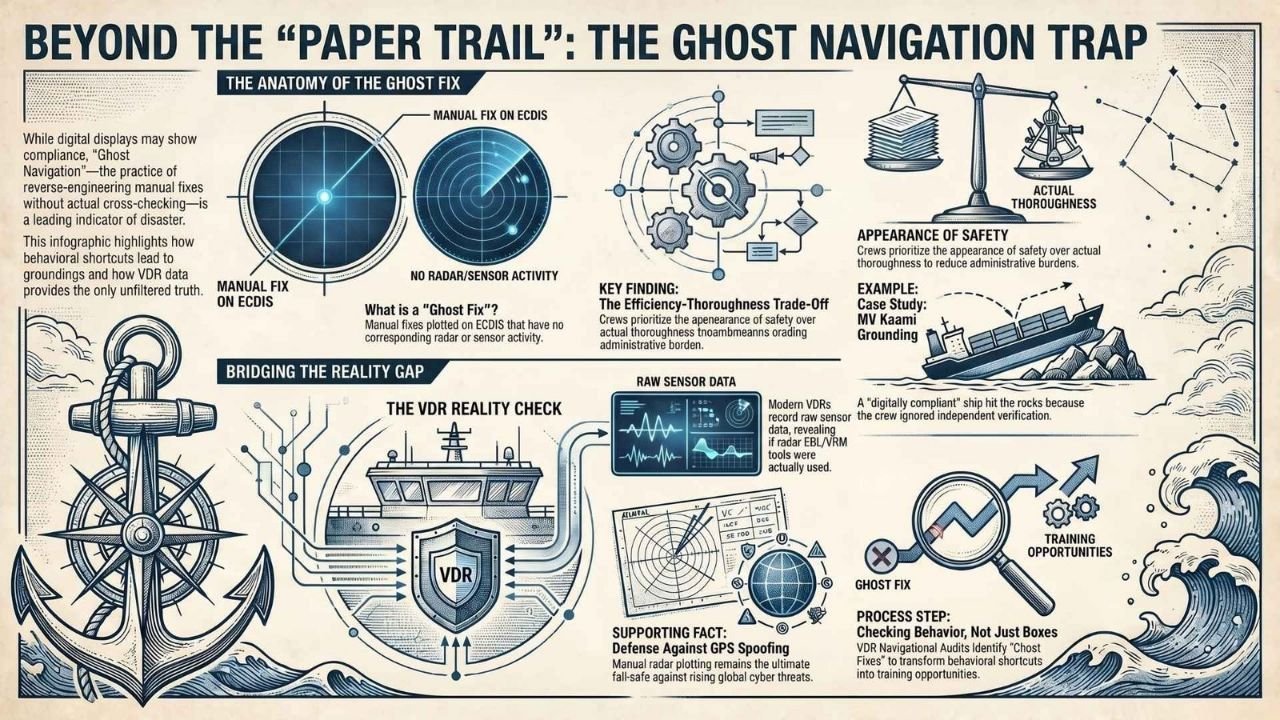
I have reviewed hundreds of hours of VDR data. One pattern shows up more than almost any other: a manual fix plotted on the ECDIS, time stamped correctly — and completely absent from the radar screen. No VRM movement. No EBL activity. No cursor movement at all.
The fix never happened.
The Officer of the Watch plotted a position that was never actually taken. On the ECDIS screen, the fix is there. In reality, the cross-check never happened.
This is what I call “Ghost Fix.” In my experience, it is one of the most reliable leading indicators of a serious incident waiting to happen.
“Everything looks checked. Nothing was”
What Is a “Ghost Fix”?
Section 4.15.3 of the Bridge Procedures Guide (BPG) 6th Edition is clear: every opportunity should be taken to confirm the validity of a GNSS position with traditional fixing techniques. Over-reliance on ECDIS should be avoided. The guidance is unambiguous — the GNSS position on the ECDIS screen is not, by itself, a verified position.
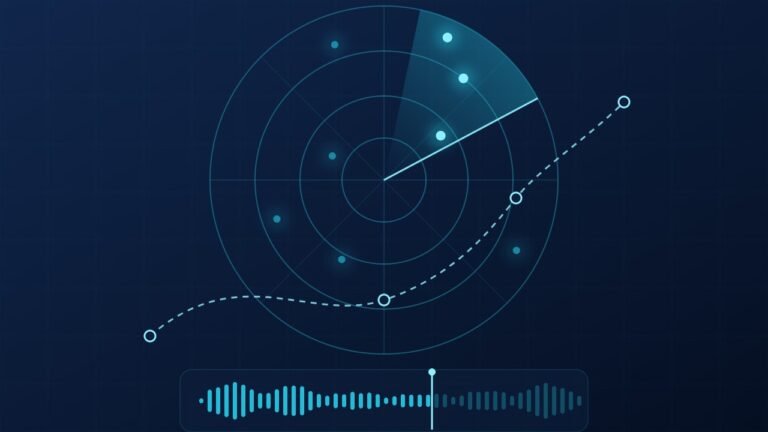
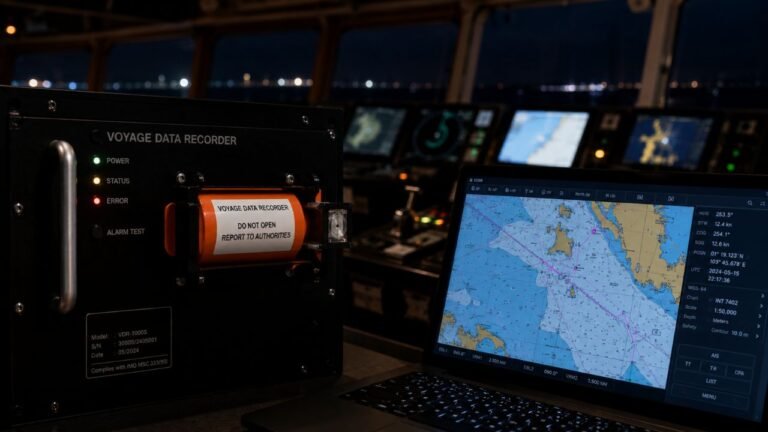
The VDR is what makes ghost fixing visible. Per IMO Resolution MSC.333(90), VDRs are required to record the electronic signals of the radar display — meaning I can see on playback exactly what was visible on that screen, including whether the VRM and EBL tools were in use. I can see whether there was any cursor activity at all in the minutes before a fix was plotted.
A “Ghost Fix” is a manual position plotted on the ECDIS with no corresponding radar activity to support it. The officer has reverse-engineered a position into the ECDIS track — not to navigate the ship, but to produce the appearance of a position-fixing record.
This is not a paperwork error. It is the complete abandonment of the primary defence against GPS failure.
Why Do Experienced Officers Do This?
This is the question that matters most. These are not reckless mariners. They are, in many cases, experienced, qualified officers who have stood thousands of watches.
The OCIMF Human Factors Approach (October 2020) makes a point that is directly relevant here: most mistakes are not the result of individual failure, but of workplace conditions and task design that make error more likely. When the administrative burden of completing a task — in this case, taking a proper radar fix — begins to outweigh its perceived value, people begin to take shortcuts. Not all at once. Gradually.
It starts with a quiet watch, a straight channel, GPS tracking perfectly. The officer plots the fix from the ECDIS position readout and adds the manual fix marker. Once. Then again. Then it becomes habit.
This is what the human factors literature calls the “Efficiency-Thoroughness Trade-Off” (ETTO). In a high-pressure operational environment, officers gravitate towards the most efficient path to looking compliant — even when that path makes them less thorough, and less safe.
The tragedy is that by the time conditions become genuinely demanding — a confined channel, poor visibility, degraded GPS — the muscle memory for proper radar fixing is gone. The officer has not practised it in months.
Case Study: The Grounding of the MV Kaami
We do not have to speculate about where this leads.
The MAIB Investigation Report (7/2021) into the grounding of the MV Kaami documents exactly this failure. The port radar was routinely switched off on passage. The ECDIS look ahead was configured but never activated. All alarm audio was silenced. The safety contour was set below the vessel’s own draught.
Six minutes before grounding, a fishing vessel warned the C/O on VHF that Kaami was heading into shoal water. He acknowledged the call — but without an independent positional fix, he had no means of evaluating the warning. He held the planned course.
At 0141, Kaami struck Sgeir Graidach and was later declared a constructive total loss.
A bridge team that has stopped practising independent verification cannot recover it under pressure.
The GPS Spoofing Reality: Why This Is No Longer a Theoretical Risk
GPS jamming and spoofing incidents are increasing globally — in the Baltic, the Eastern Mediterranean, the Black Sea approaches, and parts of the Middle East. Ships are reporting GNSS positions that are kilometres from their actual location, with no immediate indication that anything is wrong.
The crew’s only reliable defence in a spoofing event is the ability to take an accurate, independent position fix using radar and visual means. Dead Reckoning. Manual radar plotting. Old techniques — but the ultimate fallback when digital systems fail or are compromised.
Here is the problem: if a bridge team has been ghosting their fixes for the past three months — plotting radar positions that were never actually taken — they have not practised manual fixing in three months. When the GPS output becomes unreliable and the OOW attempts an independent fix, he finds he cannot do it quickly, accurately, and under pressure.
The ghost fix is not just a documentation problem. It is an active erosion of the crew’s cyber resilience.
What SIRE 2.0 Inspectors Are Looking For
Under the original SIRE framework, an inspector might check whether position fixing procedures existed. Under SIRE 2.0, the question has changed. Question 4.2.1 specifically looks for evidence that manual position fixing was carried out in accordance with company procedures at the planned frequency and interval. If the records don’t support this, it is grounds for a negative observation.
The SIRE 2.0 question library is also explicit on the broader principle: Masters and Bridge Officers should use traditional position-fixing and navigational techniques to cross-check navigational information. This is not optional guidance — it is the standard against which bridge teams are measured.
If an officer is asked about their fixing practice and the VDR tells a different story, the gap becomes visible immediately.
A Remote VDR Audit identifies these behavioural gaps before an inspector does — giving the ship time to correct the problem, not explain it.
Three Signals in the VDR Data
When reviewing for ghost fixing behaviour, these are the indicators
No VRM or EBL activity
No radar range or bearing tool used in the two to three minutes before a manual fix is plotted on the ECDIS.
No cursor movement
The radar screen shows no cursor interaction during the fixing period — the tools were not touched.
A mechanical pattern
Fixes appear at identical intervals regardless of navigational complexity — the hallmark of a crew going through the motions rather than responding to the environment.
Any one of these can have an innocent explanation. All three together, across multiple watches, is a systemic issue.
From Ghost Fixes to a Resilience Culture
Navigational safety is built on active verification — not digital artefacts.
The ECDIS track cannot tell me whether a position was actually taken. The VDR can. It is the only audit tool that shows me the ship as it actually operates, not as it was prepared to be seen.
When I identify ghost fixing in a fleet, the immediate response is targeted coaching — bringing the specific finding back to the officers involved, with the VDR data as the evidence. Not as a disciplinary exercise. Most officers do not realise how visible the shortcut has become, or how dangerous the habit has grown.
The goal is a bridge team that can navigate the ship safely when the GPS fails at 0300 in a confined channel — because they have been practising real navigation every watch, not performing it for an audience.
That is the difference between a fleet that looks safe and one that genuinely is.
More from the VDR Series
→ Explore our VDR Navigational Audit Service — Book a VDR Navigational Audit
- The VDR Audit Guide: What the Bridge Data Shows, and Where to Start
- The VDR Audit Report Isn’t Just Good Practice. SIRE 2.0 Question 3.2.4 Asks For It By Name.
- Bridge Procedures Is a DryBMS Priority Area. It Still Doesn’t Move Your Score.
- The VDR Playback Software Is There. The Procedure That Covers It May Not Be.
- ECDIS in Tidal Ports: The Alarm That Stops Working When You Need It Most
- The Lookout During Port Approach Is on the Manning Matrix. The VDR Shows Whether Anyone Was Standing It.
- When Risk Becomes Routine, the Bridge Goes Quiet
- The First VDR Audit Your Fleet Runs Should Be Announced. Here’s Why.
- The Anchor Is Down. The VDR Doesn’t Know That.
- The VDR Track Shows More Than Where the Pilot Boarded
- The Radar Is Running. The VDR Shows Whether It’s Doing Its Job.
- When VDR Data Works For You, Not Against You
- Tug Bollard Pull, Ship Fittings, and the Conversation That Doesn’t Happen
- The Master Pilot Exchange: What the VDR Hears, and What Most Ships Leave Unsaid
- The Port Approach Is Already on Film. Most Managers Don’t Know It.
- The Radar Log Says Done. The VDR Says Otherwise.
- Passage Planning Mistakes Ships Make — And What the VDR Reveals
- VDR Navigational Audits: What They Are, Why They Matter, and When to Do One
- How a VDR Navigational Audit Works — A Step-by-Step Guide for Ship Managers