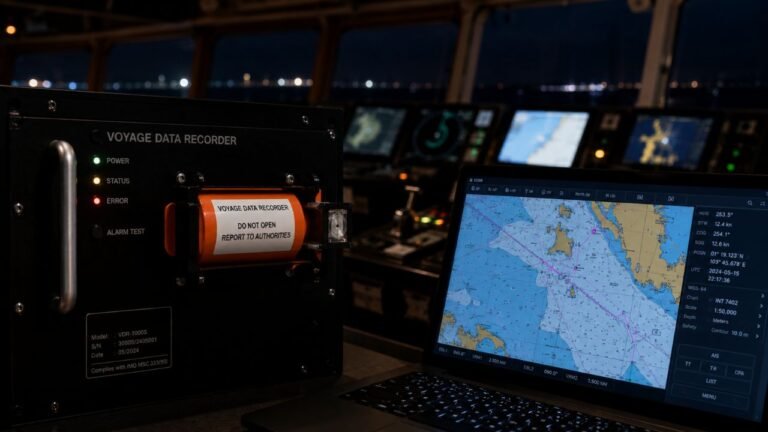

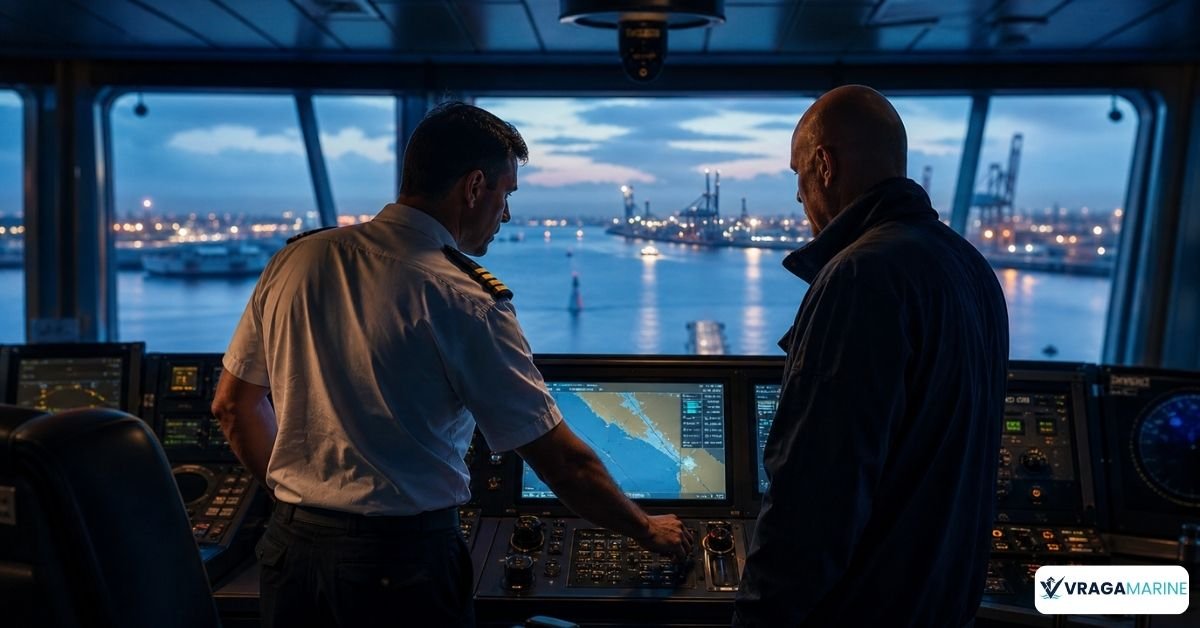
During a recent VDR audit, I reviewed the port approach and berthing of a vessel calling at a busy commercial port. The Master Pilot Exchange (MPX) checklist was complete. Every item had been covered — passage plan, berth details, tugs, mooring, contingencies. On paper, it was a thorough exchange.
When I listened to the bridge audio, something was immediately clear. Every topic had been introduced by the pilot. The Master responded, confirmed, acknowledged — but contributed nothing that the pilot had not already raised. When the pilot finished, the Master had no questions.
That is not an exchange. That is a briefing with a second person in the room.
This pattern — complete form, passive Master — is the most consistent finding in MPX recordings across the fleets I have reviewed. The procedure was followed. The conversation did not happen.
Every topic had been introduced by the pilot. The Master responded, confirmed, acknowledged — but contributed nothing that the pilot had not already raised. When the pilot finished, the Master had no questions. That is not an exchange. That is a briefing with a second person in the room.
What the VDR Actually Captures
When I review a port approach as part of a VDR audit, the Master Pilot Exchange (MPX) recording — also known as the Master Pilot Information Exchange — tells me several things quickly.
Did the Master arrive prepared, or was he responding to the pilot’s agenda throughout? Did he mention anything specific to this vessel’s current condition — something the pilot could not already know? Did he ask a single question that wasn’t a clarification of something the pilot had just said?
Across multiple fleets and vessel types, the answers are consistent. Masters cover what the pilot raises. They confirm, they acknowledge, they agree. What they rarely do is contribute information the pilot did not already have.
The specific gaps that appear most often in audit recordings are these.
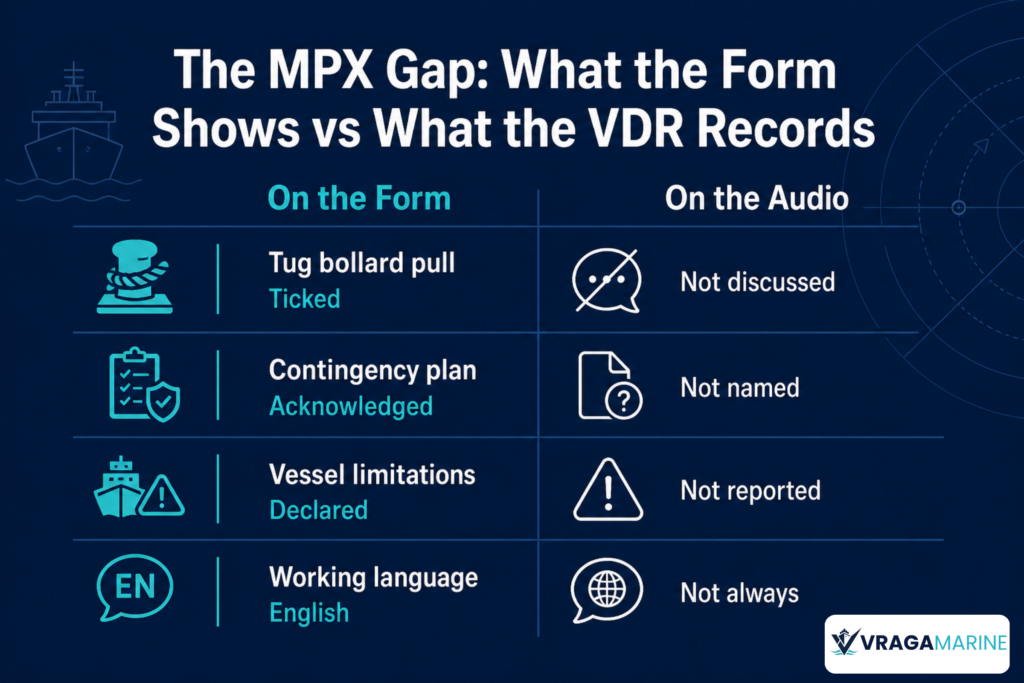
Items ticked but not discussed. Tug bollard pull is the clearest example. The form has a box for it. The box is ticked. The audio shows no conversation about it took place. This is not a documentation finding — it is an evidence finding. The VDR knows the difference between a box that was ticked and a conversation that happened.
The VDR knows the difference between a box that was ticked and a conversation that happened.
Vessel-specific limitations not reported to the pilot. The BPG is direct on this: all defects that might affect the manoeuvrability of the ship or the pilotage should be reported to the pilot. Not offered if asked — reported. Engine response characteristics, thruster limitations, anything about this vessel on this day that differs from what the pilot card shows. In most recordings, this information does not appear unless the pilot specifically asks for it. Pilots do not always ask.
Contingency plans acknowledged but not named. “We’ll handle any problems as they arise” is not a contingency plan. A contingency plan names something specific — what happens if a tug cannot make fast in time, what the abort point is if the approach changes, where the emergency anchorage is. When I listen to most MPX recordings, the contingency discussion, where it happens at all, lasts about twenty seconds and produces no shared understanding of what either party would actually do.
Language confirmed on the form, not always the reality. The working language is declared as English. The VDR records what language the bridge team actually uses with each other and with deck stations during the approach. These are not always the same thing. In several audits across different fleets, bridge communications shifted to English once officers were aware of the review — and reverted otherwise. The VDR notices.
What the Standards Actually Say
The ICS Bridge Procedures Guide 6th Edition describes safe navigation in pilotage waters simply: it is a shared task of the bridge team and the pilot. Share navigation information. Respect each other. Communicate throughout the voyage. Work together. Stay alert. Five principles that any mariner can understand and apply — and which describe something fundamentally different from one party briefing and the other listening.
IMO Resolution A.960(23), which is the international framework for pilot operational procedures, is equally clear. The exchange should cover contingency plans, any unusual ship handling characteristics, machinery difficulties, navigational equipment problems, or crew limitations — and it should be a continuous process throughout the pilotage, not a single handover at the start.
Both documents describe the same thing: a two-way exchange in which both parties contribute information the other needs. The pilot brings local knowledge. The Master brings vessel knowledge. Neither can do the other’s half.
Both documents also address regular port callers specifically. The IMPA guidance states that the exchange should not be abandoned for ships calling on a frequent basis — such vessels have the potential to induce complacency. The Canadian Marine Pilots’ Association guidelines say the same. Familiarity is where Master Pilot Exchange (MPX) quality most reliably deteriorates. It is also where the VDR record is most likely to reflect it.
The Pilot Card Is Not the Exchange
There is a tendency in fleet operations to treat a completed pilot card as evidence that a Master Pilot Exchange (MPX) took place. It is not. A pilot card is a reference document. It changes hands. That is not the same as an exchange.
IMO A.960(23) addresses this directly: when a pilot is presented with a pilot card, he is under no obligation to sign it, and a signature could be construed as confirmation that the information on the document is accurate. A signature on a pilot card is not evidence that an exchange occurred. It is evidence that a document changed hands.
The practical consequence of treating the card as the exchange is that errors on the card go undetected. In the same audit I mentioned at the opening, the pilot card had a deadweight figure that did not match the ship’s particulars, and a steering pump timing entry that was internally inconsistent. Neither had been caught because nobody had actually worked through the card during the Master Pilot Exchange (MPX) — it had been presented, and accepted. The VDR recorded the exchange. The card errors were only identified during the document review that followed.
What SIRE 2.0 Is Looking For
SIRE 2.0 Question 4.3.3 asks whether the Master and navigation officers were familiar with the company procedures for integrating a pilot into the bridge team — and whether records were available to demonstrate the process had been followed.
That is a higher bar than most ships realise. The inspector is not asking whether the form exists. He is asking whether the officers understand what each item on the form means and why it is there. The inspection guidance specifies that the inspector will review the Master Pilot Exchange (MPX) checklists from two recent operations and verify that required information was fully and accurately entered. He will also interview the accompanying navigation officer to verify that they understood the intent and meaning of each item on the checklist.
The negative observation grounds listed in the SIRE guidance make the gaps explicit. Officers not familiar with the practical requirements for each item on the Master Pilot Exchange (MPX) checklist. Defective equipment affecting manoeuvrability not recorded on the pilot card for the operations reviewed. MPX checklists missing completion times. The Master Pilot Exchange (MPX) not repeated when there was a change of pilot.
That last point is worth specific attention. The Master Pilot Exchange (MPX) should be repeated whenever there is a change of pilot. This is a requirement in the inspection guidance and it is widely missed in practice. When a river pilot hands over to a port pilot mid-passage, the second MPX rarely happens with the same depth as the first — often it is a brief introduction and a summary of conditions. The VDR records both handovers. The SIRE inspector may ask about both.
TMSA KPI 5.1.3 also connects here, requiring that procedures for effective BRM are in place including for navigation with a pilot on board. For TMSA-managed fleets, a weak Master Pilot Exchange (MPX) is not just a SIRE question — it is a potential TMSA finding as well.
Once the Approach Has Begun
The Master Pilot Exchange (MPX) establishes the working relationship that carries through the entire pilotage. The BPG’s bridge team and pilot co-operation structure is clear: the Master retains ultimate responsibility for the safety of the ship. The OOW remains responsible for managing the bridge team and monitoring the approach. The pilot directs the navigation, supported by the bridge team. None of this changes because the MPX is finished.
Britannia P&I Club’s published pilotage guidance introduces a practical framework for Masters and bridge teams called PACE — Probe, Alert, Challenge, Emergency. Probe: ask questions if you are concerned. Alert: raise concerns formally if ignored. Challenge: formally question the decision. Emergency: take alternative action. This is available publicly at britanniapandi.com and is worth putting on the bridge.
PACE is not a confrontation framework. It is a structured way to escalate from a concern to an action, at the right level, without either doing nothing or taking over abruptly. The value of the Master and bridge team understanding this before the approach begins — not mid-approach when something is already going wrong — is obvious.
The 2022 grounding of Ever Forward in Chesapeake Bay demonstrates what happens when this dynamic breaks down. The US Coast Guard investigation found that the pilot was on a personal phone call during the critical phase of the approach — five calls totalling approximately 61 minutes of a 126-minute voyage, with an email being drafted at the exact moment the vessel missed its turn. The Master had left the bridge for dinner. The Third Officer noticed the vessel had passed its waypoint but chose to cue the pilot indirectly by repeating the heading rather than challenging him directly. By the time the pilot recognised the situation, it was too late. The vessel grounded and remained so for over a month, requiring extensive dredging and container removal before refloating. The US Coast Guard cited inadequate bridge resource management as a causal factor alongside pilot distraction. The investigation report is public record.
It does not describe an unusually careless pilot or an indifferent bridge team. It describes a situation where nobody had a shared understanding of when and how to step in — and where the Master’s absence from the bridge at a critical moment removed the one person who should have been there to exercise that judgment. That understanding should have been established during the MPX and reinforced throughout the approach.
When Masters Get It Right
Across the VDR audits I have conducted, the picture is not uniformly negative. There are Masters who arrive at the Master Pilot Exchange (MPX) prepared. They know their current drafts without checking, they identify the specific limitation the pilot needs to know about that day, they ask a question that shows they have actually thought about the approach — not just received it. When that happens, auditors notice. It gets recorded as a good practice. It stands out precisely because it is not the norm, but it is far from rare.
The vessels where the Master leads the exchange tend to be the vessels where the bridge team stays engaged throughout the approach. That correlation is visible across multiple fleets. A thorough MPX sets a tone. It signals to the pilot that the Master is present and paying attention. It signals to the bridge team that this approach is being taken seriously. What the VDR captures in those approaches is different — more questions asked mid-manoeuvre, more information passed between Master and pilot as conditions develop, a bridge that feels like a team rather than an audience.
That is what both the BPG and A.960(23) are describing. It happens. It just needs to happen more consistently.
What the VDR Records
The VDR audio does not record what the SMS required. It records what was said.
In a post-incident investigation, the Master Pilot Exchange (MPX) recording answers one question: did both parties understand the approach they were about to make? In a proactive audit, it answers a different but equally useful one: is the quality of this exchange consistent with what the BPG and A.960(23) describe — or has the MPX become a card-signing exercise that satisfies the checklist and achieves very little else?
The gap between those two things is visible in the recording. It is audible in the questions the Master did not ask, the limitations he did not report, and the contingency that neither party named before the approach began. In the audit I opened with, every aspect was covered. The form was complete. And the Master was a passenger in his own exchange.
That is what a proactive VDR audit finds before anything has gone wrong. The fix is not a new form or a longer checklist. It is a Master who arrives at the Master Pilot Exchange (MPX) prepared to contribute — not just to listen.
More from the VDR Series
→ Explore our VDR Navigational Audit Service — Book a VDR Navigational Audit
- The VDR Audit Guide: What the Bridge Data Shows, and Where to Start
- The VDR Audit Report Isn’t Just Good Practice. SIRE 2.0 Question 3.2.4 Asks For It By Name.
- Bridge Procedures Is a DryBMS Priority Area. It Still Doesn’t Move Your Score.
- The VDR Playback Software Is There. The Procedure That Covers It May Not Be.
- ECDIS in Tidal Ports: The Alarm That Stops Working When You Need It Most
- The Lookout During Port Approach Is on the Manning Matrix. The VDR Shows Whether Anyone Was Standing It.
- When Risk Becomes Routine, the Bridge Goes Quiet
- The First VDR Audit Your Fleet Runs Should Be Announced. Here’s Why.
- The Anchor Is Down. The VDR Doesn’t Know That.
- The VDR Track Shows More Than Where the Pilot Boarded
- The Radar Is Running. The VDR Shows Whether It’s Doing Its Job.
- When VDR Data Works For You, Not Against You
- Tug Bollard Pull, Ship Fittings, and the Conversation That Doesn’t Happen
- The Port Approach Is Already on Film. Most Managers Don’t Know It.
- The Radar Log Says Done. The VDR Says Otherwise.
- Passage Planning Mistakes Ships Make — And What the VDR Reveals
- Ghost Fix: What the Bridge Team Does When the Auditor Has Gone Home
- VDR Navigational Audits: What They Are, Why They Matter, and When to Do One
- How a VDR Navigational Audit Works — A Step-by-Step Guide for Ship Managers