
When a ship manager or DPA decides to start a VDR audit programme, the first question is usually about findings — what will the data show, what will the auditor look for, which ships should go first. These are reasonable questions for any VDR audit programme. But they are not the first question that matters.
The first question is simpler: will the data actually arrive?
An announced audit shows what the bridge team does when they know they are being observed. That is not a compromised finding — it is a useful one.
The Download Problem Nobody Talks About
Every VDR-fitted vessel is required to display a download procedure on the bridge. It is a requirement referenced in the OCIMF recommendations on the proactive use of VDR data.
It is a posted document — not a checklist item, not an SMS procedure. There is no tick-box to confirm it was followed, no log entry to record that the extraction was completed. It exists on the wall. Whether anyone on board has ever worked through it is a different matter entirely.
VDR equipment sits largely untouched between the annual performance test and an incident. Officers are familiar with the recording indicator, aware that the system is running, and — in most cases — have never actually extracted data from start to finish. The procedure was written by someone who understood the system. That person knew which menu to open, which confirmation screen to advance through, and what the receiving party needed at the other end. None of that assumed knowledge appears in the document, because to the writer, it was not knowledge — it was obvious.
The officer reading it for the first time does not have that context.
Every System Is Different
This is where the variability of the installed base makes the problem harder than it first appears.
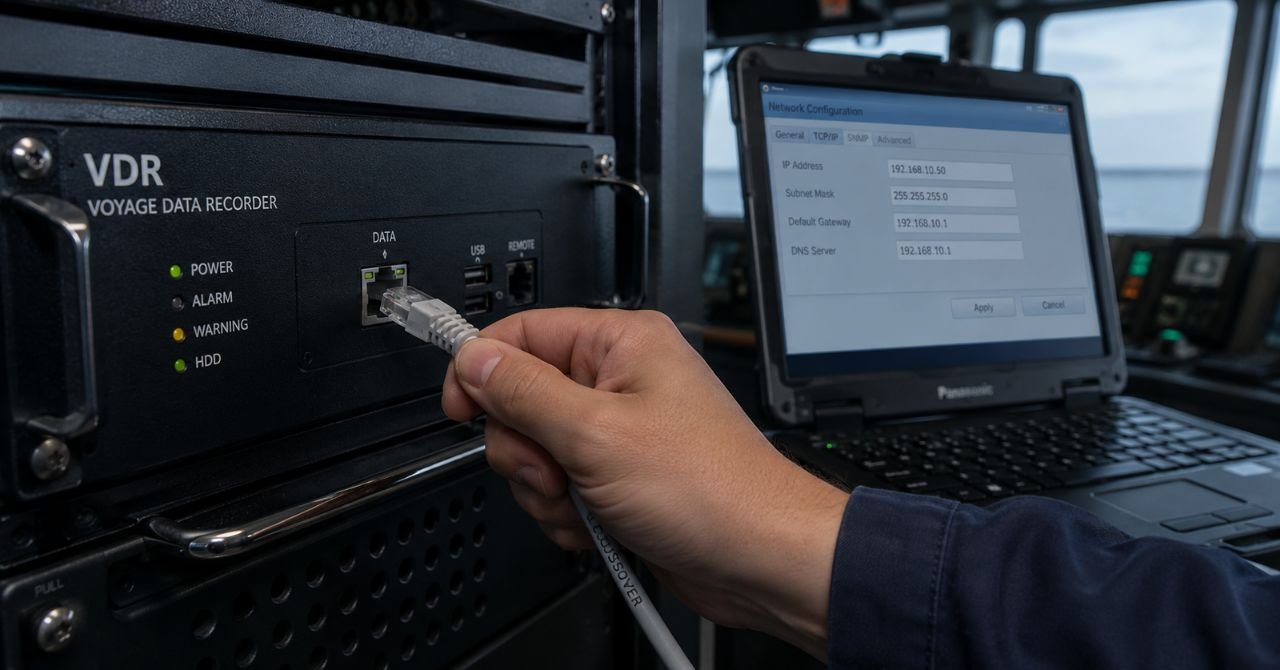
A Furuno VR-3000 series requires the connection to be made via an Ethernet cross cable — not a standard LAN cable, but a crossover cable — plugged into the J14 DATA port on the DCU. The PC’s IP address must then be manually reconfigured to sit on the same network as the VDR, the Windows firewall fully disabled before the software will connect, and the Maintenance Viewer application run with Administrator privileges. The VDR itself sits at a fixed IP address; the PC must be set to any other address on the same subnet before the connection is recognised.
That is five distinct steps before a single byte of data has been transferred. Each one is a failure point for someone working through the process for the first time. The crossover cable alone — a technician’s tool, not bridge equipment — may simply not be on board.
Other manufacturers use different media and different processes entirely. Newer systems have moved toward USB download, which removes most of this complexity — and that is becoming the standard. But the fleet a DPA manages is rarely uniform in vintage, and the procedure posted on the bridge reflects only the system fitted to that vessel. Following it correctly, under pressure, on the day it matters, requires familiarity that no document alone provides.
What an Announced VDR Audit Programme Achieves
An announced VDR audit — where the ship knows in advance that a specific period of data will be reviewed — runs the extraction process in controlled conditions for the first time.
The officer locates the procedure. They work through it. They encounter the IP configuration step they did not expect, or discover that the required cable is not in the equipment store, or find that the file format is not what the receiving system can open. They resolve it, flag it to the superintendent, and the next time they do it, the process takes a fraction of the time.
This matters beyond the audit itself. In the immediate aftermath of an incident — a collision, a grounding, a near-miss that will generate a PSC report — the company may need that data quickly. In serious cases, a technician will be dispatched to handle the extraction. But on ships where the crew has done it before, under no pressure, with time to work through the steps, the process does not wait for a technician. It happens correctly, the first time.
Practice does not just build speed. It builds the certainty that the procedure works on that specific system, with the hardware that is actually on board.
We do not audit ships. We audit people — the decisions made on watch, the conversations that did or did not happen, the habits that were or were not there.
We Audit People, Not Ships
This is worth being direct about. A VDR navigational audit is not an inspection of equipment. The recorder is the instrument, but what the audit examines is the people — the decisions made on watch, the conversations that did or did not happen on the bridge, the habits that were or were not there.
The announced versus unannounced question is, at its core, a question about people too.
An announced audit shows what the bridge team does when they know they are being observed. That is not a compromised finding — it is a useful one. If a ship’s best performance, with full awareness that the data will be reviewed, still shows poor position fixing discipline or a Master-Pilot Exchange with no confirmation of bollard pull, the DPA has learned something significant: the ceiling of this team’s performance is not where it needs to be.
If the announced audit shows a disciplined watch, clear communication, and a passage plan that was followed, the DPA has a baseline. The question that follows is whether that standard holds when no one is watching.
That is what the unannounced audit answers.
How a VDR Audit Programme Should Be Structured
As a fleet VDR audit programme matures, the most diagnostic comparison is not between ships — it is between a ship’s announced and unannounced performance.
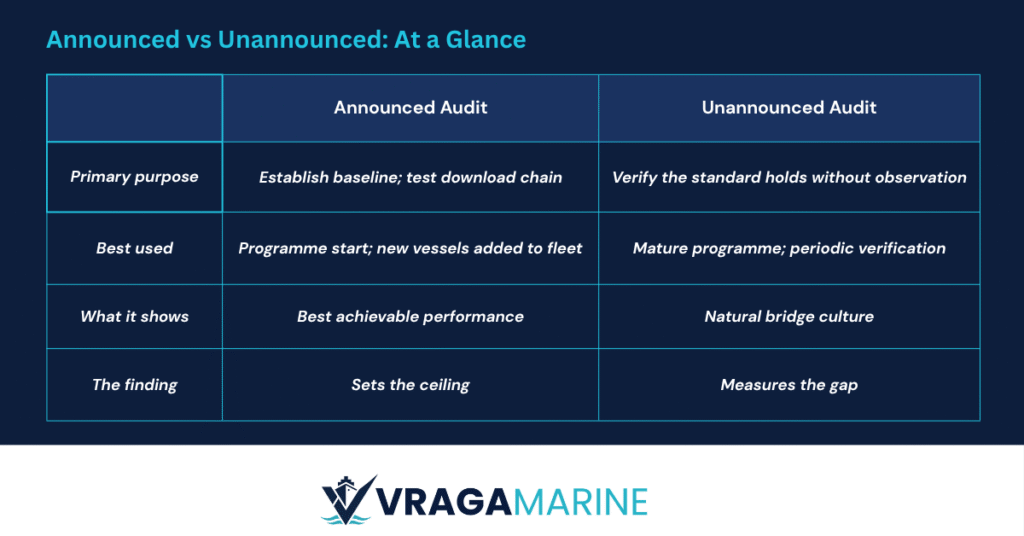
A consistent standard across both confirms that the bridge culture being observed is real. A significant gap tells the DPA something else: that this crew can perform when it matters to them, but does not by default.
That gap is not visible in any document review. It does not appear in the SMS, the checklist records, or the master’s monthly report. It only appears when you have both data points — and you only get both data points by running a programme over time, starting with announced.
Starting announced is not the cautious option. It is the structured one. It builds the technical foundation, establishes the baseline, and sets up the comparison that makes the unannounced audit meaningful.
More from the VDR Series
→ Explore our VDR Navigational Audit Service — Book a VDR Navigational Audit
- The VDR Audit Guide: What the Bridge Data Shows, and Where to Start
- The VDR Audit Report Isn’t Just Good Practice. SIRE 2.0 Question 3.2.4 Asks For It By Name.
- Bridge Procedures Is a DryBMS Priority Area. It Still Doesn’t Move Your Score.
- The VDR Playback Software Is There. The Procedure That Covers It May Not Be.
- ECDIS in Tidal Ports: The Alarm That Stops Working When You Need It Most
- The Lookout During Port Approach Is on the Manning Matrix. The VDR Shows Whether Anyone Was Standing It.
- When Risk Becomes Routine, the Bridge Goes Quiet
- The Anchor Is Down. The VDR Doesn’t Know That.
- The VDR Track Shows More Than Where the Pilot Boarded
- The Radar Is Running. The VDR Shows Whether It’s Doing Its Job.
- When VDR Data Works For You, Not Against You
- Tug Bollard Pull, Ship Fittings, and the Conversation That Doesn’t Happen
- The Master Pilot Exchange: What the VDR Hears, and What Most Ships Leave Unsaid
- The Port Approach Is Already on Film. Most Managers Don’t Know It.
- The Radar Log Says Done. The VDR Says Otherwise.
- Passage Planning Mistakes Ships Make — And What the VDR Reveals
- Ghost Fix: What the Bridge Team Does When the Auditor Has Gone Home
- VDR Navigational Audits: What They Are, Why They Matter, and When to Do One
- How a VDR Navigational Audit Works — A Step-by-Step Guide for Ship Managers