
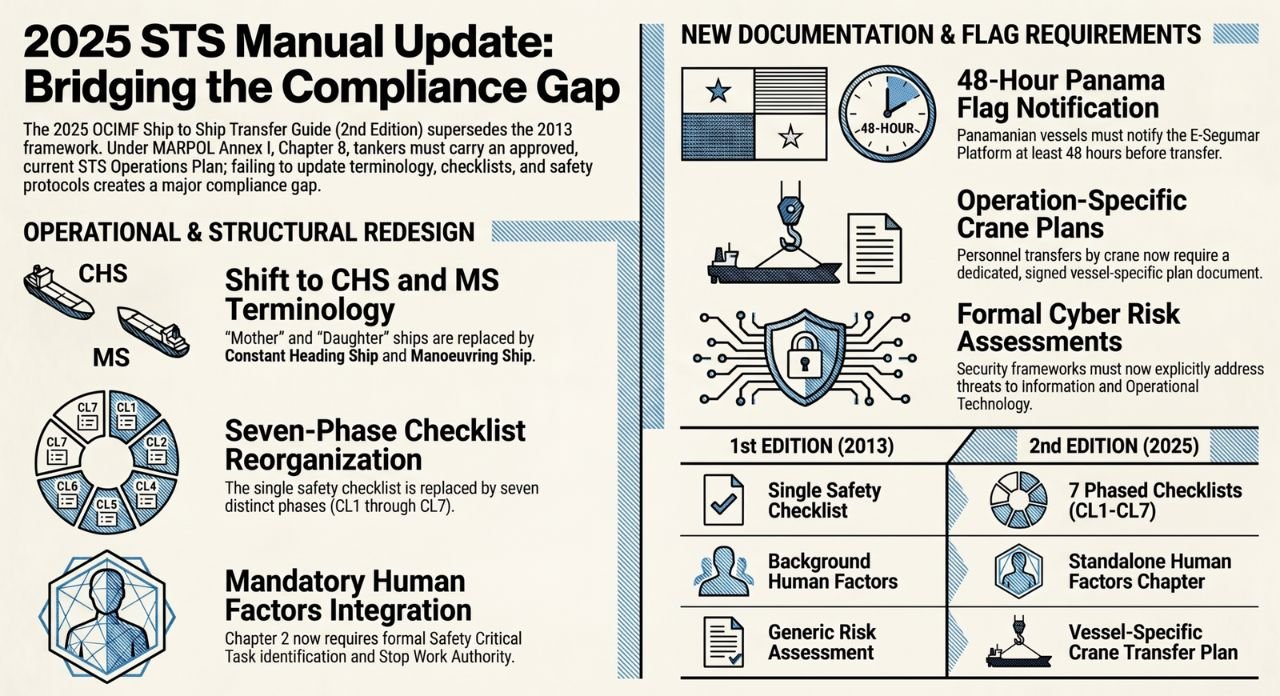
The OCIMF Ship to Ship Transfer Guide for Petroleum, Chemicals and Liquefied Gases was published in a second edition in 2025. The first edition, the document that most existing STS Operations Plans reference — and in many cases were built on — was published in 2013. An STS operations manual update that bridges these two editions is not optional. The 2nd Edition is the operative industry guidance document referenced by MARPOL Annex I and against which flag states, ROs and vetting inspectors will now assess your plan. The gap between what your plan says and what the guide now requires is where the compliance problem sits.
This matters because the STS Operations Plan is not simply a company document. MARPOL Annex I, Chapter 8 requires oil tankers engaged in STS operations to carry a flag state-approved STS Operations Plan on board. The plan must be current, ship-specific, and built around recognised best practice guidance. The 2nd Edition is that guidance now. A plan that references the 1st Edition in its header, or that was structured around the 2013 framework without subsequent revision, is working to a superseded standard.
The STS operations manual update is not a formatting exercise — it is a compliance review against a document that has materially changed.
What follows is drawn from reviewing existing STS Operations Plans against the 2nd Edition and working through the documentation consequences of each change.
What the STS Operations Manual Update Must Address
The terminology change runs through every page
The Purpose and Scope section of the 2nd Edition states the position plainly: Mother ship and Daughter ship have been replaced throughout the Guide by the terms Constant Heading Ship (CHS) and Manoeuvring Ship (MS). These are not cosmetic substitutions. CHS and MS carry specific operational definitions — the ship that maintains course and speed or is at anchor, and the ship that approaches — and those definitions are applied consistently across every checklist, every procedure reference, and every appendix in the new edition.
An existing STS Operations Plan that continues to use Mother Ship and Daughter Ship is misaligned with its reference document.This is the most pervasive element of the STS operations manual update: it affects every page, not just the role definitions.
Every crew briefing template, every pre-operation checklist, every section of the plan that names the roles of the vessels involved will need updating. On a plan of any substance, this is not a find-and-replace exercise — the role-specific responsibilities described throughout the pre-transfer conference checklists and cargo transfer sections are now written around CHS and MS, and the narrative context around each reference matters.
The checklist structure has been redesigned from a single document into seven phases
The Ship to Ship Transfer Safety Checklist in the 1st Edition was a single document. The 2nd Edition has replaced it with seven distinct phased checklists, designated CL1 through CL7, with sub-checklists running from CL3A through CL4F. The pre-transfer conference alone carries five cargo-type sub-checklists — generic checks, additional for vapour balancing, additional for chemicals, additional for LPG and LNG transfer, and additional for LNG specifically — plus a separate pre-transfer agreements sheet capturing agreed parameters between CHS and MS. The cargo transfer monitoring checklist is now a timed repetitive document with a six-column structure for ongoing checks at agreed intervals.
Any SMS procedure that references the checklist by its previous structure, embeds checklist items by section heading, or cross-references specific item numbers is now pointing at a document that has been fundamentally reorganised. The practical consequence is that a Master conducting a pre-transfer conference using an SMS checklist derived from the 1st Edition is working through a structure the 2nd Edition has replaced.
Chapter 2 makes human factors a formal obligation, not a background principle
The 1st Edition addressed human factors within its operational chapters. The 2nd Edition gives the subject a standalone chapter — Chapter 2 — that ship operators and STS service providers are required to apply directly to their operations.
The chapter introduces a Safety Critical Task (SCT) framework. The Guide defines an SCT as a task related to hazards where human error, action or inaction may cause or fail to avoid a serious incident. Ship operators and STS service providers are required to identify which tasks in STS operations are safety critical, identify opportunities for error and the conditions that make error more likely, design tasks to eliminate or minimise error, and identify barriers that will reduce the likelihood of human error and mitigate consequences if error occurs. The Guide identifies communications and information sharing, personnel transfer, mooring and unmooring operations, and cargo transfer operations as areas where error has the potential to lead to a serious incident.
The chapter also introduces Stop Work Authority (SWA) as an explicit requirement. The Guide states that ship operators and STS service providers should emphasise to their personnel that everybody has Stop Work Authority. It identifies the specific barriers that prevent personnel from stopping work — including uncertainty about authority, fear of being wrong, and the strongly hierarchical tradition in shipping — and requires leadership to actively build confidence to act.
An STS Operations Plan that does not address SCT identification, or whose pre-operation crew briefing procedures make no reference to Stop Work Authority, is not aligned with the 2nd Edition standard. This is not aspirational guidance. It is Chapter 2 of the operative reference document.
Personnel transfer by crane now requires a specific plan document
Chapter 5 and Appendix B of the 2nd Edition introduce a formal personnel transfer by crane plan with a permit-to-work structure. The plan is not a reference to a generic risk assessment. It is a vessel-specific, operation-specific document that must capture environmental conditions, visibility, vessel heading and speed, crane configuration and the specific crane to be used, Personnel Transfer Basket type and certification status, a compatibility analysis including hook height over rail, available clearance, and crane outreach against landing zone geometry, PPE requirements, and the identity of responsible persons and signallers on both vessels. Both vessels must sign the completed plan, and the personnel being transferred must also confirm agreement.
The plan is distinct from the pre-operation risk assessment. Where a vessel’s existing STS Operations Plan addresses personnel transfer by crane through a reference to “a risk assessment to be conducted,” that approach no longer reflects the 2nd Edition requirement.
Cyber risk is now a formal section of the security framework
Section 1.6.6 of the 2nd Edition addresses cyber safety and security as a distinct element of STS operational security. The Guide defines cyber security as concerned with the protection of Information Technology (IT) and Operational Technology (OT), information and data from unauthorised access, manipulation and disruption. It requires that the cyber security risk assessment considers threats to both, explicitly noting that attacks on either IT or OT can harm personnel, the environment and the ship or terminal.
A plan whose security section addresses physical access and ISPS compliance but makes no reference to cyber risk assessment is working to a pre-2nd Edition framework.
If Your Vessels Fly the Panama Flag, a Deadline Has Already Passed
Panama Maritime Authority Merchant Marine Circular MMC-217, referencing Resolution No. 106-035-DGMM of April 11, 2025, imposes requirements that make the STS operations manual update a flag state obligation. The circular applies to all Panamanian-flagged oil tankers of 150 GRT and above, regardless of where in the world the STS operation takes place.
From August 6, 2025, any Panamanian-flagged oil tanker engaged in a mid-ocean STS transfer is required to notify the flag state through the E-Segumar Platform not less than 48 hours before the operation commences. Where the STS involves two Panamanian-flagged vessels, both must notify. The notification must include the names, flags, call signs, IMO numbers and estimated times of arrival of all vessels involved; the date, time and geographical position of the planned commencement; whether the operation will be conducted at anchor or underway; the type and quantity of oil to be transferred; the expected duration; the identification and contact details of the Designated Person Ashore for each vessel; and confirmation that the vessel carries an STS Operations Plan complying with MARPOL Annex I, Regulation 41.
One detail worth noting: Paragraph 4.2 of MMC-217, even in its August 2025 amendment, still references the 2013 edition of the STS Transfer Guide as the applicable industry guidance. The circular has not yet been updated to reflect the 2nd Edition. In practice this means an STS Operations Plan for a Panamanian-flagged vessel must satisfy the circular’s notification and approval framework while also being aligned with the 2nd Edition — the document that now defines current best practice and against which a competent auditor or RO surveyor will assess it.
The STS Operations Plan itself must be updated to include the flag state notification procedure, and that updated plan must be formally approved by a Recognised Organisation. The deadline for RO review is the first annual, intermediate or renewal survey of the IOPP Certificate occurring after August 6, 2025. For vessels whose next survey falls in the near term, this work needs to be in progress now.
The circular also makes explicit what is otherwise only implied in the wider regulatory framework: AIS and LRIT must be operational throughout any STS transfer operation, and Panamanian-flagged oil tankers are prohibited from conducting STS operations with vessels included on international sanctions lists recognised by the Panamanian state. Non-compliance may result in sanctions up to and including cancellation of registry.
The Broader Question for Your SMS
An STS Operations Plan approved against the 1st Edition was compliant in 2013. The question now is not whether the plan was ever approved — it is whether it reflects the guide as it currently stands.
The plan does not exist in isolation within the SMS. Pre-operation briefing procedures may reference the checklist by phase or item number. Risk assessment frameworks may incorporate 1st Edition guidance on location assessment and ship compatibility. Training references may point to the 2013 publication. Where the STS Operations Plan references the 2nd Edition in its revision history but the surrounding SMS procedures still reflect the 1st Edition structure, the gap is visible to any competent auditor — and to a PSC officer conducting a targeted examination of cargo transfer documentation.
The more immediate concern is operational. A Master working from an SMS whose pre-transfer conference checklist does not reflect the new phased structure, whose crew briefing does not reference Stop Work Authority, and whose personnel transfer section does not require a completed crane plan, is conducting an STS operation to a standard the 2nd Edition has moved beyond.
If you would like VragaMarine’s assistance with an STS operations manual review or update against the 2nd Edition, get in touch through the contact page.
More from the Amendment Log
- MSC-MEPC.5/Circ.17: What the New Remote Survey and Audit Guidance Actually Allows
- MSC.1/Circ.1704: What the New Bridge Software Maintenance Guidelines Cover, and What They Don’t
- SOLAS Pilot Transfer Arrangements 2028: What Ship Managers Need to Know
- ECDIS Performance Standards 2026: What MSC.530(106)/Rev.1 Actually Changes
- The PFOS Ban Is in Force. The Survey Clock Is Already Running.
- The Ballast Water Management Plan Has Three New Requirements. Is Yours Current?
- The Lifting Appliances Manual: What the Regulation Requires, and What Actually Gets It Through Survey
- SOLAS II-1/3-13: What Ship Managers Need to Know About the New Lifting Appliance Requirements