
Most VDR audits begin and end with a compliance requirement. A SIRE inspection is coming. A TMSA review is due. The audit is commissioned, the report is received, and the box is ticked. The proactive use of VDR data — what the industry has been recommending for over a decade — rarely makes it into that conversation.
I understand why this happens. Ship management is a high-volume operation. There are always more pressing things demanding attention than extracting additional value from an audit already marked complete.
But in treating the VDR audit as a compliance activity, most managers delete something they paid to collect — and cannot recover.
What makes this particularly worth addressing is that OCIMF has already said so. heir published guidance on the proactive use of VDR data specifically recommends that bridge teams review VDR footage before calling a port for the first time — and explicitly names this as best practice.
Most managers may not be aware this recommendation exists — and fewer still have built a process around it.
The data exists. The question is whether you treat it as a compliance by-product or a navigational asset.
What the VDR Is Recording on Every Passage
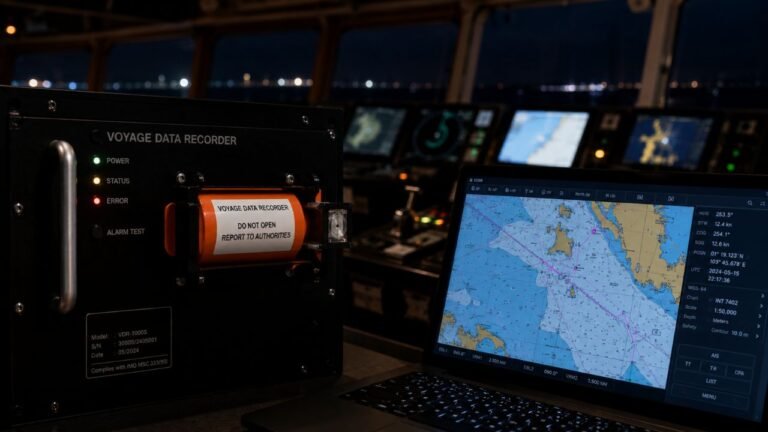
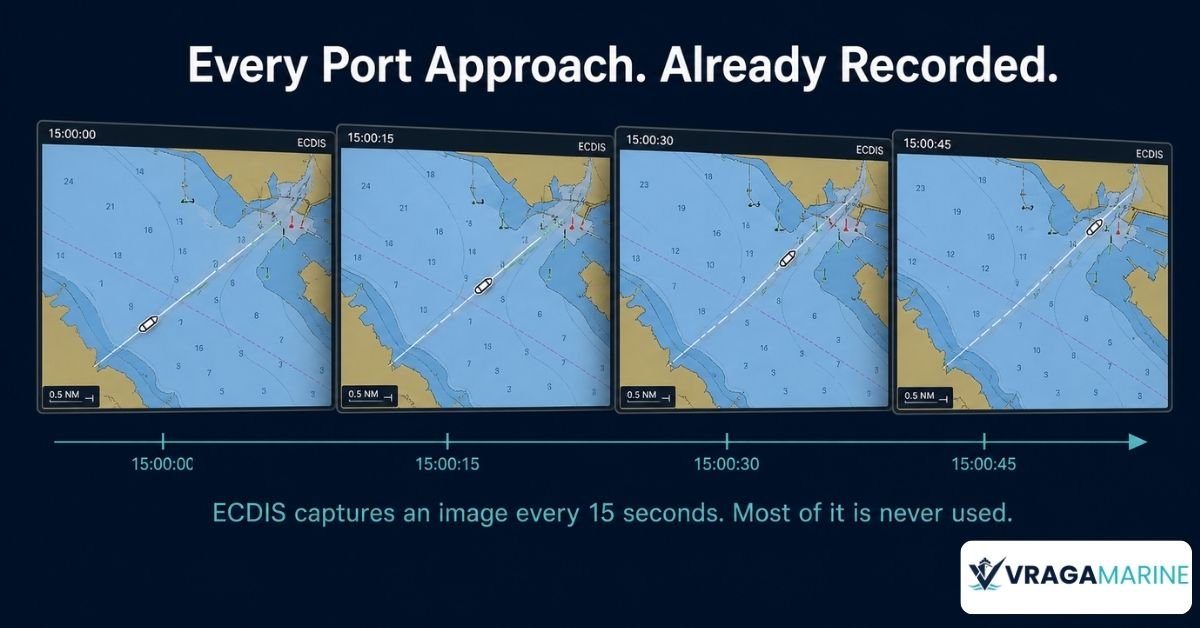
Every time one of your vessels makes a port approach, the VDR is recording. Not just position and speed — the ECDIS display itself, at 15-second intervals, exactly as it appeared on the bridge at the time.
The range selected. The chart scale. The overlay settings. The vessel’s position relative to the planned track. Tug engagement. Pilot boarding approach. The final approach to berth.
This is a complete visual record of how the passage was actually made — not how it was planned on paper, and not how it might have appeared if an auditor had been standing on the bridge.
When we extract VDR data during an audit, we receive folders of images — JPG or BMP files, one every 15 to 30 seconds, for the duration of the passage. Assembled in sequence and rendered as video, those images become a time-lapse of the entire approach. The process is straightforward. What it requires is a decision to do it.
Under IMO Resolution MSC.333(90), modern VDRs retain data for at least 30 days on the long-term recording medium. After that window, unless the data has been extracted, it is gone permanently.
The Data You Are Already Paying to Collect
Most managers are familiar with published port information guides — reference materials that describe approach procedures, berth characteristics, tidal constraints, and local regulations. These are useful resources. Companies subscribe to them and expect navigating officers to consult them before calling a new port.
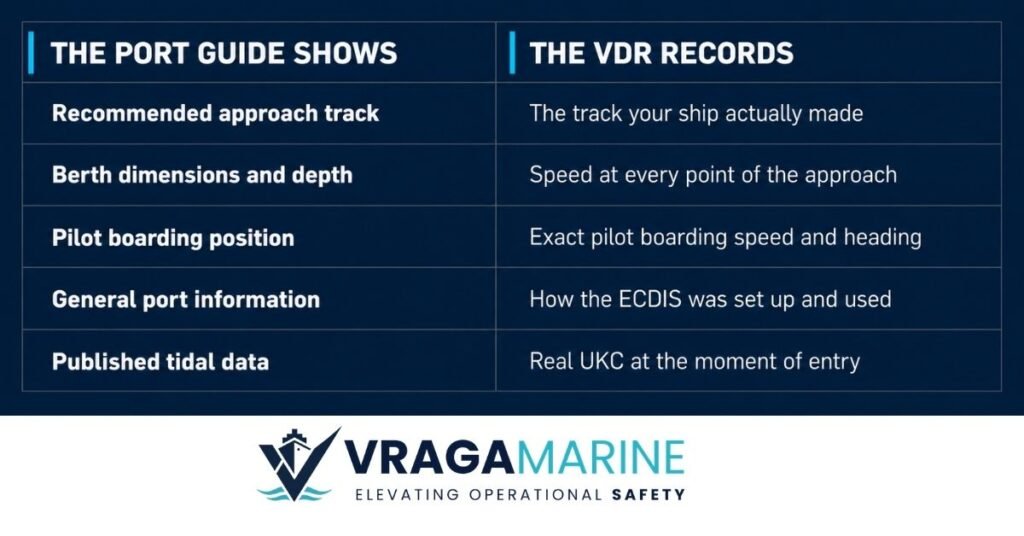
What those guides cannot show you is how your own ships actually make the approach.
They cannot show you the speed your vessel typically carries when the pilot boards. They cannot show you where the tugs engage in practice, as opposed to where the berth plan says they should. They cannot show you what the ECDIS display looked like at the moment the Master decided to proceed — what range was selected, whether radar overlay was active, how close the track ran to the charted hazard.
Your VDR captures all of this. On every port call your fleet makes.
The guide tells you about the port. The time-lapse shows you how your ship actually made the approach.
The approach your vessel made to that port three months ago — the one that would have been genuinely useful to the 2nd Officer planning the next call — no longer exists unless someone extracted it. In most cases, no one did.
Two Audiences, One Video
When I include ECDIS time-lapse videos as part of an audit report package, they serve two distinctly different purposes.
The first is passage planning. A 2nd Officer preparing for a first call at an unfamiliar port can watch footage from a previous visit by a sister vessel and see the actual approach track, the actual speeds, where the pilot boarded, how the tugs were deployed, and where the critical decision points fell. That is information no published guide provides.
The second use becomes apparent during incident investigations. When a P&I correspondent or a senior shore manager needs to understand what happened during a navigational event, they are often not navigation specialists. Walking them through a written report — position at time X, speed at time Y, helm order at time Z — requires sustained concentration on abstract data.
A time-lapse of the ECDIS changes that immediately. Non-specialists can watch the approach unfold, see where the track deviated, see the moment speed failed to reduce, understand the proximity to the hazard. They grasp in minutes what a written narrative takes considerably longer to convey.
Same video. Same footage. Two entirely different applications.
Building an Institutional Memory for Port Approaches
Consider what this means across a fleet over time.
A manager operating ten vessels calling twelve regular ports generates, over the course of a year, a substantial visual record of how those approaches are actually made. Pilot behaviour at each port. Typical approach speeds. Where the track diverges from the charted recommendation. How different Masters handle the same approach in different conditions.
That record exists in your VDR archive right now. In most cases, it is not being retained. In most cases, it has already been deleted — and with it, every opportunity for proactive use of that VDR data.
The alternative is a deliberate step in the audit workflow: extract ECDIS footage from selected port calls as part of the routine audit, build the time-lapse, retain it alongside the audit report. Over time, the fleet builds a navigational reference library — not from published data, but from actual operational experience. From what your own ships have actually done at those ports.
This does not require significant additional investment. The extraction happens as part of the audit. What it requires is a decision to treat the footage as an asset rather than a by-product.
For a practical overview of how modern VDR systems capture and store this data, see this summary of VDR recording requirements from one of the leading VDR manufacturers.
The Proactive Use of VDR Data Starts With a Decision
The compliance mindset around VDR audits is understandable. It is also a low ceiling.
The report is the minimum the process delivers. What managers often leave behind — in the raw data, in the sequence of images that document an entire port approach minute by minute — is material that could improve how their fleet navigates, how their officers plan, and how their incidents are communicated and investigated.
The VDR is recording every critical passage your vessels make. The proactive use of VDR data is a management decision, not a technical limitation.
The port approach is already on film
More from the VDR Series
→ Explore our VDR Navigational Audit Service — Book a VDR Navigational Audit
- The VDR Audit Guide: What the Bridge Data Shows, and Where to Start
- The VDR Audit Report Isn’t Just Good Practice. SIRE 2.0 Question 3.2.4 Asks For It By Name.
- Bridge Procedures Is a DryBMS Priority Area. It Still Doesn’t Move Your Score.
- The VDR Playback Software Is There. The Procedure That Covers It May Not Be.
- ECDIS in Tidal Ports: The Alarm That Stops Working When You Need It Most
- The Lookout During Port Approach Is on the Manning Matrix. The VDR Shows Whether Anyone Was Standing It.
- When Risk Becomes Routine, the Bridge Goes Quiet
- The First VDR Audit Your Fleet Runs Should Be Announced. Here’s Why.
- The Anchor Is Down. The VDR Doesn’t Know That.
- The VDR Track Shows More Than Where the Pilot Boarded
- The Radar Is Running. The VDR Shows Whether It’s Doing Its Job.
- When VDR Data Works For You, Not Against You
- Tug Bollard Pull, Ship Fittings, and the Conversation That Doesn’t Happen
- The Master Pilot Exchange: What the VDR Hears, and What Most Ships Leave Unsaid
- The Radar Log Says Done. The VDR Says Otherwise.
- Passage Planning Mistakes Ships Make — And What the VDR Reveals
- Ghost Fix: What the Bridge Team Does When the Auditor Has Gone Home
- VDR Navigational Audits: What They Are, Why They Matter, and When to Do One
- How a VDR Navigational Audit Works — A Step-by-Step Guide for Ship Managers