
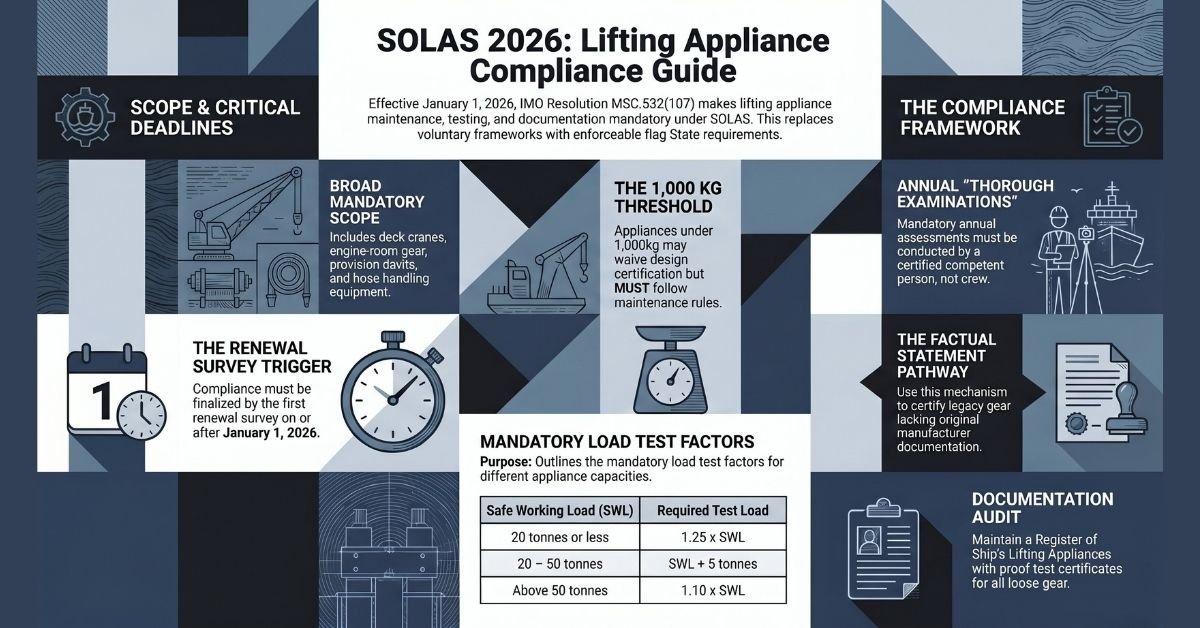
The new SOLAS lifting appliances regulation 2026 — SOLAS Regulation II-1/3-13 — came into force on 1 January 2026. Adopted under IMO Resolution MSC.532(107), it establishes mandatory requirements for the design, testing, examination, and maintenance of lifting appliances and anchor handling winches across the global merchant fleet.
For most vessels, this is not a distant compliance horizon — it is already active. The question for ship managers and DPAs is whether their fleets are positioned correctly before the first renewal survey triggers a formal audit of the lifting appliance regime.
This article sets out what the regulation requires, which equipment it covers, what the compliance deadlines are, and where the common gaps tend to appear.
What Changed Under the SOLAS Lifting Appliances Regulation 2026
Before this regulation, lifting appliances fell under a patchwork of flag State requirements and voluntary frameworks — primarily the ILO Convention No. 152 on dock work, which many flag administrations applied on a voluntary basis. There was no single mandatory SOLAS standard covering the full range of lifting equipment aboard merchant vessels.
MSC.532(107) changes that. For the first time, SOLAS Chapter II-1 includes a dedicated regulation — Regulation 3-13 — that brings lifting appliances and anchor handling winches under mandatory flag State survey requirements, with defined testing intervals, documentation standards, and examination obligations.
The stated purpose is straightforward: to prevent accidents, injuries, and fatalities caused by lifting appliance failures through enforceable design, construction, and maintenance standards.
Which Equipment Is in Scope
The definition of a “lifting appliance” under SOLAS II-1/2.30 is intentionally broad. It covers any load-handling ship’s equipment used for the following purposes:
cargo loading, transfer, or discharge; raising and lowering hold hatch covers or movable bulkheads; engine-room crane operations; stores crane operations; hose handling; launch and recovery of tender boats; and personnel handling.
In practical terms, this means deck cranes, engine-room cranes, provision davits, hose handling gear, and personnel transfer equipment are all in scope.
The following are explicitly excluded: integrated mechanical equipment for opening and closing hold hatch covers (hydraulic hatch cover systems, for example); life-saving launching appliances complying with the LSA Code; lifting appliances on certified MODUs; and equipment on offshore construction vessels complying with accepted standards.
Anchor handling winches — specifically those used for deploying, recovering, and repositioning anchors and mooring lines in subsea operations — are also covered under a separate part of the regulation. Standard anchor windlasses used for a vessel’s own anchoring operations are not affected.
The 1,000 kg Threshold
SOLAS II-1/3-13.1.3 gives individual flag State administrations discretion over whether the design, construction, and installation provisions apply to lifting appliances with an SWL below 1,000 kg. Several major flag States — including the Marshall Islands and Liberia — have confirmed they do not apply the design and certification requirements to sub-1,000 kg appliances.
However, the maintenance, inspection, and operational testing obligations under SOLAS II-1/3-13.3 apply to all lifting appliances regardless of SWL and regardless of installation date. There is no flag State discretion on this point.
The same universal scope applies to loose gear. Every shackle, hook, block, sling, and chain used in conjunction with any lifting appliance must have documentary evidence of a proof test.
Compliance Deadlines
Under the SOLAS lifting appliances regulation 2026, compliance deadlines depend on whether equipment was installed before or after the regulation came into force.
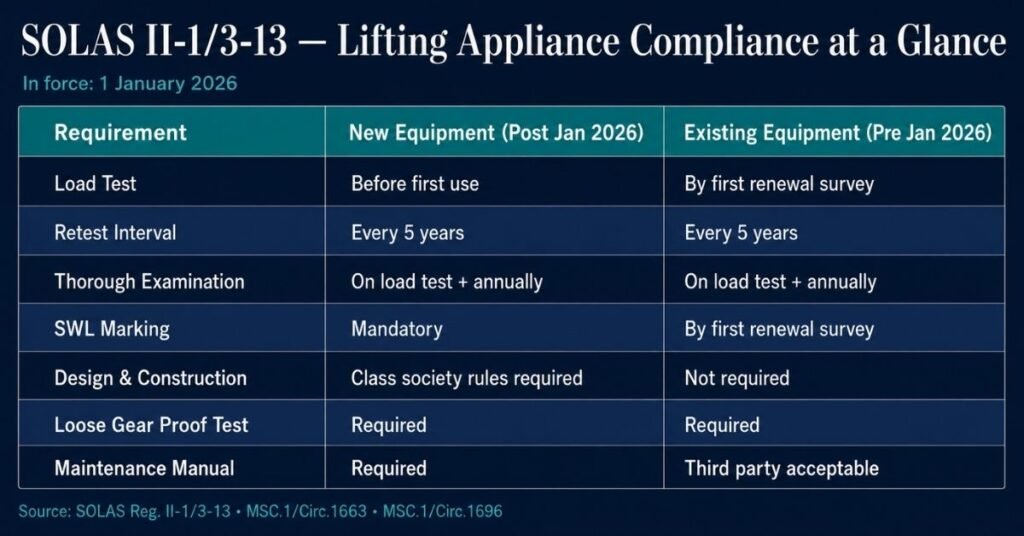
Equipment installed on or after 1 January 2026
Must be designed, constructed, and installed in accordance with a recognised classification society’s rules or equivalent standards acceptable to the flag State. Must be load tested and thoroughly examined before first use, and permanently marked with the SWL.
Equipment installed before 1 January 2026
Must be load tested, thoroughly examined, and permanently marked with the SWL no later than the date of the first renewal survey on or after 1 January 2026. Annual thorough examinations are required thereafter, and a full load test must be repeated at least every five years.
The renewal survey trigger is the critical deadline. For vessels whose renewal survey falls in 2026 or 2027, compliance work needs to be in progress now.
What Compliance Actually Looks Like
The Register
The primary document a surveyor will check is the Register of Ship’s Lifting Appliances and Cargo Handling Gear. This register must be maintained on board and must contain valid certificates of test and thorough examination for every in-scope appliance and item of loose gear.
MSC.1/Circ.1663 provides the sample formats for the register and for certificates of test and thorough examination. Flag States may require their own specific formats.
The Marshall Islands issued Marine Notice MN 2-011-62 (December 2025)
Liberia issued Marine Notice SAF-020 (revised December 2025) — both set out flag-specific documentation requirements, certificate formats, and clarifications on the thorough examination standard. Liberia’s SAF-020 also includes a corrected test load factor for multi-sheave blocks and hook blocks, and clarifies the application of the regulation to boom conveyors on self-unloading ships.
Load Testing
Test loads are defined in Table 1 of MSC.1/Circ.1663. For appliances with an SWL of 20 tonnes or less, the test load is 1.25 × SWL. For 20–50 tonnes, it is SWL + 5 tonnes. For appliances above 50 tonnes SWL, it is 1.10 × SWL.
Thorough Examination
A thorough examination is not a visual check by a ship’s officer. Under MSC.1/Circ.1663, it is a detailed assessment carried out by a competent person acceptable to the Administration or its Recognised Organisation. The scope covers structural integrity of crane jibs, pedestals, and foundations; correct functioning of all safety and limitation devices; wire rope condition assessed against ISO 4309:2017 discard criteria; and full assessment of hydraulic systems, motors, winches, brakes, and drums.
Thorough examinations must be completed upon completion of any load test, and annually thereafter.
Maintenance and Operations Manuals
From 1 January 2026, maintenance and operations manuals are required on board for all lifting appliances. Where manufacturer documentation is unavailable — a common situation for older equipment — manuals prepared by a competent third party are acceptable.
The Legacy Gear Problem
The most common compliance gap for existing fleets is not equipment condition — it is documentation. Many vessels carry lifting appliances installed years or decades ago for which original certificates, design drawings, or SWL documentation no longer exist.
IMO Circular MSC.1/Circ.1696, issued in August 2025, provides a specific mechanism for this situation. For existing non-certified appliances without valid certificates under a prior international instrument, compliance with SOLAS II-1/3-13.2.4 can be demonstrated through a Factual Statement — sometimes referred to as a Statement of Fact — issued by the vessel’s RO or a competent person approved by the flag Administration.
The Factual Statement confirms the appliance was subjected to a load test and subsequent thorough examination. It does not confirm compliance with new-build design standards, and it does not validate the SWL. Where the SWL is undocumented, the company nominates a figure and the test load is calculated from that nomination. The nominated SWL is the company’s responsibility, not the RO’s.
The Factual Statement must be attached to the Register of Lifting Appliances to form part of the documented history of the appliance.
For vessels approaching their first renewal survey, the Factual Statement pathway is the practical compliance route for any appliance that cannot produce a prior certificate.
Loose Gear — The Documentation Gap Most Companies Miss
Loose gear compliance tends to be treated as secondary. It should not be.
Every item of loose gear used with an in-scope lifting appliance must have a proof test certificate traceable to that specific item by serial number or distinguishing mark. The proof test loads follow Table 2 of MSC.1/Circ.1663 — for example, hooks, shackles, and chains with an SWL up to 25 tonnes must be proof tested to 2 × SWL.
Loose gear must be permanently marked with its unique identification and SWL. Items without markings or certificates must not be used and must be segregated from serviceable gear.
ClassNK surveyors will check that proof test certificates for all loose gear aboard are available. ClassNK confirmed this position in Technical Information No. TEC-1361 (September 2025), which superseded TEC-1357 and clarified that proof test certificates are required for loose gear used with all lifting appliances subject to SOLAS II-1/3-13 — not only those under paragraphs 13.2.1 and 13.2.4 as previously stated. Other flag State ROs are taking equivalent positions.
What to Do Before Your Next Renewal Survey
01
Inventory
Compile a complete list of all lifting appliances aboard, including engine-room cranes, provision davits, hose handling gear, and any appliance regardless of SWL. Include location, SWL, and installation date. There is no prescribed format.
02
Documentation Audit
Identify which appliances have valid load test certificates, which require the Factual Statement pathway, and which have no documentation at all. Do the same for loose gear. Cross-check against flag State requirements for your specific vessels.
03
Survey Preparation
Arrange load testing and thorough examinations through your RO in advance of the renewal survey. Do not wait until the survey window. Build annual thorough examination intervals into the PMS now, and ensure maintenance and operations manuals are on board.
Vraga Marine can assist with lifting appliance compliance work. Get in touch at sales@vragamarine.com or through the contact page.
SOLAS · MSC.532(107) · Lifting Appliances · Ship Managers · Survey Readiness · MSC.1/Circ.1663
More from the Amendment Log
- MSC-MEPC.5/Circ.17: What the New Remote Survey and Audit Guidance Actually Allows
- MSC.1/Circ.1704: What the New Bridge Software Maintenance Guidelines Cover, and What They Don’t
- SOLAS Pilot Transfer Arrangements 2028: What Ship Managers Need to Know
- ECDIS Performance Standards 2026: What MSC.530(106)/Rev.1 Actually Changes
- The PFOS Ban Is in Force. The Survey Clock Is Already Running.
- Your STS operations manual references a guide that no longer exists in its old form
- The Ballast Water Management Plan Has Three New Requirements. Is Yours Current?
- The Lifting Appliances Manual: What the Regulation Requires, and What Actually Gets It Through Survey