
Every time a ship is nominated for a cargo, a question is being asked in a room the ship manager is not in: what is the probability that this vessel creates a problem for us?
Not a theoretical question. A commercial one, with a financial answer. If the ship grounds, if the cargo is damaged, if there is a structural failure, if a port or terminal refuses her — the consequences flow back to the party that nominated her. The charterer, the cargo owner, the terminal operator. Their reputation, their schedule, their liability. They are the ones with commercial exposure to an asset they do not own, crewed by people they have never met.
Vetting is the system the commercial maritime industry developed to quantify that risk before committing to a fixture. Understanding how the ship vetting system works— what it measures, who makes the decisions, and what the inspector’s role actually is — is fundamental to understanding how to operate a commercially competitive ship.
This article explains that system from the beginning.
Why the ship vetting system exists: the commercial problem
For most of maritime history, cargo owners and charterers evaluated ships individually, each applying their own standards through their own processes. By the late 1980s, a series of high-profile tanker incidents made clear that this fragmented approach was not working. The environmental and financial consequences of a major tanker casualty fell not just on the ship’s owner but on every commercial party connected to that voyage. Cargo owners were exposed. Terminal operators were exposed. The oil majors chartering tankers bore reputational and regulatory consequences that went far beyond the cost of the cargo.
The commercial case for a standardised, shared system of ship assessment was straightforward: if oil companies could pool their inspection data, each would benefit from the inspections commissioned by the others, the burden on individual ships would reduce, and the overall quality of vessels entering commercial service would improve under the pressure of collective scrutiny.
That logic produced SIRE in 1993.
SIRE — the original programme
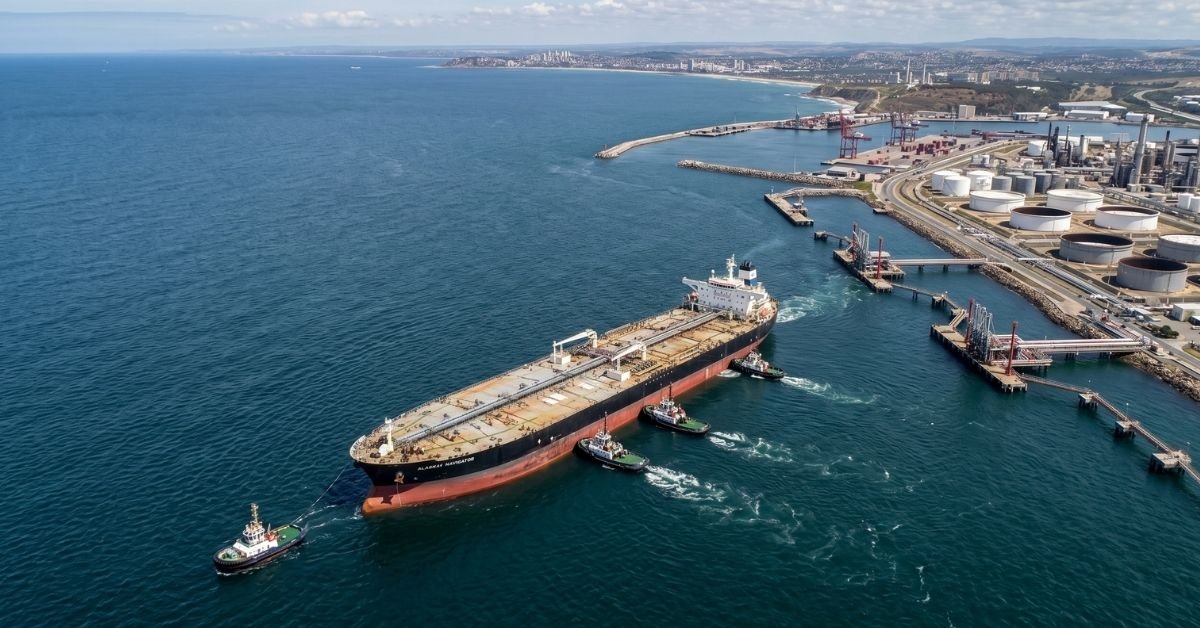
The Ship Inspection Report Programme, managed by the Oil Companies International Marine Forum (OCIMF), was launched to provide a standardised inspection format for tankers, with objective reports capable of being shared across the industry. It covers oil tankers, combination carriers, shuttle tankers, chemical tankers, and gas tankers — any vessel carrying liquid cargo for an oil or chemical major.
At its core is a database. Accredited inspectors board tankers around the world, complete a standardised inspection questionnaire, record their findings, and submit the completed report to the SIRE database managed by OCIMF. OCIMF member companies, bulk oil terminal operators, and other qualifying organisations can then access that database to retrieve inspection reports on specific vessels. The standardised Vessel Inspection Questionnaire was introduced in 1997 to bring uniformity to what had been a more varied set of inspection protocols in the programme’s earliest years, and was revised periodically through to VIQ 7, the version in use immediately before the transition to SIRE 2.0.
The inspector’s role is precisely defined: he assesses the vessel’s condition and crew competency against the parameters the questionnaire sets out, records what he finds, and submits the report. He does not pass or fail the ship. He does not make a chartering recommendation. Once the report is submitted and he has left the vessel, his involvement with that inspection is complete. He will not see the operator’s response to the observations he raised.
That response — the operator’s explanation of each observation and the corrective actions taken — is submitted separately, directly to the SIRE database. It sits alongside the inspection report and is available to vetting users who access it. But the inspector who raised the observation never reads it. His report and the operator’s response are two distinct documents in the same file, managed by different parties.
How an oil major actually makes a vetting decision
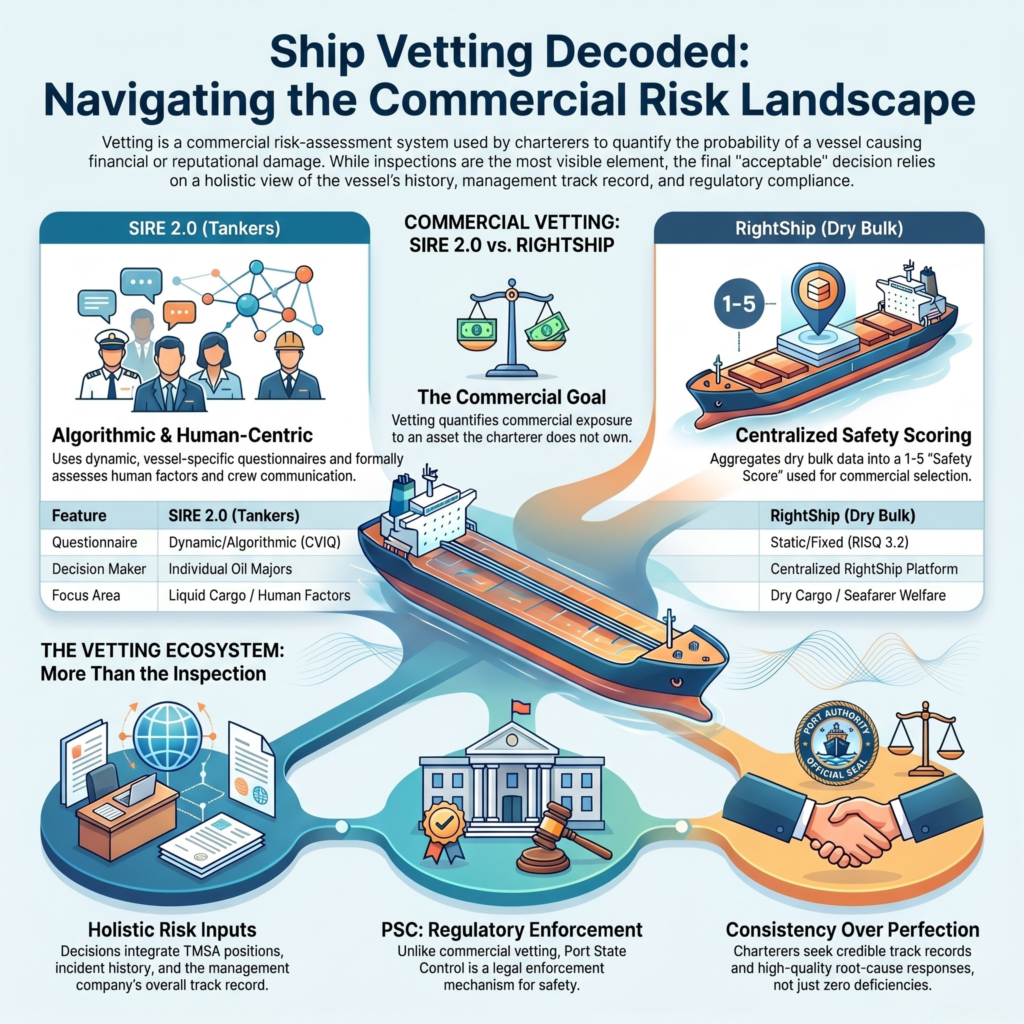
This is the part that is most often misunderstood. The SIRE inspection is one input into a vetting decision. It is an important input, but it is not the whole picture.
When a tanker is nominated for a voyage, the oil major’s vetting team or vetting superintendent retrieves the vessel’s SIRE report from the database. They review the inspection findings and the operator’s responses to each observation. A well-written response that clearly explains the root cause of an observation and demonstrates credible corrective action carries weight. A vague response that simply asserts the matter has been addressed does not.
But the vetting team is also looking at several other things simultaneously.
TMSA position. The Tanker Management and Self-Assessment programme, also managed by OCIMF and integrated with SIRE on the OCIMF platform since 2017, covers thirteen elements of ship management practice across four progressive stages — from minimum compliance at stage one to demonstrable best practice at stage four. Operators self-assess and submit evidence against each element. Oil majors access the TMSA data as part of their vetting. A strong TMSA position reflects organisational maturity. A weak one raises questions that the inspection report alone cannot answer.
PSC record. Port State Control inspections (discussed separately below) generate a public record of deficiencies and detentions. The vetting team reviews this. A ship with a pattern of PSC deficiencies — particularly in navigation, fire safety, or life-saving appliances — presents a different risk profile to one with a clean record, regardless of what the latest SIRE report says.
Incident history. The OCIMF database and the oil major’s own records will contain information on any reported incidents involving the vessel or the management company — near misses, machinery failures, navigational incidents, cargo contamination events. This history informs the vetting decision alongside the inspection report.
Management company track record. The vetting team is not only assessing the ship. They are assessing the company managing it. A management company with a strong track record across its fleet carries credibility that mitigates borderline findings on an individual vessel. A company with recurring themes across multiple reports — similar observations appearing on different ships in the same fleet — raises a different concern.
Charterers and terminals are not looking for perfection — they are looking for consistency and credibility.
Only after reviewing all of these inputs together does the vetting team reach a conclusion: acceptable for business, conditionally acceptable, or not acceptable. That decision is commercial and confidential. The ship manager may not be told the reasons if the vessel is rejected. The SIRE report is the most visible part of the process; the decision behind it is not.
SIRE 2.0 — a significant evolution
The programme that OCIMF launched in 1993 ran, with periodic updates, until September 2024. VIQ 7 remained structurally consistent with the format the industry had grown accustomed to: a standardised questionnaire, the same for all tankers of a given type, answered by the inspector with yes, no, not seen, or not applicable.
SIRE 2.0, which went live on 2 September 2024, is a fundamentally different system. Rather than a fixed questionnaire, SIRE 2.0 uses an algorithm to generate a Compiled Vessel Inspection Questionnaire (CVIQ) that is unique to each vessel and each inspection. The algorithm draws from a comprehensive question library and tailors the questionnaire based on the vessel’s type, risk profile, previous inspection history, and other parameters. No two SIRE 2.0 inspections are identical. Within each CVIQ, questions are categorised as Core (allocated to every inspection of an applicable vessel type), Rotational 1 (cycling approximately every third or fourth inspection), and Rotational 2 (cycling approximately every sixth inspection), so the question set faced by any single vessel changes meaningfully between inspections.
Several other significant changes accompany this.
The inspection now formally assesses human factors — how crew members communicate, make decisions under pressure, and manage workload — alongside the hardware and process dimensions of every applicable question. This dimension was implicit in VIQ 7; in SIRE 2.0 it is structured into the response format itself.
Operators are required to maintain a photo repository: standardised, dated photographs of safety-critical equipment, cargo areas, accommodation, and engine spaces. OCIMF recommends these are refreshed at approximately six-month intervals, with the proviso that photographs must be refreshed sooner whenever the condition of the vessel materially changes, and may be retained for up to a year if the operator is confident they remain representative.
The onboard inspection is conducted entirely on a digitised tablet device. The report is generated in real time and transmitted digitally. The turnaround between inspection and report availability has shortened significantly.
For tanker operators, SIRE 2.0 represents a shift from preparation focused on a known, fixed questionnaire to preparation that must cover the full scope of the question library, since any question from that library may appear in the CVIQ. The crew’s ability to discuss their work fluently — not recite memorised answers — is now directly assessed.
What the SIRE inspection actually involves
Describing SIRE 2.0 as an algorithm and a question library says nothing about what actually happens when the inspector is standing on the deck. It is worth being specific, because most of what determines whether a SIRE inspection goes well or badly is decided before the inspector ever boards.
The inspection itself typically runs across a full day, sometimes longer on larger or more complex tonnage. The inspector works from the CVIQ generated for that specific boarding, moving through the vessel — bridge, engine room, deck, accommodation, mooring stations, cargo control room — cross-referencing what the questionnaire asks against what he observes and what the crew demonstrate. This is not a paperwork audit conducted from an office chair. Certificates and manuals are checked, but the greater part of the inspection is the inspector watching crew members operate equipment, respond to hypothetical scenarios, and explain procedures in their own words.
This is where the human factors dimension introduced under SIRE 2.0 changes what “passing” an inspection actually requires. A crew member who can locate the correct procedure in the SMS but cannot explain, in his own words, why it exists or what happens if it is skipped, will generate an observation under the current questionnaire in a way that a VIQ 7 inspection, focused more narrowly on hardware and paperwork, would not have flagged. Preparing a crew for a SIRE vetting inspection now means preparing them to discuss their work fluently, not to recite a script.
The observations that recur most often across SIRE inspections cluster in predictable areas: mooring arrangements and equipment condition, enclosed space entry procedures, permit-to-work systems, and the currency of the photo repository against the vessel’s actual condition. None of these are exotic. They are also, consistently, the areas where the gap between what the SMS documents and what the crew can demonstrate is widest — which is precisely why SMS rationalisation work and inspection preparation are not separate exercises. A document the crew does not trust is a document they will not perform well against, inspection day or otherwise.
The report that follows a SIRE inspection is not the end of the process, as described above — it is the beginning of the operator’s response, and the quality of that response shapes how the finding is read by every vetting team that accesses it afterward.
RightShip and the RISQ — the dry bulk equivalent
The dry bulk sector faced the same commercial problem as the tanker trade, but SIRE was built for tankers and governed by oil majors. The bulk carrier trade — coal, grain, iron ore, bauxite — had different charterers, different terminal operators, and different risk profiles.
RightShip identified this gap and built a programme for the dry bulk market. The RightShip Inspection Ship Questionnaire (RISQ) is the instrument that programme uses. Its structural origins are evident: the RISQ is derived from VIQ 7, with the tanker-specific cargo sections replaced by bulk carrier equivalents — structural integrity, cargo hold condition, hatch covers and lifting appliances — and several sections added or expanded to reflect the specific risks of the dry bulk trade, including the health and welfare of seafarers as a standalone section. The navigation, certification, safety management, mooring, machinery space, and pollution prevention sections of RISQ map directly to their equivalents in VIQ 7. The numbering differs; the substance does not.
The current version, RISQ 3.2, was issued in November 2025 and broadened scope further — adding a dedicated section for heavy lift vessels and updating fuel management to cover alternative fuels (LNG, methanol, ammonia) alongside conventional oil. RISQ already covers a range of dry cargo types, including bulk carriers, general cargo vessels, and cellular container ships, with cargo-specific sections for each.
There is, however, a material difference in how SIRE and the RightShip programme operate commercially.
Under SIRE, each oil major manages its own ship vetting system & decision. They access the SIRE platform, retrieve the inspection report, review it alongside their own TMSA data and PSC records, and reach their own conclusion. The decision is made in-house, by the company’s vetting team, applying that company’s criteria.
Under RightShip, the ship vetting system function is centralised. The inspection report and the operator’s responses to observations go to RightShip. RightShip generates a Safety Score for the vessel — an aggregated assessment that also takes into account PSC history, incident record, management company performance, and other data. Charterers, terminal operators, and other RightShip subscribers log into the platform and see that score and the underlying data. The commercial decision is then made by the charterer or terminal, but the synthesis of the information has been done by RightShip rather than by each subscriber independently.
The Safety Score runs on a scale of one to five. A score of three or above is the accepted commercial threshold across most of the subscriber base — vessels scoring below that face additional scrutiny, mandatory inspection requirements, or outright rejection at nomination.
This means that under RightShip, the risk profile of the vessel on the platform reflects not only the last inspection but the accumulated record. An inspection with several observations that are poorly responded to damages the score. A vessel with a strong PSC record and a clean inspection history carries that in its profile. Potential charterers are assessing a continuously maintained picture, not just the most recent boarding.
It is also worth noting that RISQ 3.2 remains a static questionnaire in the VIQ 7 mould — every inspection works through the same comprehensive document, with the inspector recording responses to applicable questions across the full scope. Unlike SIRE 2.0, it has not transitioned to an algorithmic, dynamically generated format. The two programmes, which shared a common ancestor, have now diverged considerably in their methodological approach.
It is worth being clear on one point that is sometimes misread: although container vessels fall within RISQ’s scope through the cellular container ship cargo section, the wider container trade does not have an industry-wide commercial ship vetting system regime equivalent in scale or commercial weight to SIRE for tankers. The major box-line operators have not built a shared inspection programme of comparable reach, and most commercial assessment of container vessels continues to rely on class records, PSC history, management company reputation, and individual assessments commissioned by specific cargo owners or shippers. Whether this gap will close — given the scale of the sector and the precedent set by SIRE and RISQ — is a question the industry has debated for some time.
Port State Control — a different instrument entirely
Port State Control is not a vetting programme. It is a regulatory enforcement mechanism, and the distinction matters.
PSC inspections are conducted by officers of the Port State — the country whose port the ship is visiting — acting under the authority of international conventions including SOLAS, MARPOL, STCW, and the MLC. The focus is the safety of the ship’s crew, the protection of the marine environment, and compliance with flag state and classification requirements. The primary concern is not whether the ship is commercially suitable for a charterer. It is whether the ship is safe to operate and whether the crew’s rights and welfare are being met.
PSC officers have powers that no vetting inspector holds. They can issue deficiency notices requiring rectification before the ship departs. In cases of serious deficiency — a life-saving appliance not fit for use, critical navigation equipment non-functional, crew certification not in order — they can detain the ship, preventing it from sailing until the deficiency is corrected and the PSC officer is satisfied.
PSC inspections are organised through regional Memoranda of Understanding — the Paris MoU, Tokyo MoU, and their equivalents across all major trading regions. A vessel’s PSC record is publicly accessible through the relevant MoU databases and feeds into both the SIRE platform and the RightShip Safety Score as part of the broader risk picture.
For a ship manager, PSC and vetting are two separate obligations that measure different things. A ship that passes a SIRE 2.0 or RISQ inspection but carries a pattern of PSC deficiencies — particularly repeated deficiencies in the same areas — will face questions in the vetting process that the inspection report alone cannot resolve. And a ship detained by PSC faces immediate commercial consequences regardless of what its vetting record shows.
What a commercially strong vessel record actually requires
The ship vetting system, properly understood, measures two related but distinct things: the condition and operation of the ship on the day the inspector boards, and the quality of the management system behind it over time.
A single inspection, however positive, does not establish a track record. A single good SIRE 2.0 or RISQ report, submitted alongside weak TMSA evidence, a pattern of PSC deficiencies, and an incident history that raises questions, will not produce a confident vetting decision. The inspection is the most visible moment, but it sits within a larger picture that the vetting team or RightShip’s platform is constructing continuously.
“The inspection reveals what is already there. The record being built between inspections is what the vetting team is ultimately reading
Conversely, a ship with a strong PSC record, a credible TMSA or management audit history, a clean incident record, and consistently clear inspection reports builds a risk profile that makes vetting decisions straightforward. Charterers and terminals are not looking for perfection — they are looking for consistency and credibility. A well-responded observation on a SIRE 2.0 or RISQ report, where the root cause is identified and the corrective action is specific and verifiable, reflects better on a management company than a report with no observations and no evidence of how the company monitors its own fleet.
For the ship manager, the practical implication is that vetting readiness is not a pre-inspection exercise. It is a continuous operational standard.
The inspector’s position — worth understanding clearly
One point that ship managers sometimes misread: the inspector is an instrument of accurate assessment, not an advocate for the ship or against it. His professional obligation is to record what he finds, against the parameters the programme sets. An observation is not a personal judgement. It is a recorded finding.
The inspector is not someone to be managed or persuaded. He is someone whose job is to see accurately. The only reliable approach is to ensure that accurate observation reveals a well-run ship
Once the inspector leaves the vessel, he is done with that inspection. He does not follow the operator’s response. He does not engage with the vetting decision. He does not know whether the vessel was accepted or rejected for a fixture. The report he submitted is in the database; what happens to it commercially is managed by other parties.
This structural separation is worth keeping in mind when thinking about inspections. The ship vetting system, from beginning to end, is built on that assumption.
More from the Vetting Series
→ Explore our Remote Assurance Service — See the Remote Assurance Audit