
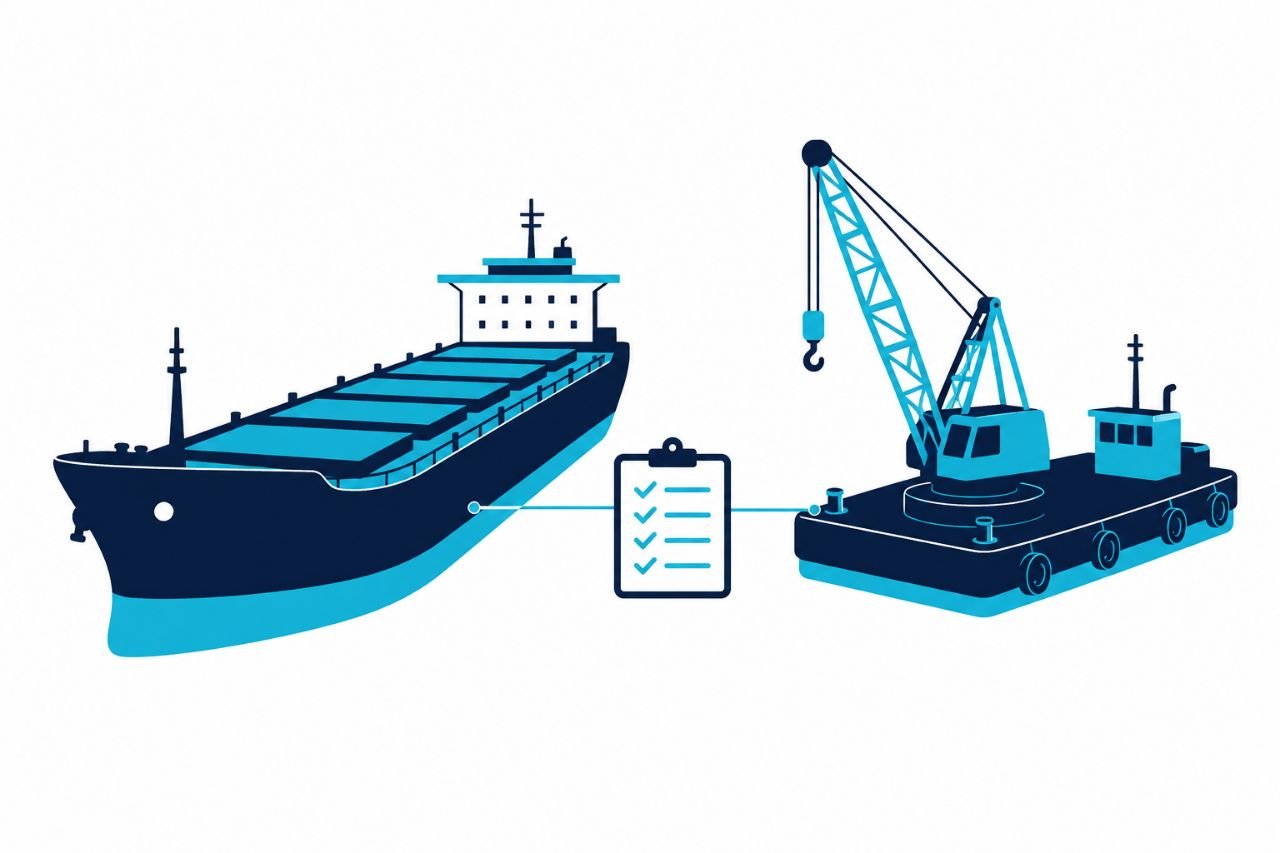
Most ship managers who run RISQ inspections know the questionnaire inside out — statutory items, recommended items, the guide-to-inspection notes against every question. What fewer managers have on their radar is a separate document entirely: the RightShip STS Unit Questionnaire, which doesn’t assess the vessel at all. It assesses the other party in the transfer — the barge, floating crane, transloader, or offshore support vessel the ship is about to moor alongside.
That distinction matters more than it sounds like it should, because the unit doesn’t answer to the same people. RISQ is something a ship manager controls directly. The rightship STS Unit Questionnaire assesses equipment the manager very often has no contractual relationship with at all.
Who’s Actually Responsible for Getting It Completed
The questionnaire’s own requirements section is direct about this: it should be submitted through established commercial channels, typically via the charterer or cargo owner, requesting completion for each unit involved. The reasoning given is that there’s frequently no direct contractual relationship between the vessel’s manager and the STS Unit Manager, so communications route through whoever holds the commercial agreement with the unit instead.
In practice, that means the manager is dependent on a third party to chase a document assessing a piece of equipment the manager’s own crew will be mooring against, taking cargo from, and relying on for a safe alongside operation. If that chain breaks down, the vessel is the one exposed, not the charterer.
The Twelve-Month Window Cuts Both Ways
Once completed, the questionnaire is valid for twelve months, and a unit used repeatedly within that window doesn’t need reassessment for every operation. That’s sensible for units in continuous transshipment service — but it also means a unit assessed as satisfactory in month one could have deteriorated significantly by month eleven without triggering a fresh questionnaire. Sections E (Structure, Equipment, and Machinery) and F (Mooring) are exactly the areas where that gap matters: fendering condition, mooring winch maintenance records, and hull or superstructure defects don’t stay static for a year, particularly on units that see continuous cargo-side wear.
Q17.11 Doesn’t Ask If the Form Exists — It Asks What You Did With It
This is the part most easily misunderstood. RISQ 3.2’s own question on the subject, 17.11, isn’t a filing checkbox confirming the questionnaire was received. It asks whether the Rightship STS Unit Questionnaire was completed, and whether there’s available objective evidence that any gaps it identified were assessed and addressed through appropriate risk mitigation measures, specifically to protect the ocean-going vessel during operations with that unit.
That’s a materially higher bar than simply having the paperwork. A completed questionnaire with a “No” against the fendering condition or mooring equipment questions, and nothing further done about it, doesn’t satisfy 17.11 — it’s evidence of precisely the gap the question exists to catch. The document itself is the easy part. What an inspector is actually testing for is whether any negative answer in Sections B through F triggered a documented risk mitigation response before the operation went ahead, not after an inspector asked about it.
Sections C and D Ask Questions the Ship Can’t Always Verify Independently
Section C — Management of Crew and Contractors — asks whether the unit’s crew are experienced in STS operations and whether a common working language is established, with the safety system documentation accessible in that language. Section D asks whether the unit can monitor weather, sea state, and wind limitations independently during the operation. Both are reasonable questions. Both are also things a ship’s own bridge team has limited means of verifying directly — they’re relying on the questionnaire’s answers being accurate, since there’s no equivalent of a pre-arrival document review the way there is for another merchant vessel.
What Happens When It Isn’t There in Time
The document allows for this directly. Where the questionnaire genuinely can’t be completed in time despite the vessel manager’s due diligence, the manager is expected to conduct and document a risk assessment addressing its absence, and notify relevant stakeholders as required. That’s a legitimate fallback — but it only holds up if the risk assessment is actually written and dated before the operation, not reconstructed afterward to explain a gap an inspector has already flagged.
The Practical Takeaway
The Rightship STS Unit Questionnaire exists because dry bulk transshipment brings two very different categories of asset alongside each other — a classed, inspected, RISQ-compliant vessel, and a unit that may have none of that regulatory history behind it. But the questionnaire alone doesn’t close that gap. RISQ 17.11 is testing whether the answers on that form actually changed anything before the operation went ahead. A completed questionnaire filed away with unresolved “No” answers is not a lesser version of compliance — under 17.11, it isn’t compliance at all.
More from the Vetting Series
→ Explore our Remote Assurance Service — See the Remote Assurance Audit