
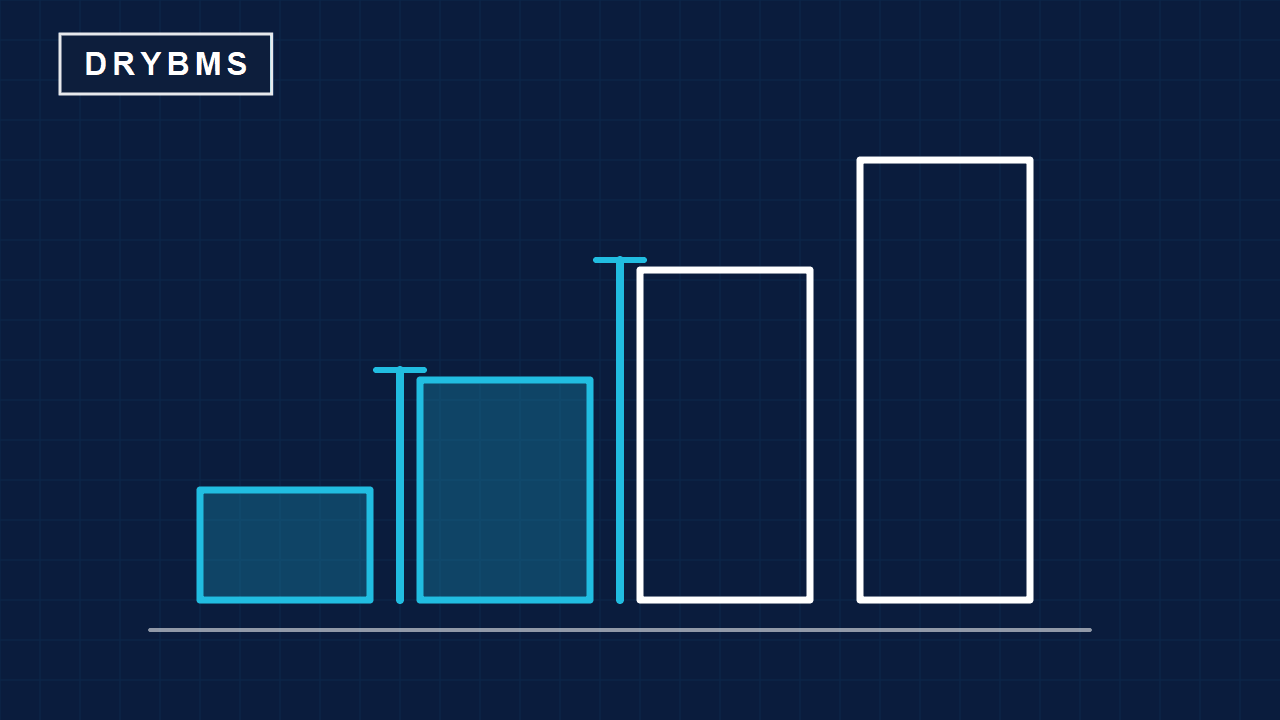
DryBMS scoring looks simple. Each of the four levels in a subject area, Basic, Intermediate, Advanced and Excellence, is scored from 0 to 100 per cent, and the four are added and divided by 100 to give a score out of four. What the Dry Bulk Centre of Excellence (DBCE) guidance adds is two rules that change the arithmetic, and they matter more than any single judgement at the higher levels. This article sets out the rules from DBCE’s own documents, works through DBCE’s example, and then looks at what the rules mean for how a company declares its levels.
DryBMS Scoring: The Scale for Each Level
DBCE’s guidance asks the company to score each level in a subject area against five criteria:
| Judgement | Score |
|---|---|
| This level is not met | 0% |
| This level has substantial opportunities for improvement | 25% |
| This level is partially met | 50% |
| This level is substantially met | 75% |
| This level is fully met | 100% |
The four percentages are totalled and divided by 100, so a company that fully meets every level in a subject area scores 4.00. That is the straightforward case, DBCE’s Column A in its scoring example. Each level also builds on the one below it. Intermediate requires the company to meet all the expectations of Basic, Advanced all those of Intermediate, and Excellence all those of Advanced.
DryBMS Scoring: The Two Gates
The DBCE guidance, version 1.1, then sets two rules for scoring above Basic and Intermediate. They apply within the dashboard DBCE uses, which is why the plain total above is not the whole story:
- First gate. Unless the score for the Basic level is 100%, the scores for Intermediate, Advanced and Excellence are counted at 5% of the self-assessed score.
- Second gate. Unless the scores for both Basic and Intermediate are 100%, the scores for Advanced and Excellence are counted at 5% of the self-assessed score.
The wording of the first gate is often quoted on its own, and the second is easy to miss. Read together they mean the levels are not independent: Intermediate only counts in full when Basic is fully met, and Advanced and Excellence only count in full when both Basic and Intermediate are fully met. A level that is only “substantially met”, which is 75%, closes the gate above it.
DBCE’s Worked Example
DBCE’s scoring methodology summary (revision 0.0, February 2024) shows nine columns. Four are worth looking at:
| Column | Basic | Intermediate | Advanced | Excellence | Score |
|---|---|---|---|---|---|
| A | 100% | 100% | 100% | 100% | 4.00 |
| C | 100% | 100% | 75% | 75% | 3.50 |
| G | 100% | 75% | 75% | 75% | 1.83 |
| I | 75% | 75% | 75% | 75% | 0.86 |
Column C has Advanced and Excellence only substantially met, but Basic and Intermediate are fully met, so both count in full and the total is 350%. In Column G, Basic is 100% but Intermediate is 75%, so the first gate is open and the second is shut. DBCE’s formula is 100 + 75 + (75 × 0.05) + (75 × 0.05) = 183%, or 1.83 out of four. In Column I, Basic is 75%, so all three levels above it fall to 5%: 75 + (75 × 0.05) + (75 × 0.05) + (75 × 0.05) = 86%, or 0.86.
The same Intermediate, Advanced and Excellence answers that score 3.50 in Column C score 1.83 in Column G once Intermediate drops from 100% to 75%. One notch of judgement at Intermediate costs 1.67 points out of four.
The Same Judgement at Different Levels
The arithmetic below is mine, using DBCE’s rules, to show how asymmetric they are. Each row is a company that rates itself fully met everywhere except one level:
| Rated 75% at | Other levels | Score |
|---|---|---|
| Excellence | 100% | 3.75 |
| Advanced | 100% | 3.75 |
| Intermediate | 100% | 1.85 (100 + 75 + 5 + 5 = 185%) |
| Basic | 100% | 0.90 (75 + 5 + 5 + 5 = 90%) |
A company that is a quarter short at Excellence loses a quarter of a point. A company that is a quarter short at Basic loses more than three points. The scale was designed to reward a sound foundation, and in the Basic and Intermediate columns the difference between “fully met” and “substantially met” is the largest single decision in the self-assessment.
What Priority Areas Do and Do Not Change in DryBMS Scoring
DBCE identifies seventeen priority subject areas as having a potentially higher impact for injury to people, damage to the environment and effective performance. The guidance says that these priority subject areas make no difference to the overall score of a company, and that a company may wish to focus improvement there ahead of other areas. A weak result in a priority area is not weighted more heavily in the score. It is where DBCE suggests the effort should go first. The full list, with each area’s one-line description, is in TMSA Compliance: A Practical Guide to All 13 Elements, and Where DryBMS Fits.
What DryBMS Scoring Means When a Company Declares Its Levels
I would draw three practical points from the rules:
- Be strict at Basic and Intermediate. The company can afford generosity at Excellence. It cannot afford it at Basic, where an honest 75% is a number the company can defend, and a 100% that cannot be backed with evidence is one it will have to. The same discipline is behind TMSA Self Assessment: Declare What You Can Sustain, Not What You Aspire To.
- Spend the effort where the gates are. If Basic is at 100% and Intermediate is stuck at 75%, the improvement that moves the score most is closing the last gap at Intermediate, not building the Advanced tools. The extra work at Advanced and Excellence is counted at 5% until it does.
- Read a subject area’s Basic expectations first. They describe mandatory compliance with IMO and flag State requirements, so they overlap with what a port state control officer checks. The DryBMS standards on this site, such as DryBMS Cargo and Ballast and DryBMS Risk Assessment, set out what each level asks for.
DBCE guidance also says that completing and submitting the self-assessment is voluntary for ship managers, and suggests it is included in the company’s management review and updated annually, and at other times such as after a major change to the organisation or the SMS.
Sources
- DBCE, DryBMS Scoring Methodology Summary, revision 0.0, February 2024 (nine-column example and formulas for Columns G and I)
- DBCE, The Dry Bulk Management Standard: Guidance, version 1.1 (scoring methodology, the two scoring rules, priority subject areas, submitting reports, description of the four levels)
- Dry Bulk Centre of Excellence
The scores in the second table are arithmetic using DBCE’s rules, not figures published by DBCE. DryBMS is a DBCE standard, and this site is not affiliated with or endorsed by DBCE, INTERCARGO or RightShip.
More from the HSEQ Series
→ Explore our HSEQ Outsourcing Service — Get HSEQ Outsourcing Support
- TMSA Maritime Security: What Element 13 Stage 4 Actually Requires
- TMSA Environmental Management: What Element 10 Stage 4 Actually Requires
- TMSA Seafarer Welfare, Manning and Rest Hours: What Element 3A Stage 4 Actually Requires
- TMSA Vessel Personnel: What Element 3 Stage 4 Actually Requires
- TMSA Shore-Based Personnel: What Element 2 Stage 4 Actually Requires
- TMSA Leadership and Accountability: What Elements 1 and 1A Actually Require
- Alarm Management on Ships: What the Watchkeepers Told Lloyd’s Register
- How to Plan a TMSA Audit: Four Phases From Gap Analysis to Submission
- TMSA Emergency Preparedness: What Element 11 Stage 4 Actually Requires
- TMSA Management of Change: What Element 7 Stage 4 Actually Requires
- The TMSA Incident Investigation Audit: What Element 8 Stage 4 Actually Requires
- The DryBMS Cyber Security Standard: What Excellence Actually Requires
- TMSA Compliance: A Practical Guide to All 13 Elements, and Where DryBMS Fits
- The DryBMS Audit Planning and Close Out Standard: What Excellence Actually Requires
- The DryBMS Engine Room and Bunkering Standard: What Excellence Actually Requires
- The DryBMS Risk Assessment Standard: What Excellence Actually Requires
- The DryBMS Mooring and Anchoring Standard: What Excellence Actually Requires
- The DryBMS Cargo and Ballast Standard: What Excellence Actually Requires
- TMSA Self Assessment: Declare What You Can Sustain, Not What You Aspire To
- The Audit Is Closed. The Problem Isn’t.