
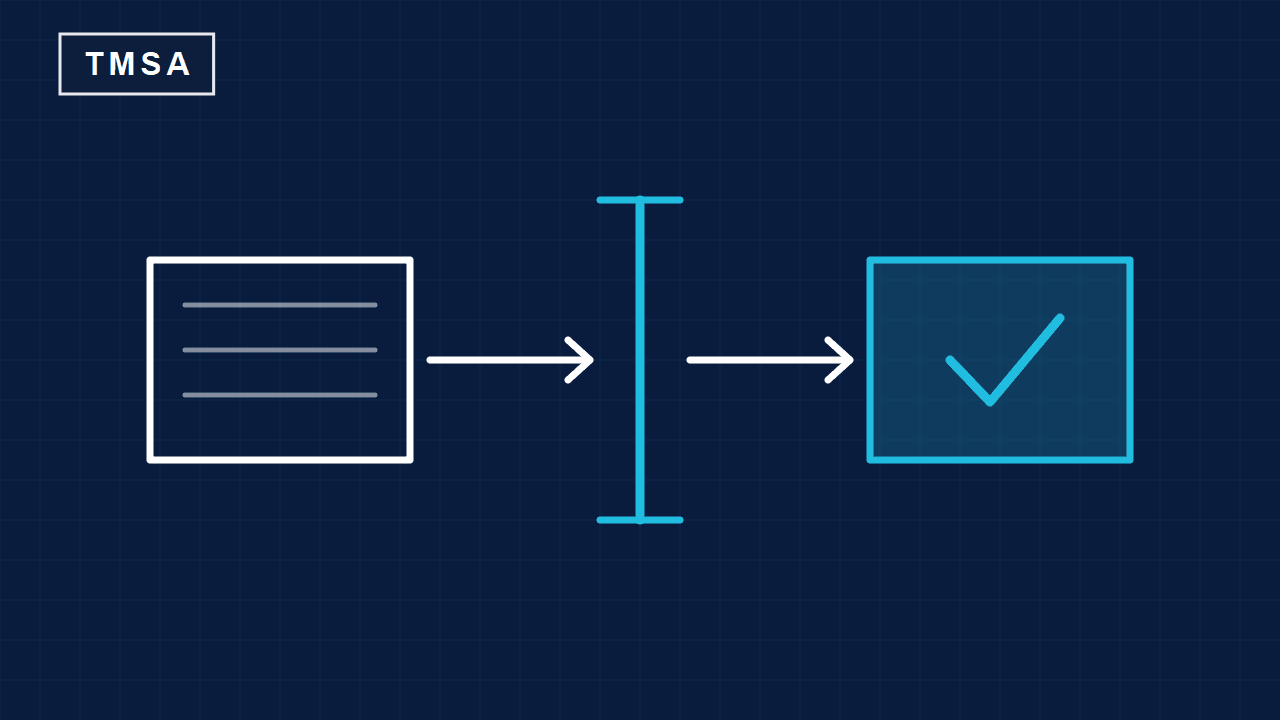
Most companies have a procedure for TMSA management of change. The question Element 7 asks is whether anything was ever stopped, delayed or re-approved because of it. A procedure that every change passes through without friction is usually a form that gets filled in after the decision has been made.
Element 7 has fourteen key performance indicators: four at Stage 1, five at Stage 2, three at Stage 3 and two at Stage 4. This article goes through them in order and then looks at where the evidence tends to be thin. The wording is from OCIMF’s TMSA 3; the commentary is mine.
TMSA Management of Change at Stage 1: The Procedure, the Assessment and the Authority
Stage 1 requires a documented procedure for management of change (7.1.1) that covers permanent and temporary changes, on board and ashore. The guidance lists what these may include: new or modified equipment, temporary isolation and reactivation of alarms for maintenance, changes or upgrades to software, new legislation, changes in trading area, organisational changes, revisions to procedures and taking new tonnage under management.
- The impact of any proposed change is assessed (7.1.2), against justification, potential consequences for safety, personnel and the environment, risk reduction measures and any additional resources required.
- Levels of authority are defined (7.1.3). The guidance is specific that a change is approved at an appropriate level and not by the person directly involved in the change.
- Emerging requirements are identified (7.1.4), whether legislative or industry-recommended best practice, permanent or temporary, across safety, environmental and energy management, security, health and operations, and the company has identified the sources that will tell it.
In TMSA management of change, the line about the person directly involved is the one most often read past. It is the control that stops a superintendent approving their own modification. If the approval record shows the same name as the requester, Stage 1 has not been met in substance.
TMSA Management of Change at Stage 2: Risk, People, Records and Review
- All proposed temporary and permanent changes to onboard procedures and equipment are subject to risk assessment (7.2.1), conducted as part of planning the change and addressing the full range of hazards and consequences.
- All personnel who may be affected are identified and understand the extent and likely impact of the change (7.2.2).
- Training needs arising from the change are identified and documented, and personnel are trained within a defined period (7.2.3).
- All documentation and records the change may affect are identified (7.2.4): certification, manuals, plans and drawings, operational procedures, records, checklists and forms, planned maintenance including spare parts inventories. The mechanism ties into the document control system.
- Regular reviews are made of change plans being implemented (7.2.5), and any change not carried out within the proposed time is reviewed, revalidated and approved. Temporary changes must not exceed their initial authorisation for scope or time without review and re-approval at the appropriate level.
The last of these is the one that exposes weak systems. A temporary change, such as a bypassed alarm, a defeated interlock or a temporary procedure, has an expiry in the procedure and none in practice. If the register shows temporary changes open for many months with no re-approval, the company has a list of permanent changes that nobody approved as permanent. A Wrong Answer Doesn’t Fix Itself. Document Control Decides Who Fixes It. looks at the document control side of the same loop.
TMSA Management of Change at Stage 3: Acquisitions, Outcome Reviews and Software
- A management of change procedure is applied when the company acquires additional vessels (7.3.1), whether new builds or existing tonnage. The guidance lists supervision of new builds, pre-purchase inspection and survey including priority maintenance, involvement of appropriate people in the decision, manning requirements on board and ashore, familiarisation and training (including a period sailing or on standby for key personnel before delivery), transfer of operational history such as planned maintenance history, modifications and plans, and, where applicable, a period of downtime between delivery and entering service.
- There is a periodic review of the outcome of all changes to ensure objectives were met (7.3.2). The review period is defined and documented, a procedure ensures appropriate action where objectives were not met, and the findings may feed the periodic management review.
- A software management procedure covers all shipboard and shore systems (7.3.3). The guidance lists assigned responsibilities including cyber security, records of all software installed with version numbers, a method to ensure the right version is installed, compatibility checks, instructions for updates and back-up, performance tests after upgrades and training requirements.
Stage 3 is where TMSA management of change stops being about equipment and starts being about everything the company changes. Software is easy to leave out because it does not look like a change. A fleet that can say which version of the ECDIS software runs on every ship, and who authorised the last update, has met 7.3.3. A fleet that learns from the ship that an update was installed has not. The bridge side of this is covered in Bridge Software Maintenance Guidelines 2026.
TMSA Management of Change at Stage 4: Changes to the Shore Organisation and to Design
Stage 4 has two indicators, and neither is about a ship:
- Major changes to the shore organisation are managed so that manning, competency and experience levels are maintained and supervision and management of key processes do not deteriorate (7.4.1). Examples are a significant increase or decrease in fleet size, a new vessel type, a merger or acquisition and restructuring.
- The company actively seeks improvements for new build design specifications (7.4.2), with design improvements considered for future new builds and existing vessels upgraded proactively. The guidance lists ergonomics including bridge and control rooms, environmental performance, energy efficiency, operational safety, new technology, mooring equipment design and layout, security features and accommodation, drawing on vessel feedback, equipment manufacturers, industry practice and pilot programmes.
The first is a test of the head office, not the fleet. When a company doubles its fleet or merges with another, supervision per ship is the obvious figure to check. Element 7 expects that to be assessed as a change in its own right, before it happens.
Where Other Standards Look at This
TMSA is an office standard, but ship-side inspections test its output. SIRE 2.0 question 2.5.1 asks whether the company management of change procedure had been effectively implemented for changes affecting structure, machinery and equipment governed by class rules or statutory survey. On the dry bulk side, DryBMS Subject Area 26, Management of change including vessel acquisition, is one of DBCE’s seventeen priority areas. The same register of changes answers both.
What a TMSA Management of Change Review Looks At
- the change register, read for who requested and who approved, and for temporary changes past their authorised period;
- a sample of changes with their risk assessments, showing the assessment was part of planning and not written afterwards;
- the link from an approved change to the training record, the document revision and the planned maintenance update;
- the software inventory with versions, and the authorisation of the last updates;
- the outcome reviews, and what was done where an objective was not met;
- the last acquisition or major reorganisation, and the evidence that manning and competency were assessed beforehand;
- the management review record, showing whether the change register drove an action.
The gap between Stage 2 and Stage 4 in Element 7 is rarely the procedure. It is whether the register shows changes being refused, delayed or re-approved, and whether the effect of each one was checked afterwards.
Headcount reviews after a major change are covered under Element 2, in TMSA Shore-Based Personnel: What Element 2 Stage 4 Actually Requires, and environmental improvements for newbuilds under Element 10, in TMSA Environmental Management: What Element 10 Stage 4 Actually Requires.
Sources
- OCIMF, Tanker Management and Self Assessment (TMSA 3), Element 7, Management of Change, KPIs 7.1.1 to 7.4.2
- OCIMF, SIRE 2.0 Question Library, question 2.5.1
- DBCE, DryBMS Subject Area 26 (Management of change including vessel acquisition) and DBCE guidance v1.1 (priority subject areas)
General information only. This article is not an OCIMF publication and is not endorsed by OCIMF.
Updated 18 November 2026 to correct the RightShip RISQ question references, which now follow the numbering and wording of the RISQ 3.2 questionnaire (November 2025).
More from the HSEQ Series
→ Explore our HSEQ Outsourcing Service — Get HSEQ Outsourcing Support
- DryBMS Scoring: The Two Gates That Decide a Self-Assessment
- TMSA Maritime Security: What Element 13 Stage 4 Actually Requires
- TMSA Environmental Management: What Element 10 Stage 4 Actually Requires
- TMSA Seafarer Welfare, Manning and Rest Hours: What Element 3A Stage 4 Actually Requires
- TMSA Vessel Personnel: What Element 3 Stage 4 Actually Requires
- TMSA Shore-Based Personnel: What Element 2 Stage 4 Actually Requires
- TMSA Leadership and Accountability: What Elements 1 and 1A Actually Require
- Alarm Management on Ships: What the Watchkeepers Told Lloyd’s Register
- How to Plan a TMSA Audit: Four Phases From Gap Analysis to Submission
- TMSA Emergency Preparedness: What Element 11 Stage 4 Actually Requires
- The TMSA Incident Investigation Audit: What Element 8 Stage 4 Actually Requires
- The DryBMS Cyber Security Standard: What Excellence Actually Requires
- TMSA Compliance: A Practical Guide to All 13 Elements, and Where DryBMS Fits
- The DryBMS Audit Planning and Close Out Standard: What Excellence Actually Requires
- The DryBMS Engine Room and Bunkering Standard: What Excellence Actually Requires
- The DryBMS Risk Assessment Standard: What Excellence Actually Requires
- The DryBMS Mooring and Anchoring Standard: What Excellence Actually Requires
- The DryBMS Cargo and Ballast Standard: What Excellence Actually Requires
- TMSA Self Assessment: Declare What You Can Sustain, Not What You Aspire To
- The Audit Is Closed. The Problem Isn’t.