
The new SOLAS pilot transfer arrangements 2028 requirements — adopted by the IMO Maritime Safety Committee at its 110th session as Resolution MSC.576(110) — replace the pilot ladder standard most fleets have worked under since 2012. The change is not cosmetic. Strong point breaking strength doubles. Pilot ladders and manropes get a mandatory service life for the first time. And two entirely new categories of obligation — mandatory maintenance planning and mandatory familiarization training — appear where none existed before.
For ship managers, the more relevant date isn’t 1 January 2028 — it’s the first annual, periodical, or renewal survey on or after 1 January 2029, the point at which every SOLAS ship, regardless of when its pilot transfer arrangements were installed, must be able to demonstrate compliance. That’s between two and three years away, depending on when each ship’s first survey falls, which is enough runway to fold the retrofit work — largely welding to securing points and, where needed, a winch reel replacement — into a normally scheduled drydock rather than treating it as anything urgent. The value in reading up now is knowing what to plan for, not racing a deadline.
Where the SOLAS Pilot Transfer Arrangements 2028 Requirements Come From
Despite SOLAS regulation V/23, the minimum standards in resolution A.1045(27), and the guidance in MSC.1/Circ.1428, accidents involving pilot transfer arrangements — including pilot fatalities — kept occurring. The IMO’s own stated reasoning is that pilot ladders were frequently poorly maintained, irregularly inspected, and used improperly, and that the existing framework didn’t do enough to prevent it.
MSC 110 responded with a package of five resolutions and two circulars, adopted together:
- MSC.572(110) — amends SOLAS chapters II-2 and V, including regulation V/23 itself
- MSC.576(110) — Performance Standards for Pilot Transfer Arrangements, the core new instrument
- MSC.573(110) and MSC.574(110) — consequential amendments to the 1994 and 2000 HSC Codes
- MSC.577(110) — consequential amendments to the 2008 SPS Code
- MSC.1/Circ.1428/Rev.1 — the revised IMO/IMPA pilot transfer arrangements poster
- MSC.1/Circ.1690 — permits flag Administrations to allow voluntary early implementation
Resolutions A.1045(27) and A.1108(29), along with the original MSC.1/Circ.1428, are revoked outright — but not until 1 April 2030, giving a deliberate overlap period.
The Compliance Timeline
| Date | What applies |
|---|---|
| 1 January 2028 | Regulation enters into force. Any pilot transfer arrangement installed on or after this date must meet the Introduction and Parts A, B and C of the performance standards. |
| 1 January 2028 | Parts D and E — inspection, stowage, maintenance, replacement, familiarization — apply to every pilot transfer arrangement regardless of installation date. |
| First survey on or after 1 January 2029 | SOLAS ships with arrangements installed before 1 January 2028 must meet Parts A, B and C. |
| 1 January 2030 | Non-SOLAS ships (per the standard SOLAS exemption list) must meet the same requirements. |
| 1 April 2030 | A.1045(27), A.1108(29) and the original MSC.1/Circ.1428 are revoked. |
“Installed on or after 1 January 2028” is defined by contractual delivery date for the arrangement — or, absent one, actual delivery date to the ship. That definition matters for newbuildings contracted now but delivered in 2026 or 2027: without early action, they risk needing modification or replacement within a year or two of delivery, which is exactly the scenario Korean Register’s early-implementation guidance (KR Technical Information 2026-IMO-06 Corr.1) was written to help shipyards and owners avoid, under the voluntary early-adoption route in MSC.1/Circ.1690.
What Actually Changes on the Ladder Itself
The performance standards fold in most of ISO 799-1:2019, but not entirely — and the gaps are where compliance gets missed:
- Side rope diameter: 20–22 mm, up from 18 mm under the old resolution.
- Thimble position: the midpoint of a double-length side rope must sit on a thimble. Ladders built to the ISO 799-1 configuration — thimble at the end, finished by splicing and seizing — will no longer be accepted from 1 January 2028.
- Permanent marking: manufacturer’s name, serial or unique ID, full date of manufacture, and approving authority, marked permanently on the underside of the top step and the lowest spreader step. The previous standard required only the year; tag markings, previously accepted, no longer satisfy the requirement — everything must now be marked directly onto the ladder to prevent counterfeiting.
- Single-length rule extended to combination arrangements: pilot ladders must reach the water in all seagoing conditions of draught and trim, including a 15° adverse list in the lightest seagoing condition. Under the previous IACS interpretation (UI SC 257) and MSC.1/Circ.1495/Rev.1, vessels with a combination arrangement were exempt from the 15° list calculation. From 1 January 2028 they are not — the additional length is calculated as ΔL = B/2 × tan 15°, where B is the ship’s beam.
- Securing method: cable ties, U-clamps, and worm-driven clips are now explicitly prohibited as a means of fixing steps to side ropes.
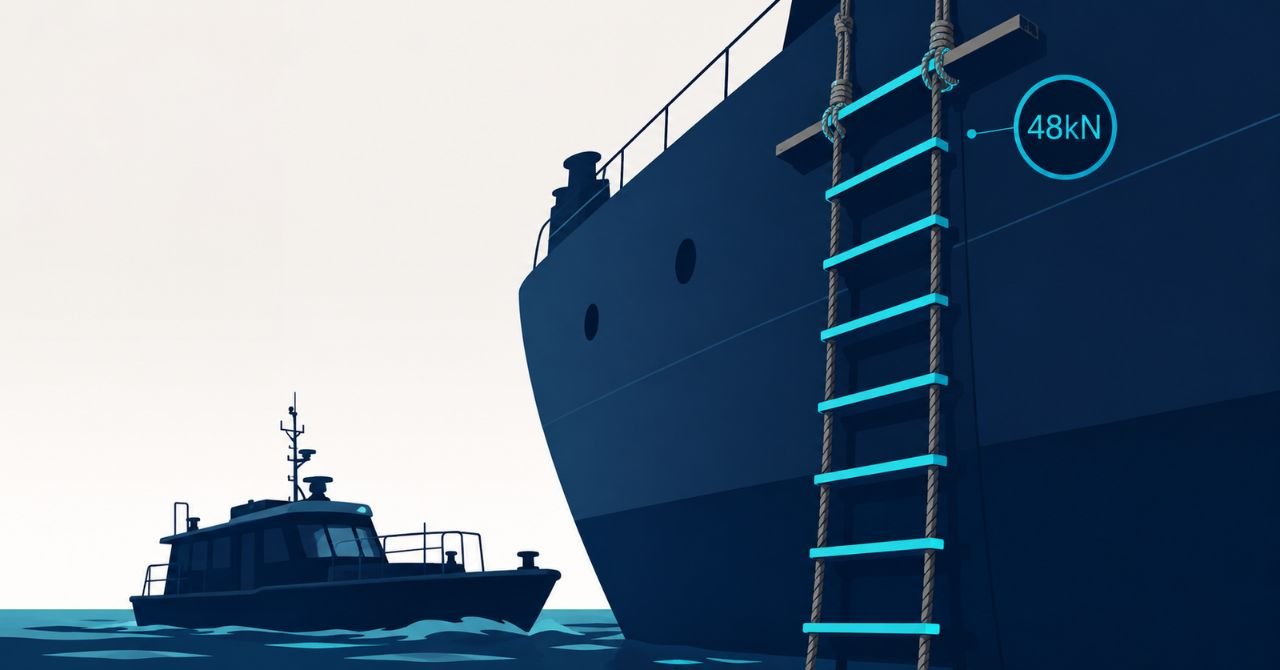
- Securing rope: minimum 3 m length, minimum breaking strength of 48 kN, permanently marked or tagged, and — because it’s now treated as a component of the pilot ladder itself — subject to type approval and replaced on the same interval as the ladder.
Securing Points: The 24 kN to 48 kN Change
The single largest structural change under the SOLAS pilot transfer arrangements 2028 requirements is to strong points.
Minimum breaking strength doubles from 24 kN to 48 kN, and — for the first time — that figure must be permanently marked on or near the securing point itself, with documentary evidence available on board.
Where existing strong points can’t be verified against the 48 kN threshold, replacement is the primary route Korean Register recommends. A proof load test in the presence of a class surveyor, followed immediately by non-destructive testing to confirm the point wasn’t damaged, is described as the fallback — not the preferred option, given the risk of damage to the fitting under test.
Securing arrangements — strong points, shackles, securing ropes — must sit at least 915 mm inboard from the deck edge, or the maximum distance the width of the deck allows if that is not possible (a combination arrangement using an accommodation ladder is excepted), with dedicated, separate strong points required for the pilot ladder and for the manropes. Winch reels get their own new requirement: a minimum drum diameter of 0.16 m and a sunken securing point for the pilot ladder, independent of the reel itself. KR’s guidance notes that a number of installed winch reels — particularly those from before 1 July 2012 — don’t meet either requirement, which makes a physical check of existing reels worth doing well ahead of any survey.
Combination Arrangements and Trapdoors
For vessels using accommodation ladders in combination with a pilot ladder, the standards address a specific failure mode directly: the accommodation ladder’s hoisting and lowering mechanism must not be capable of inadvertent operation during a transfer. That now requires at least two independent actions to activate — an emergency stop button alone, even one compliant with ISO 7364:2016, does not satisfy the requirement.
Ships fitted with a combination arrangement must display a two-tone visual marking — white over red, at least 4 m high and 0.5 m wide — positioned 9 m below the point of access, measured from the actual access point rather than the deck edge.
Where a trapdoor arrangement uses a separate structural frame, that frame, its connection points, the accommodation ladder winch, and the pad eyes must all be designed to withstand a vertical breaking load of at least 48 kN — the same figure that governs strong points elsewhere in the standard.
Two further physical checks belong on the same survey list. An accommodation ladder used for pilot transfer must not exceed a 45° slope. And where rubbing bands or other hull features stop a pilot boat approaching safely, they must be cut back to leave at least 6 m of unobstructed ship’s side, although the Administration may exempt specialised offshore and similar ships under 90 m where that is not practicable.
Requirements That Simply Didn’t Exist Before
Parts D and E of the SOLAS pilot transfer arrangements 2028 performance standards are new in kind, not just in detail — SOLAS regulation V/23 and resolution A.1045(27) had no equivalent provisions. All of the following apply from 1 January 2028 regardless of when the equipment was installed:
- A documented maintenance plan, covering inspection checklists, a periodic inspection and maintenance schedule, spare parts sourcing, inspection records, and the anticipated withdrawal-from-service date for each ladder.
- Mandatory spares: at least one spare compliant pilot ladder and one spare set of compliant manropes must be carried on board. Spares fall under the same replacement rule below.
- Mandatory replacement: pilot ladders and manropes, including spares, must be withdrawn from service within 36 months of manufacture or 30 months of being placed in service, whichever comes first — a fixed service life that simply didn’t exist under the old framework.
- Periodic inspection: before and after every use, and a full inspection at least every three months, covering the ladder, any combination-arrangement accommodation ladder, winch reels, securing arrangements, the point of access, and stowage.
- Mandatory familiarization training, under STCW regulation I/14, for any crew involved in inspecting, maintaining, installing, or operating pilot transfer arrangements — covering equipment operation, which characteristics make an arrangement unfit for use, inspection and maintenance procedures, replacement procedures, and operating considerations in adverse weather.
- Re-approval after modification. Any repair, alteration, or modification to combination arrangements, securing arrangements, side openings, deck access, pilot boat approach clearance, or winch reels requires (re)approval by the Administration — regardless of the equipment’s original installation date.
Two approval rules apply to new fittings rather than to everything already on board. Pilot ladders, manropes and the means of securing a ladder at intermediate lengths fitted from 1 January 2028 must be type-approved. That is approval of the product, held by the maker, not approval of the installation on the ship. What matters for the ship is that the equipment was type-approved when it was fitted. If a maker’s approval later lapses, ships already fitted with that equipment are not affected, and it only stops the maker selling new units. Drawing approval for the arrangement itself, which was common practice but not formally required before, becomes mandatory for arrangements installed on or after 1 January 2028.
Certificates follow the equipment. The SOLAS Records of Equipment (Forms P, C and E, with equivalents for HSC and special purpose ships) now carry entries for pilot ladders and manropes, for spare pilot ladders and manropes, and for the means of securing a ladder at intermediate length, and the records need to be updated and reissued after 1 January 2028.
The re-approval rule is the one most likely to catch fleets out during the retroactive-compliance window: welding work to securing points, or replacing a winch reel to meet the new drum-diameter requirement, isn’t just a maintenance job once these standards apply — it’s a class approval event.
What This Means for Planning
For most fleets, meeting the SOLAS pilot transfer arrangements 2028 retroactive deadline — first survey on or after 1 January 2029 — sits comfortably inside a normal drydock cycle – a similar pattern to how the SOLAS lifting appliances regulation 2026 brought lifting appliances under mandatory survey requirements for the first time
Welding new strong points, replacing a non-compliant winch reel, or fitting a trapdoor structural frame are routine yard jobs, not major works, and most vessels will have at least one scheduled drydock between now and the relevant survey where this fits naturally alongside everything else already planned for that period. The main reason to get ahead of it early is simply to make sure it’s on the drydock specification when the yard period is being scoped, rather than being noticed for the first time at the survey itself.
Newbuildings contracted for delivery in 2026 or 2027 sit in a different position: built to the old standard, they would need modification within a year or two of delivery. The early-implementation route under MSC.1/Circ.1690 — applying the new performance standards at the design and construction stage, verified through class before delivery — exists specifically to avoid that outcome.
Sources
The requirements above are taken from the IMO texts. Class and P&I club guidance was used to cross-check how they are being interpreted.
- IMO Resolution MSC.576(110), Performance Standards for Pilot Transfer Arrangements
- IMO Resolution MSC.572(110), amendments to SOLAS chapters II-2 and V
- Consequential amendments: MSC.573(110) and MSC.574(110) (HSC Codes), MSC.577(110) (SPS Code)
- MSC.1/Circ.1428/Rev.1 and MSC.1/Circ.1690
- Korean Register, Technical Information 2025-IMO-17/Rev.1 (amendments to pilot transfer arrangements) and 2026-IMO-06/Corr.1 (early implementation)
- NorthStandard, “Act Now: Changes to Pilot Transfer Standards”, 22 September 2026
Updated 9 October 2026 to add the mandatory spares requirement, the Record of Equipment changes, the 45° slope and 6 m clearance checks, and to clarify how type approval and re-approval apply.
More from the Amendment Log
- MSC-MEPC.5/Circ.17: What the New Remote Survey and Audit Guidance Actually Allows
- MSC.1/Circ.1704: What the New Bridge Software Maintenance Guidelines Cover, and What They Don’t
- ECDIS Performance Standards 2026: What MSC.530(106)/Rev.1 Actually Changes
- The PFOS Ban Is in Force. The Survey Clock Is Already Running.
- Your STS operations manual references a guide that no longer exists in its old form
- The Ballast Water Management Plan Has Three New Requirements. Is Yours Current?
- The Lifting Appliances Manual: What the Regulation Requires, and What Actually Gets It Through Survey
- SOLAS II-1/3-13: What Ship Managers Need to Know About the New Lifting Appliance Requirements