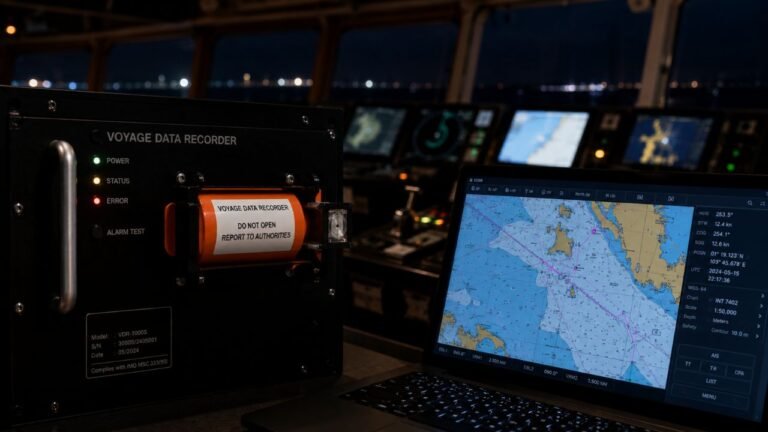


Most ship managers treat a VDR audit log the way many do at first: a useful internal record of what the bridge team actually did, separate from what the SMS says they should have done. Good practice, not something a regulator or a vetting standard is actually asking for by name.
That assumption doesn’t survive contact with SIRE 2.0 Question 3.2.4, or with DryBMS.
What SIRE 2.0 Question 3.2.4 Actually Asks
Chapter 3 of the SIRE 2.0 question library, Crew Management, contains a question that only fires once an operator has already declared — through the Pre-Inspection Questionnaire — that a remote navigational assessment was carried out on a vessel within the previous twelve months. When it fires, the question is direct: was a report available onboard confirming that assessment, one that included review of VDR and ECDIS data by an independent contractor or specialist company representative, had actually been completed as declared.
SIRE 2.0 Question 3.2.4 is conditional. Once it fires, the inspector is not asking whether a VDR audit happened in general terms. He is checking the report against a specific list.
It has to cover a real voyage, not the easy part of one. The guidance is explicit that the assessment should not cover “solely a period at anchor or open sea navigation where no navigational challenges are present.” A VDR audit that reviews a quiet mid-ocean watch and calls it done does not satisfy SIRE 2.0 Question 3.2.4.
It has to be unannounced, and it has to include both VDR and ECDIS data. Not one or the other. The combination is what lets an assessor cross-check the plotted track against the actual navigational decisions being made on the bridge at the time.
The assessor’s credentials go in the report. SIRE 2.0 requires brief details of the assessor’s qualifications and experience, and sets the bar explicitly: the assessor must hold a Senior Deck Officer licence, or have sailed as one, with proven seafaring experience. An audit report with no stated assessor background does not meet SIRE 2.0 Question 3.2.4, regardless of how good the findings are.
The format has to match a named external standard. This is the detail most operators miss. SIRE 2.0 states the report must be substantially in alignment with the format and content suggested by the OCIMF publication A Guide to Best Practice for Navigational Assessments and Audits. SIRE is not describing a generic write-up. It is pointing at a specific document and asking the report to look like what that document describes.
Every SIRE 2.0 question carries a note showing which TMSA KPI it exists to verify, and SIRE 2.0 Question 3.2.4 is no exception: it’s tied to TMSA KPI 5.4.1, which requires that “comprehensive navigational audits are conducted while on passage by a suitably qualified and experienced person.” It is not a freestanding requirement — it’s the vetting inspection checking whether a company is actually doing what its own TMSA submission for element 5 says it does.
This Isn’t SIRE Inventing a New Requirement
The reason SIRE 2.0 can point at the OCIMF guide so specifically is that VDR-based assessment is already built into that guide’s own structure, not bolted on as an afterthought.
The OCIMF guide sets out where navigational assessment requirements come from, in three tiers: government level (IMO regulation, statutory requirements, Port State Control), industry level (the ICS Bridge Procedures Guide, TMSA, SIRE and OVID), and company or vessel level. VDR-based review sits explicitly in that third tier, listed alongside the Master’s own navigational assessment, company reviews of bridge teams, and third-party contractor assessments — one of five recognised ways a company demonstrates it is meeting the guidance and regulation sitting above it.
The same guide’s section on remote navigational assessments using Voyage Data Recorders sets out the method almost exactly as SIRE 2.0 later inspects for it: download and extract VDR data, calibrate it against supplementary vessel information, then assess communications, pilot interaction, position-fixing technique, and UKC, routing and collision-avoidance practice over a defined passage. Its section on the proactive use of VDRs goes further, describing the technology moving from a purely reactive, post-incident tool to a proactive one — the same shift that makes an unannounced VDR audit meaningful rather than just a records exercise.
None of this is a coincidence between one consultant’s methodology and one vetting standard. It is SIRE 2.0 citing the same OCIMF guide that defines the methodology in the first place.
DryBMS Reaches the Same Conclusion, From a Different Direction
SIRE 2.0 isn’t alone in this. DryBMS Subject Area 21 sets the same bar at its Excellence tier — third-party navigation assessment supplemented by routine, office-based VDR review, not a periodic snapshot. A vetting inspection protocol and a management-maturity standard published by the Dry Bulk Centre of Excellence, built by different organisations for different fleets, converge on the same requirement.
The Log Doesn’t End at the Findings
The part of this that gets missed most often, on both standards, is what happens after the report is written.
SIRE 2.0 requires that where an assessment identified areas for improvement, there is evidence a corrective action plan existed with due dates — and separately, that supporting evidence is available demonstrating those areas were closed out within them. DryBMS says the same thing at its Excellence tier in almost the same words: action plans from the assessment are followed up and closed out, evidenced by the audit and assessment reports together with the action plans themselves.
The report, the assessor’s credentials, the corrective action plan, and the closeout evidence together are the log a regulator or vetting standard is actually asking to see. Any one piece missing, and the question is not satisfied — no matter how thorough the underlying VDR review was.
Where the First Audit in a Programme Fits
The First VDR Audit Your Fleet Runs Should Be Announced. Here’s Why. makes the case that a fleet’s very first VDR audit should be announced, to prove the data extraction process actually works before anything else is asked of it. That is not in tension with SIRE 2.0’s unannounced requirement — it is what happens before the programme SIRE is inspecting for exists at all. The announced run tests whether the ship can produce the data. The unannounced audits that follow are what the standard is actually asking about.
A VDR audit that never becomes a report with a qualified assessor’s name on it, reviewed against a real navigational challenge, tied to a corrective action plan with dates, is not invisible to SIRE 2.0 or DryBMS — it simply doesn’t exist as far as either is concerned. The VDR review itself can be excellent and still fail the question, if what ends up on file doesn’t look like what these standards describe.
More from the VDR Series
→ Explore our VDR Navigational Audit Service — Book a VDR Navigational Audit
- The VDR Audit Guide: What the Bridge Data Shows, and Where to Start
- Bridge Procedures Is a DryBMS Priority Area. It Still Doesn’t Move Your Score.
- The VDR Playback Software Is There. The Procedure That Covers It May Not Be.
- ECDIS in Tidal Ports: The Alarm That Stops Working When You Need It Most
- The Lookout During Port Approach Is on the Manning Matrix. The VDR Shows Whether Anyone Was Standing It.
- When Risk Becomes Routine, the Bridge Goes Quiet
- The First VDR Audit Your Fleet Runs Should Be Announced. Here’s Why.
- The Anchor Is Down. The VDR Doesn’t Know That.
- The VDR Track Shows More Than Where the Pilot Boarded
- The Radar Is Running. The VDR Shows Whether It’s Doing Its Job.
- When VDR Data Works For You, Not Against You
- Tug Bollard Pull, Ship Fittings, and the Conversation That Doesn’t Happen
- The Master Pilot Exchange: What the VDR Hears, and What Most Ships Leave Unsaid
- The Port Approach Is Already on Film. Most Managers Don’t Know It.
- The Radar Log Says Done. The VDR Says Otherwise.
- Passage Planning Mistakes Ships Make — And What the VDR Reveals
- Ghost Fix: What the Bridge Team Does When the Auditor Has Gone Home
- VDR Navigational Audits: What They Are, Why They Matter, and When to Do One
- How a VDR Navigational Audit Works — A Step-by-Step Guide for Ship Managers