
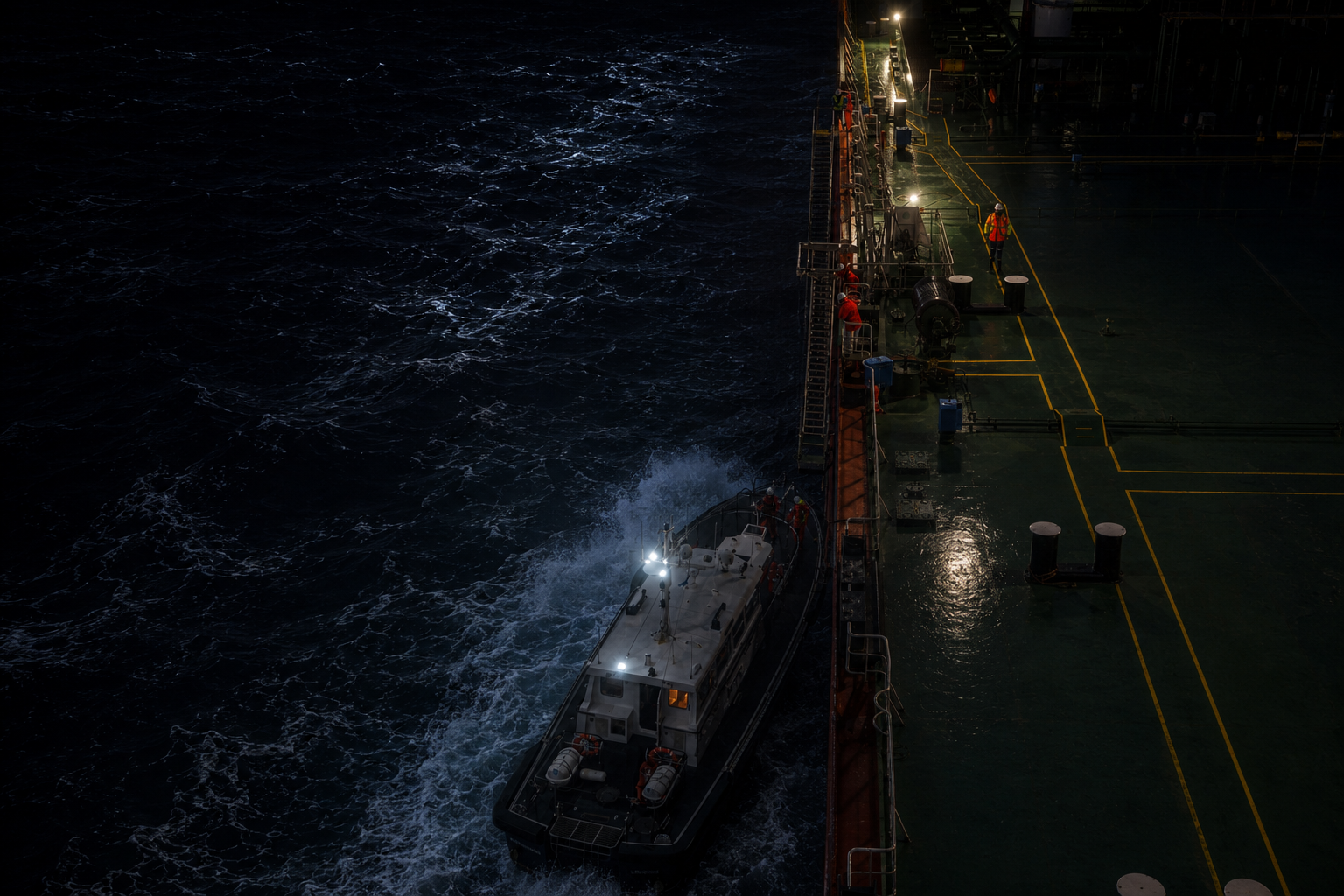
There is a moment in every port arrival where the procedural framework meets operational reality, and the two do not always agree.
The pilot is inbound. The Master is managing the approach. The question of who receives the pilot — who supervises the transfer, receives him at the embarkation point, and escorts him to the bridge — is one that most SMS documents address in a single line. That single line rarely does the work it needs to.
I have reviewed this sequence across many audits. The gap between what the procedure says and what actually happens is not random. It follows patterns that are worth understanding.
What SOLAS Actually Requires
SOLAS Chapter V, Regulation 23.2.2 states:
“The rigging of the pilot transfer arrangements and the embarkation of a pilot shall be supervised by a responsible officer having means of communication with the navigation bridge who shall also arrange for the escort of the pilot by a safe route to and from the navigation bridge.”
The word officer carries its STCW meaning. Under the STCW Convention, officer and rating are mutually exclusive categories. A rating cannot satisfy a requirement that specifies an officer. SOLAS does not use that word loosely. The IRClass Technical Circular on pilot transfer arrangements provides a useful reference on the full scope of SOLAS V/23 compliance requirements.
The IMPA Pilot Transfer Operations guidance (2024) goes further. It identifies the Master as the person who must designate the Responsible Officer, and sets out that officer’s duties: establishing direct communications with the bridge, overseeing compliant rigging of the ladder, testing safety equipment in place, and arranging safe escort of the pilot to and from the bridge.
The Guide to Best Practice for Navigational Assessments and Audits is explicit on the bridge side of this: both the OOW and the lookout shall remain on the bridge. The integrity of the bridge team must not be compromised during pilot embarkation or disembarkation. The ICS Bridge Procedures Guide Section 6.3.2 reinforces this, requiring the Master to ensure embarkation arrangements are manned in accordance with SOLAS regulation V/23.
Reading these instruments together, the position is clear.
Who Receives the Pilot — Three Scenarios
A rating supervising embarkation is non-compliant under SOLAS V/23.2.2. It is less common than it once was and most company procedures correctly preclude it. It warrants acknowledgement but is not where the substantive conversation tends to happen.
A designated non-OOW officer is the correct and compliant arrangement. It requires that officer to be available, adequately rested, and briefed. On a well-managed arrival this is straightforward. The procedure names the role; the question is whether the conditions to execute it reliably exist.
The OOW being sent to supervise embarkation and escort the pilot up is what I see regularly — and the case for and against it is more nuanced than a simple compliance question.
The OOW Decision — Reasonable Assessment, Real Exposure
During daytime arrivals, this question rarely arises in practice. The Chief Officer is available, other officers may be up for the arrival sequence, and designating a non-OOW officer to receive the pilot is not operationally difficult.
The scenario where the temptation to send the OOW is greatest is a night arrival where the berth is several hours from the pilot boarding station. Waking a resting officer to receive the pilot means that officer comes off rest, receives the pilot, escorts him to the bridge, and then returns to rest — only to be woken again hours later for mooring stations. Where the berth is nearby, the officer would be up for mooring anyway and the question resolves itself. It is specifically the long run-in after pilot boarding where the operational calculus becomes difficult.
In that context, a Master who sends the OOW has generally made a considered call. Traffic is manageable. The approach is straightforward. The timing is predictable. The OOW will be away from the bridge for the duration of the embarkation and the escort passage up — a finite window. The Master is present and in command throughout.
The ICS Bridge Procedures Guide bridge manning matrix example (C2.2) for entering and leaving port is instructive on this point. Across all conditions — the only phase in the matrix where no conditional variation exists — it shows the Master, OOW, lookout, and helmsman on the bridge. The BPG presents this as a planning tool to be adapted per ship, but the underlying principle is consistent: port entry carries the highest bridge manning expectation of any phase in the matrix.
That assessment is not unreasonable. Masters exercise professional judgement constantly, and nothing in SOLAS removes that authority.
The question I would ask is a different one: has the planning accounted for the emergency?
An emergency is unannounced by definition. The time to plan for it is before the window opens, not after.
While the OOW is receiving the pilot and escorting him to the bridge, the Master is managing the approach. If something develops in that window — a vessel closing faster than anticipated, a position that needs immediate verification, an alarm requiring a decision — there is no second officer available to assist. The Master must manage the approach and respond to the developing situation without a watchkeeper on the bridge.
In a normal arrival this window closes without incident. But the risk assessment is not built around normal arrivals. It is built around what happens when conditions change without warning — and the nature of emergencies is that they do not wait for a convenient moment.
This is precisely why the guidance on bridge team integrity during pilot embarkation exists. It reflects the accumulated experience of what happens when that window coincides with something going wrong.
The lookout remains on the bridge during this window — though whether that position is reliably filled during a night arrival is a question that warrants its own examination.
Why Take the Risk at All
I want to be direct about what a VDR audit can and cannot surface here. If the audio record shows the OOW was sent to receive the pilot, that is an observation — a factual note about what occurred. No SMS prescribes sending the OOW down, so no SMS has been violated in writing. A Master who receives that observation may reasonably consider it a minor point.
What I want to get across is something different.
Ship navigation during a port approach is not a low-stakes environment. The window during which the OOW is away from the bridge receiving and escorting the pilot is short. The probability of something developing in that window on any given arrival is low. But probability is not the right measure when the consequence of being wrong is a ship in pilotage waters without effective navigational oversight at a critical moment.
The question is not whether the risk is likely. It is whether the consequence is acceptable if it occurs.
Masters make hundreds of judgement calls in the course of an arrival. Most carry manageable exposure. This one carries exposure that is disproportionate to the operational convenience it provides. The compliant arrangement — a designated non-OOW officer receiving the pilot — exists precisely to eliminate that exposure entirely. That is worth planning around.
If your SMS pilot boarding procedure has not been reviewed with that question in mind, contact us to discuss what that review involves.
More from the SMS Series
→ Explore our SMS Gap Analysis Service — Get an SMS Gap Analysis
- Your Near-Miss Reporting Looks Healthy. But What Is It Actually Telling You?
- Your SMS Is in English. That Doesn’t Mean the Crew Read It in English.
- What a SIRE 2.0 Compliant SMS Actually Has to Prove
- Why SMS Rationalisation Stalls — and What It Leaves Behind
- Your Crew Can Find the Procedure. That Doesn’t Mean They Can Trust It.
- Before You Rationalise Your SMS, You Need to Know What It’s Actually Doing
- The SMS Keeps Growing. No One Has a Mandate to Cut It Back.