
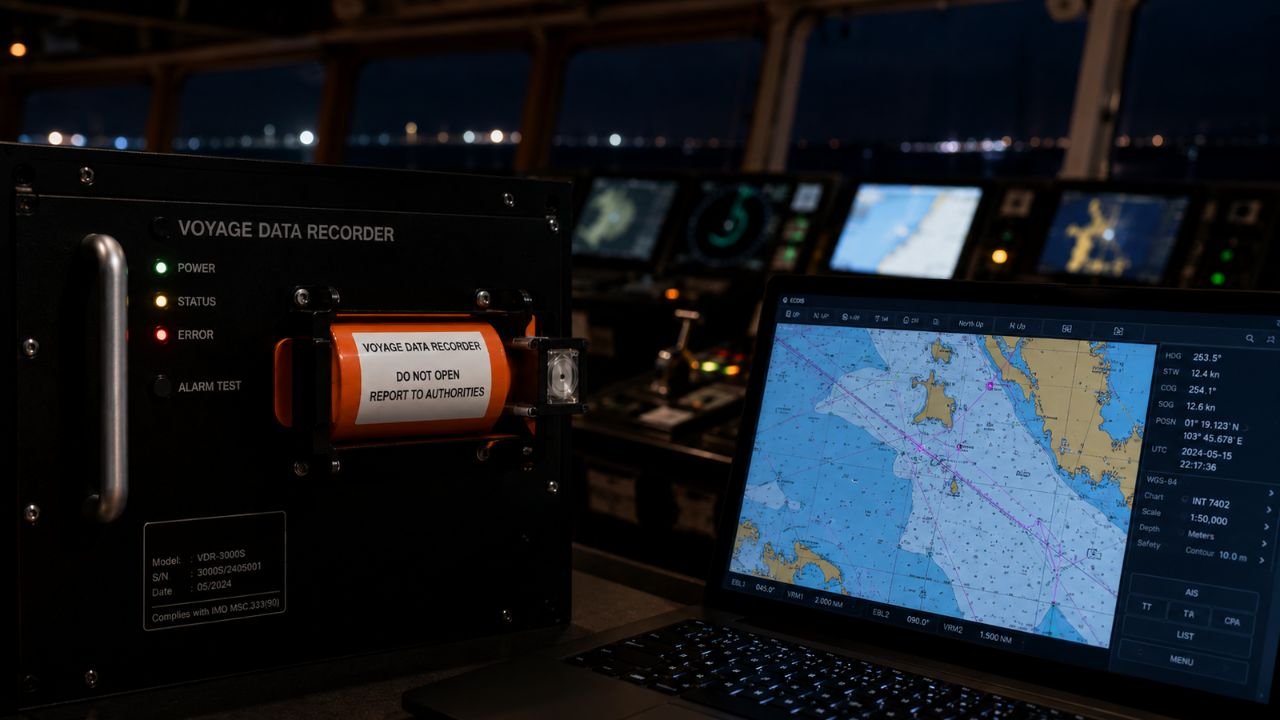
Every VDR fitted to a SOLAS vessel is required to record continuously. What is less consistently managed is the ship’s ability to access that data when it matters — not after an accident, when a manufacturer’s technician is flown in, but routinely, by the bridge team, as part of normal operations.
Two of the industry’s principal vetting frameworks have long recognised this gap. SIRE 2.0 Question 4.1.11 asks whether the Master and navigation officers are familiar with the company procedure for preserving data from the VDR or S-VDR, and whether records are available to demonstrate that tests of the equipment have been completed as required. RightShip RISQ Question 3.15 asks whether deck officers are familiar with the VDR data download procedure in the event of an incident, and whether there is a company policy within the SMS relating to the playback of VDR data.
These are not new questions. They have been part of the inspection framework for years. The fact that they continue to surface findings tells you something about the gap they were written to address.
What the VDR Data Download Procedure Actually Covers
When a SIRE inspector works through Question 4.1.11, the objective is specific: to ensure the VDR is continually recording all required data streams, and that procedures are in place to preserve records in the event of an incident.
The inspection guidance references two distinct requirements. The first is data preservation — all watchkeeping officers should be familiar with the procedures for preventing VDR recordings from being overwritten. The second is annual testing — the system is required to undergo a performance test each year, conducted using the playback equipment, confirming that all required data items are being correctly recorded. This test must also be carried out following any repair or maintenance to the VDR, or to any source providing data feeds to it.
The inspector’s expected evidence includes the company procedure governing setup, use and testing; records of the annual performance test completed by an approved service facility; instructions posted near the VDR controls on how to save data to prevent overwriting; and at least one emergency checklist from the vessel’s response plan indicating that VDR preservation is required.
The potential grounds for a negative observation are equally specific: no company procedure governing setup, use and testing; no procedure defining what the company expects in the event of an incident; a navigation officer unfamiliar with VDR management and data preservation procedures; and annual performance checks not completed by an authorised service agent.
RISQ 3.15 covers similar ground. The guide to inspection is direct: watchkeeping officers should understand and be familiar with the procedures for preserving records as required by the SMS. Company policy on playback should be in the SMS. The RightShip guidance also notes that playback of VDR data may provide a tool for analysing bridge team performance — and that a just culture should give personnel the confidence to admit mistakes, which in turn leads to a safer working environment.
Where tanker operators stand
Tanker operators have lived with SIRE inspections for long enough that VDR data download peocedure has become a practised routine rather than a theoretical procedure. The physical kit — CD, LAN cable, pen drive, CF card reader, as applicable to the VDR type — is onboard. Instructions are posted near the VDR controls. Officers have downloaded data. The question is not whether the ship can access its own VDR; it is taken as given that it can.
The residual gap on tankers tends to be documentary rather than operational. VDR playback software was written when Windows XP and Windows 7 were current operating systems. Manufacturer’s manuals referenced those platforms specifically. As the OS landscape moved on — Windows 10, Windows 11, modern laptops replacing older hardware — many company procedures and manufacturer references were not reviewed and updated to reflect the change.
The ship’s ability to download data did not change. The playback software continued to work. But the written procedure still referenced obsolete operating systems, and when a vetting inspector reviewed the documentation against RISQ 3.15, the incompatibility between the stated procedure and the current equipment became an observation. The root cause was not operational failure. It was an inadequate documentation review cycle — nobody checking whether the written procedure still described what the ship was actually doing.
This matters because both SIRE 4.1.11 and TMSA KPI 5.2.3 place a specific obligation on the person responsible for navigational standards to ensure that procedures are regularly reviewed and updated to reflect new legislation, technology and updated industry standards. ECDIS and VDR, including data recovery, are listed explicitly as areas where this applies.
Where the broader fleet sits
Outside the tanker vetting environment, the picture is different. Bulk carriers, container ships and other vessel types operate under inspection frameworks that have historically placed less direct pressure on VDR data management as an observable, practised competency.
Without that regular external prompt, VDR data preservation can settle into a pattern where the procedure exists on paper but has never been tested by the bridge team. The manufacturer’s manual is kept in the chart room. The annual performance test is carried out by a shore-based service technician. Nobody on the bridge has downloaded data themselves.
When the ship encounters a situation that requires the data — a near-miss, an incident investigation, or a vetting inspection that asks the navigation officer to demonstrate familiarity with the procedure — the gap between procedure and practice becomes visible. The shore technician is not on board. The manual references a laptop configuration that no longer exists on the vessel. The navigation officer knows the VDR records everything but has no practical experience of extracting it.
The fear of damaging the equipment is not irrational. It has never been demystified. Nobody has sat with the officer and walked through the steps. The first download, in most cases, is not performed proactively — it is performed under pressure, when someone external is watching.
What the OCIMF recommendations say about this
OCIMF’s Recommendations on the Proactive Use of Voyage Data Recorder Information address onboard review of VDR data directly. The recommendations describe the onboard review of VDR data by Masters and bridge teams, using the manufacturer’s playback equipment and software, as a simple way for the team to collectively assess their own performance and identify areas for improvement. The approach is specifically noted as useful when the team is undertaking challenging navigational activities — port calls for the first time, canal transits, pilotage waters.
The recommendations also note that the process of performing remote navigational assessments — which involves saving and downloading VDR data — serves a secondary function of confirming crew familiarity with the download process and verifying that the VDR is operating correctly. Regular downloads build competence as a by-product of use. Ships that have downloaded their own data routinely have no hesitation when the situation requires it. Ships that have not, find themselves dependent on assistance they may not have available.
Two separate problems that look like one
What the vetting frameworks surface — and what audit experience confirms — is that VDR data access sits at the intersection of two problems that are worth distinguishing.
The first is a documentation maintenance problem: the written procedure no longer matches operational reality, typically because the procedure has not been reviewed as technology has changed. This is the finding that catches well-run tankers. The fix is a systematic review of all VDR-related procedures against current hardware, software and operating systems, followed by a controlled update that reflects what the ship is actually doing.
The second is a familiarity problem: officers have never performed a download and have no confidence that they could do so correctly without assistance. This is more common in fleets operating outside the high-frequency vetting environment, and it tends to surface slowly — not as a single observation but as a pattern of uncertainty that becomes apparent when someone asks the bridge team to demonstrate VDR data download procedure rather than describe it.
Both problems respond to the same approach: a practical VDR data download procedure written against the specific VDR type fitted to the vessel, tested by the bridge team, and reviewed at defined intervals. Not a reference to a manufacturer’s manual. A ship-specific, step-by-step procedure that reflects the laptop and media available on board, tested against the current operating system, and confirmed to work before it is needed.
The VDR is recording. The question is whether the team that relies on it has ever been given the tools to access what it holds
More from the VDR Series
→ Explore our VDR Navigational Audit Service — Book a VDR Navigational Audit
- The VDR Audit Guide: What the Bridge Data Shows, and Where to Start
- The VDR Audit Report Isn’t Just Good Practice. SIRE 2.0 Question 3.2.4 Asks For It By Name.
- Bridge Procedures Is a DryBMS Priority Area. It Still Doesn’t Move Your Score.
- ECDIS in Tidal Ports: The Alarm That Stops Working When You Need It Most
- The Lookout During Port Approach Is on the Manning Matrix. The VDR Shows Whether Anyone Was Standing It.
- When Risk Becomes Routine, the Bridge Goes Quiet
- The First VDR Audit Your Fleet Runs Should Be Announced. Here’s Why.
- The Anchor Is Down. The VDR Doesn’t Know That.
- The VDR Track Shows More Than Where the Pilot Boarded
- The Radar Is Running. The VDR Shows Whether It’s Doing Its Job.
- When VDR Data Works For You, Not Against You
- Tug Bollard Pull, Ship Fittings, and the Conversation That Doesn’t Happen
- The Master Pilot Exchange: What the VDR Hears, and What Most Ships Leave Unsaid
- The Port Approach Is Already on Film. Most Managers Don’t Know It.
- The Radar Log Says Done. The VDR Says Otherwise.
- Passage Planning Mistakes Ships Make — And What the VDR Reveals
- Ghost Fix: What the Bridge Team Does When the Auditor Has Gone Home
- VDR Navigational Audits: What They Are, Why They Matter, and When to Do One
- How a VDR Navigational Audit Works — A Step-by-Step Guide for Ship Managers