


When I sit down with an operator to review their ISM SMS requirements, the picture is almost always the same.
The document is technically compliant. It references the right regulations, addresses the right hazards, and has been updated after every observation. It has also not had anything removed from it in years.
What started as a structured safety management system has become an accumulation — layer upon layer of additions that nobody consolidated and nobody questioned. The result is a document that satisfies the auditor and defeats the crew.
This is not a fringe problem. It is the normal condition of SMS documentation across a wide segment of the industry, and it is worth understanding how it happens before deciding what to do about it.
The SMS review happens when everything else is done. Everything else is never done.
How the ISM Code Set the Conditions
The ISM Code is not the cause of SMS bloat. It is, however, the structure within which bloat becomes almost inevitable.
The ISM SMS requirements cover procedures, instructions, and responsibilities for shipboard operations. It requires that the system be reviewed, updated, and improved. The Code also includes document control requirements — superseded versions must be removed. But version control is not the same as content rationalisation.
There is no ISM obligation to ask whether an existing procedure is still relevant, whether it duplicates something already covered elsewhere, or whether a new addition contradicts something written years before it.
The Code creates a one-way valve. Things go in. The question of whether they should stay in is never asked.
Four Pressures That Add — and None That Remove
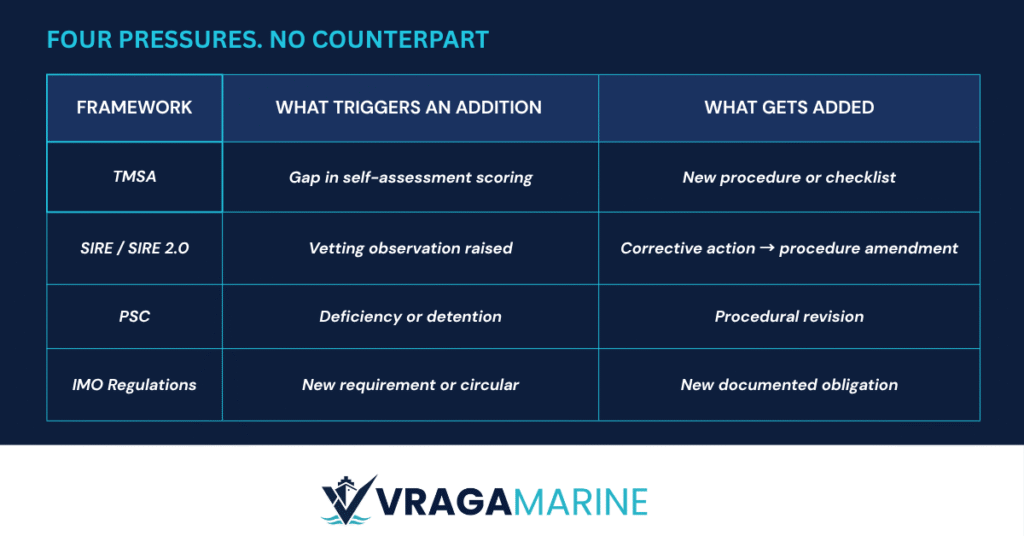
The SMS does not grow randomly. It grows in response to specific external pressures, each operating on the same logic: a finding is raised, a corrective action is required, and a new or amended procedure is the accepted response.
TMSA scores operators against defined elements and criteria. When a gap is identified — in a self-assessment or an external review — the instinct is to add documentation that closes it. A new procedure, a revised checklist, an additional record. The score improves. The document grows.
SIRE and SIRE 2.0 generate vetting observations. Observations generate corrective actions. Corrective actions, in most offices, mean a new procedure or an amendment to an existing one. Under SIRE 2.0, the move toward outcome-based questions has changed what inspectors are looking for, but the reactive documentation response to findings has not changed.
The loop where each incident ends in “retrain” or “reissue the procedure” is examined in You can’t train your way out of human error.
PSC detentions and deficiencies carry the most immediate commercial pressure, and the documentation response is proportionate to that pressure. A deficiency in enclosed space entry procedures, for example, will generate a procedural revision that may well add several pages to a chapter that was already adequate.
IMO regulations and circulars are the most structural source of growth. Each new requirement — whether from SOLAS amendments, MARPOL revisions, or guidance circulars — represents a documented obligation that must appear somewhere in the SMS. The recent changes to SOLAS lifting appliance requirements are a live example: a new compliance layer that now needs to sit within an existing documentation structure that was not built around it. It gets added. The rest of the document is not reviewed to absorb it cleanly.
None of these pressures comes with a counterpart. There is no mechanism in TMSA, SIRE, PSC, or IMO that says: review what is already there, remove what is redundant, and consolidate what overlaps. The pressures are all additive.
What Contradiction Looks Like When ISM SMS Requirements Are Never Rationalised
When a document grows across years and across multiple authors responding to separate pressures, contradictions accumulate quietly.
A procedure written in 2016 addresses enclosed space entry with a defined set of steps and a corresponding permit. A PSC deficiency in 2021 generates a revised procedure for the same operation. Both versions exist in the SMS. They are not identical. Neither references the other. The crew will find whichever version they encounter first and will not know there is another.
Cross-references become unreliable. A procedure points to a section that was renumbered two revisions ago. A checklist references a permit that was redesigned and is no longer in the same volume. The document assumes an internal coherence that it no longer has.
This is not negligence. It is the predictable consequence of a document that has been added to many times and reviewed as a whole very rarely.
What This Means for the Crew Who Have to Use It
The officer who needs to locate a specific procedure under pressure is working against the document, not with it. A well-maintained SMS should reduce decision time in a critical moment. A bloated one adds to it.
The more common consequence is subtler. Crew stop consulting the SMS because experience has taught them that finding the relevant section takes longer than it should, that the language is not always clear, and that what they find may or may not reflect current practice on board. They rely instead on what they were shown by the previous officer, or on what they remember from the last company. The SMS becomes a compliance document rather than an operational one.
New joiners face a more acute version of this problem. An induction that asks a new officer to familiarise themselves with a 2,000-page system is not an induction — it is a formality. The assumption that the document has been read and understood is rarely tested and is rarely true.
Why Smaller Operators Feel This Most Acutely
Larger operators have the resources to address this periodically. Dedicated QHSE teams, structured SMS overhaul programmes, and the internal capacity to run a rationalisation exercise every few years mean that bloat is managed, if not eliminated.
Smaller operators — those running fleets of five to fifteen vessels with a DPA managing compliance alongside a range of other responsibilities — do not have that capacity. The SMS review happens when everything else is done. Everything else is never done.
The paradox is that smaller operators have the most to lose from a vetting failure or a PSC detention, and the least capacity to prevent one through proactive SMS maintenance. A document that has grown beyond practical use is a compliance liability precisely in the moment it is needed most.
If the decision is to cut the SMS back, the next question is where to begin. Before You Rationalise Your SMS, You Need to Know What It’s Actually Doing sets out the inventory and the test for what is load-bearing.
More from the SMS Series
→ Explore our SMS Gap Analysis Service — Get an SMS Gap Analysis
- Ship Safety Management System: A Practical Guide to Keeping the SMS Usable
- Who Receives the Pilot — What the SMS Says and What the Ship Does
- Your Near-Miss Reporting Looks Healthy. But What Is It Actually Telling You?
- Your SMS Is in English. That Doesn’t Mean the Crew Read It in English.
- What a SIRE 2.0 Compliant SMS Actually Has to Prove
- Why SMS Rationalisation Stalls — and What It Leaves Behind
- Your Crew Can Find the Procedure. That Doesn’t Mean They Can Trust It.
- Before You Rationalise Your SMS, You Need to Know What It’s Actually Doing