


When an SMS has grown to a point where it no longer feels manageable, the instinct is to open it and start cutting. I understand that instinct. After years of working with operators on ISM SMS review, I have seen it acted on repeatedly. It is also, consistently, the wrong place to start.
The test is not page count. The test is whether the SMS, as it stands, could survive a line-by-line review against the operations it governs
Why Volume Is the Symptom, Not the Problem
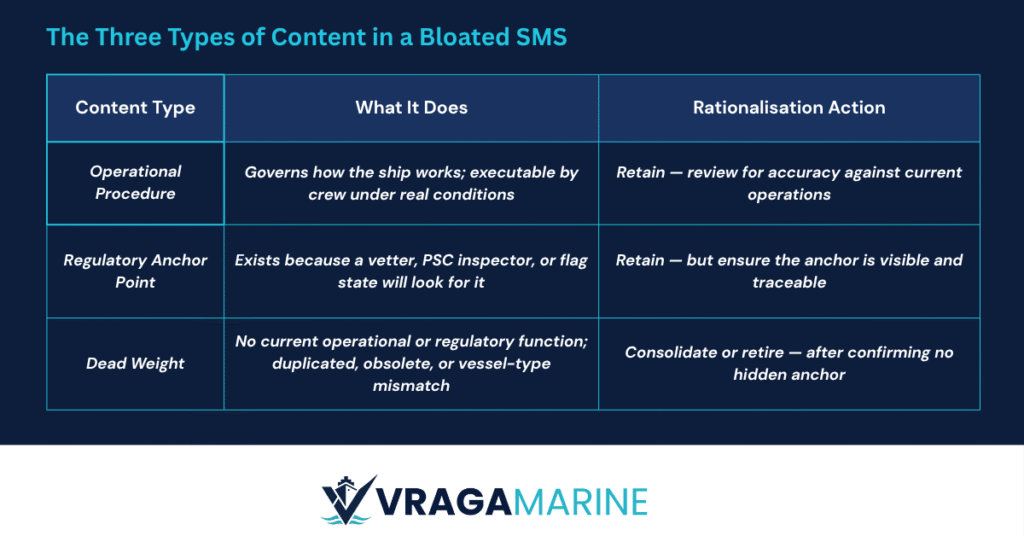
A bloated SMS is not simply a long document. It is a document in which three fundamentally different types of content have accumulated together, without distinction.
The first is genuine operational procedure — content that directly governs how the ship operates, maintained by the crew, and executable under real conditions.
The second is regulatory anchor points — content that exists primarily because a vetter, PSC inspector, or flag state surveyor will look for it. It may not describe anything crews actively do on a daily basis, but removing it creates a compliance gap.
The third is dead weight — content that was added at some point, for some reason, and has no current operational or regulatory function. It may duplicate something elsewhere in the SMS, reflect a vessel type the company no longer operates, or reference a procedure that was superseded years ago and never formally retired.
The mistake most operators make when approaching SMS rationalisation is treating all three as the same problem. A volume-reduction exercise cuts indiscriminately. The result is an SMS that is shorter but now has gaps — gaps that may not surface until a SIRE vetter or PSC inspector finds them.
The Shadow SMS: Circulars, Alerts, and Master’s Reviews
Before any rationalisation can begin, there is a prior question that most operators do not ask: what is the SMS actually composed of?
For the majority of operators I have worked with, the answer is not one document. It is the SMS itself, plus an accumulated layer of circulars, safety alerts, campaign reports, and master’s reviews issued on an ad hoc basis over years — sometimes over a decade.
These documents are issued for legitimate reasons. A PSC deficiency triggers a circular. An industry campaign generates a series of alerts. A near-miss on one vessel produces a master’s review that is distributed fleet-wide. Each one, at the time of issue, represents a genuine operational or compliance response.
The problem is what happens after. Some of these documents are eventually absorbed into the SMS through a formal revision cycle. Many are not. They continue to exist in a parallel layer — distributed to vessels, filed somewhere onboard, referenced during audits — without ever being formally reconciled with the SMS they were supposed to supplement.
Over time, this creates a situation where no one, including the DPA, can say with confidence what the actual operating standard is. The SMS says one thing. A circular issued three years ago says something adjacent. A campaign report from a TMSA cycle adds a third layer. The crew is expected to cross-reference all of it.
This is the shadow SMS. It cannot be set aside in a rationalisation process, because it is part of the document landscape that needs to be mapped — not just the main binder.
The Inventory Comes Before the Mapping
The first practical step in any structured SMS rationalisation is not revision. It is inventory.
Before anything is mapped, classified, or removed, the operator needs to establish what documents are currently governing operations. That means the SMS — all volumes, all annexes — and the full body of circulars, alerts, campaign reports, and master’s reviews that have been issued and remain in circulation on vessels.
For some operators, this inventory exercise is itself a revelation. Documents believed to have been absorbed into the SMS are still circulating separately. Alerts issued for a specific incident have remained in the fleet’s document set long after the corrective action was closed. Master’s reviews that were distributed but never formally acknowledged sit in a folder that no one has opened in two years.
The inventory establishes the true scope of what rationalisation involves. It is almost always larger than expected.
This establishes the true scope of what the ISM SMS review involves.
Classifying Before Cutting: The Load-Bearing Test
Once the full document landscape is established, the ISM SMS review moves into its mapping phase. This is the load-bearing test — the process of tracing each procedure, form, and requirement back to what it is actually doing.
For every element in the SMS, the question is the same: what is this anchored to? Is it an ISM Code clause? A TMSA element? A specific SIRE 2.0 question? A flag state requirement? An operational reality that exists independently of any regulatory requirement? Or is it anchored to nothing — added at some point and never revisited?
This classification is what separates a structured SMS rationalisation from an editing exercise. It requires working through the regulatory frameworks that apply to the company’s operations and cross-checking each SMS element against them — which is what a structured SMS gap analysis sets out to do.
Content that is anchored to a regulatory requirement but feels redundant still needs to stay — or the anchor needs to be relocated before the content is removed. Content that is unanchored, duplicated, or genuinely superseded can be consolidated or retired. But that determination has to be made for each element individually. It cannot be assumed from volume.
What the Mapping Reveals
The classification exercise rarely produces a clean list of what to keep and what to remove. What it produces first is a picture of drift — and that picture is often more significant than the rationalisation itself.
Procedures written for vessel types the company no longer operates. Forms that reference positions restructured years ago. Requirements added during a TMSA self-assessment cycle that reflected aspirational practice rather than actual operations, and remained in the SMS long after the cycle closed. Sections that duplicate each other because they were written by different people at different times, each unaware the other existed.
This drift is not unique to any particular operator. It is the predictable consequence of a system that makes it straightforward to add content and provides no mechanism for removing it — the condition I described in the previous article in this series. Understanding that the drift is structural does not make it less significant. For a DPA preparing for SIRE 2.0 vetting, or a superintendent responding to a PSC deficiency, an SMS that does not reflect how the ship actually operates is a liability.
The mapping surfaces that gap before a vetter does.
Where to Start Your ISM SMS Review
A structured SMS rationalisation cannot be conducted in a single pass across the entire document. The scope is too large and the risk of disruption to live operations is too high. It needs to be sequenced.
The sections with the highest operational and vetting exposure should be addressed first — navigation, cargo operations, enclosed space entry, emergency procedures. These are the areas where the gap between the documented procedure and what actually happens carries the most consequence, and where a SIRE vetter or PSC inspector is most likely to probe.
Administrative and management system content — policy documents, review frameworks, training records — can follow once the operationally critical sections have been stabilised.
Circulars and alerts inventoried in the earlier phase need to be resolved in parallel: absorbed into the relevant section of the revised SMS, formally retired, or acknowledged as standing instructions with a clear scope and review date. The shadow SMS cannot simply be left intact alongside a rationalised main document. That defeats the purpose.
What a Rationalised SMS Actually Looks Like
A rationalised SMS is not necessarily a shorter one. Length is not the objective.
The objective is coherence — a document where every element has a traceable purpose, where the operational procedures reflect how the ship actually works, and where the regulatory anchor points are clearly held. A document where a Master under pressure can find what is relevant to the situation in front of him. A document where the DPA can defend every element to a vetter without hesitation.
The test is not page count. The test is whether the SMS, as it stands, could survive a line-by-line review against the operations it governs.
For most operators beginning an ISM SMS review, the answer to that question is the most useful thing the process produces — before a single word has been changed.
A rationalisation also needs an owner and a finish line. Why SMS Rationalisation Stalls — and What It Leaves Behind covers who owns the work and why it so often stalls halfway.
More from the SMS Series
→ Explore our SMS Gap Analysis Service — Get an SMS Gap Analysis
- Ship Safety Management System: A Practical Guide to Keeping the SMS Usable
- Who Receives the Pilot — What the SMS Says and What the Ship Does
- Your Near-Miss Reporting Looks Healthy. But What Is It Actually Telling You?
- Your SMS Is in English. That Doesn’t Mean the Crew Read It in English.
- What a SIRE 2.0 Compliant SMS Actually Has to Prove
- Why SMS Rationalisation Stalls — and What It Leaves Behind
- Your Crew Can Find the Procedure. That Doesn’t Mean They Can Trust It.
- The SMS Keeps Growing. No One Has a Mandate to Cut It Back.