
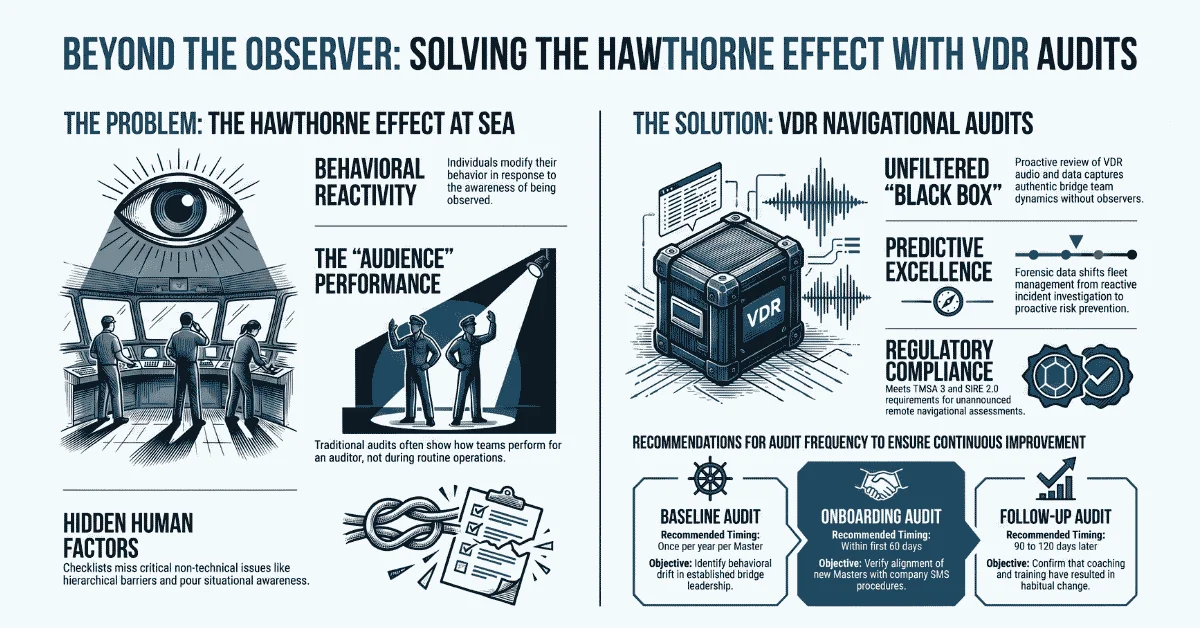
VDR navigational audit programmes exist because of a simple truth I learned in eighteen years at sea: what happens on the bridge when an assessor walks through the door is not what happens at 0300 on a rainy Wednesday in the Malacca Strait.
The clipboard comes out. Closed-loop communications suddenly become crisp. The passage plan — which may have been sitting unreviewed since the last port — gets a quiet once-over. Everyone performs.
And then the assessor leaves.
This is not a criticism of crews. It is human nature. Psychologists call it the Hawthorne Effect — the well-documented tendency for people to modify their behaviour simply because they know they are being observed. In maritime operations, it means that a traditional dynamic navigational audit often tells you how a bridge team performs for an audience, not how they actually operate on a routine passage at 0300 on a rainy Wednesday in the Malacca Strait.
“The VDR navigational audit exists to close that gap.”
So what is a VDR navigational audit, precisely? The answer starts with the data the vessel is already generating.
What Is a VDR Navigational Audit?
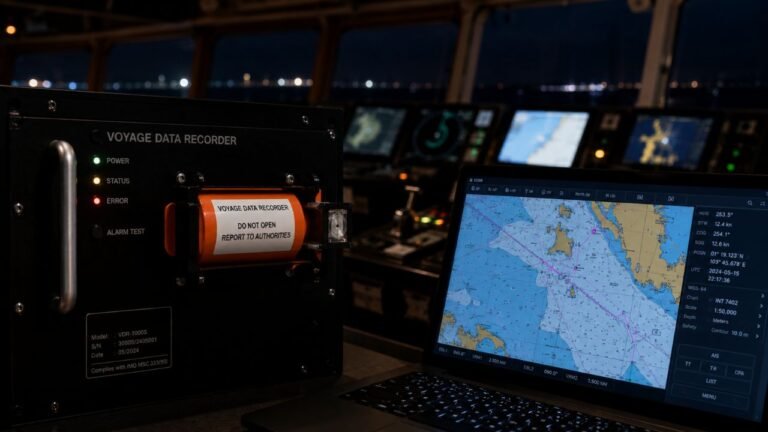
A Voyage Data Recorder — the ship’s black box — continuously captures a vessel’s position, speed, heading, radar picture, ECDIS data, helm inputs, alarm activations, and crucially, bridge audio. Every conversation. Every order. Every moment of silence when there should have been communication.
Most shipping companies treat this data as a post-incident investigation tool. A VDR navigational audit uses this same recorded data proactively — before an incident occurs — analysed forensically against the vessel’s SMS procedures, the ICS Bridge Procedures Guide, and OCIMF’s Guide to Best Practice for Navigational Assessments and Audits.
The result is an unfiltered picture of how your bridge team actually operates. Not how they perform when someone is watching.
If you want to understand exactly how a VDR audit is conducted from data request to final report, I have written a step-by-step walkthrough: How a VDR Navigational Audit Works — A Step-by-Step Guide for Ship Managers.
Why Does It Matter? The Human Factor That Checklists Cannot Capture
A static audit can tell you whether a passage plan was filled in correctly. What it cannot tell you is whether the officer of the watch actually understood the plan, whether the Master was approachable enough for a junior officer to raise a concern, or whether the pilot was properly integrated into the bridge team during a critical berthing.
These are human factors — the non-technical skills that maritime accident statistics consistently identify as the root cause of most navigational incidents. VDR audio reveals all of it.
What the Industry Frameworks Require
TMSA 3 — KPI 5.4.1
Remote Assurance by independent contractor, including VDR downloads, accepted as substitute where physical attendance is impractical.
SIRE 2.0 — Q3.2.4
Inspectors verify that remote assessment was genuinely unannounced and covered a period of real navigational challenge.
Full section dedicated to proactive VDR use — assessing communications, position fixing, UKC management and alarm response
When Is the Right Time? Audit People, Not Ships
Recommended audit cadence
01
Annual baseline
Every fleet Master audited at least once per year — regardless of vessel or trading pattern.
02
Onboarding audit
New or newly joined Masters audited within first 60 days — before habits from elsewhere become permanent.
03
Follow-up audit
90–120 days later on next assignment — confirming coaching has taken hold and new setup is working.
The Goal Is Coaching, Not Catching
A VDR audit used purely to catch mistakes and assign blame will erode the safety culture it is supposed to support. But a VDR audit used as a coaching tool — where findings are shared constructively and the bridge team is shown a replay of their own performance — builds exactly the kind of just culture the industry is working towards.
The VDR is not a surveillance camera. Used correctly, it is the most powerful bridge team development tool available to a ship manager today.
Done well, a VDR navigational audit programme becomes the foundation of a fleet-wide safety culture — one that doesn’t need an inspector present to function at its best.
More from the VDR Series
→ Explore our VDR Navigational Audit Service — Book a VDR Navigational Audit
- The VDR Audit Guide: What the Bridge Data Shows, and Where to Start
- The VDR Audit Report Isn’t Just Good Practice. SIRE 2.0 Question 3.2.4 Asks For It By Name.
- Bridge Procedures Is a DryBMS Priority Area. It Still Doesn’t Move Your Score.
- The VDR Playback Software Is There. The Procedure That Covers It May Not Be.
- ECDIS in Tidal Ports: The Alarm That Stops Working When You Need It Most
- The Lookout During Port Approach Is on the Manning Matrix. The VDR Shows Whether Anyone Was Standing It.
- When Risk Becomes Routine, the Bridge Goes Quiet
- The First VDR Audit Your Fleet Runs Should Be Announced. Here’s Why.
- The Anchor Is Down. The VDR Doesn’t Know That.
- The VDR Track Shows More Than Where the Pilot Boarded
- The Radar Is Running. The VDR Shows Whether It’s Doing Its Job.
- When VDR Data Works For You, Not Against You
- Tug Bollard Pull, Ship Fittings, and the Conversation That Doesn’t Happen
- The Master Pilot Exchange: What the VDR Hears, and What Most Ships Leave Unsaid
- The Port Approach Is Already on Film. Most Managers Don’t Know It.
- The Radar Log Says Done. The VDR Says Otherwise.
- Passage Planning Mistakes Ships Make — And What the VDR Reveals
- Ghost Fix: What the Bridge Team Does When the Auditor Has Gone Home
- How a VDR Navigational Audit Works — A Step-by-Step Guide for Ship Managers