
TMSA navigational audit requirements vary by stage. Element 5 distinguishes between three audit types, each serving a different evidential purpose. Here is what each one demands.
The distinction matters because oil majors and vetting bodies do not just ask whether a navigational audit was conducted. They ask what kind, by whom, and whether the findings demonstrate genuine assurance of navigational standards — not just a paper trail.
This article sets out what TMSA actually requires at each stage, what each audit method can and cannot reveal, and why the right answer for most tanker operators is a combination of all three.
What TMSA Element 5 Is Actually Measuring
Element 5 of TMSA is concerned with navigational safety — specifically, with whether a company has the systems, personnel, and assurance mechanisms in place to maintain navigational standards across its fleet.
Stage 1 and 2 requirements establish that procedures exist and that the Master conducts regular self-audits using a company checklist. This is internal, onboard, and compliance-focused. It tells you whether the bridge team can produce the right records. It does not tell you whether the bridge team navigates correctly when no one is watching.
Stage 3 and 4 are where the framework starts asking harder questions — and where most operators begin to feel the difference between procedural compliance and genuine assurance.
Stage 2: The Shore-Based Verification Assessment
At Stage 2, the TMSA navigational audit framework (TMSA 5.2.2) requires that appropriate shore-based personnel conduct a navigational verification assessment at intervals not exceeding 12 months. The guidance is explicit about what this covers: passage plans, chart corrections, navigational records, navigational equipment, compliance with company procedures, and verification of the Master’s own audit.
This is typically done in port. A superintendent or marine manager boards, reviews the bridge documentation, checks the ECDIS setup, looks at the logbooks, and confirms that the Master’s checklist has been completed.
What this does well: it verifies that the paperwork exists and that basic compliance with procedures is in place. An experienced superintendent will spot anomalies — a passage plan that was not updated after a route change, UKC calculations that do not match the ECDIS track, radar performance test records that are missing.
What this cannot do: it cannot observe the bridge team under operational pressure. It cannot assess whether the Master actually enforces calling conditions. It cannot hear what happens during a Master-Pilot Exchange at 0300 on a busy approach. The bridge, in port, with a superintendent present and a vetting inspection recently completed, is not the bridge at sea.
Stage 3: The Sailing Navigational Audit
At Stage 3, the TMSA navigational audit framework (TMSA 5.3.3) requires comprehensive navigational audits conducted while on passage by a suitably qualified and experienced company representative, at intervals not exceeding two years.
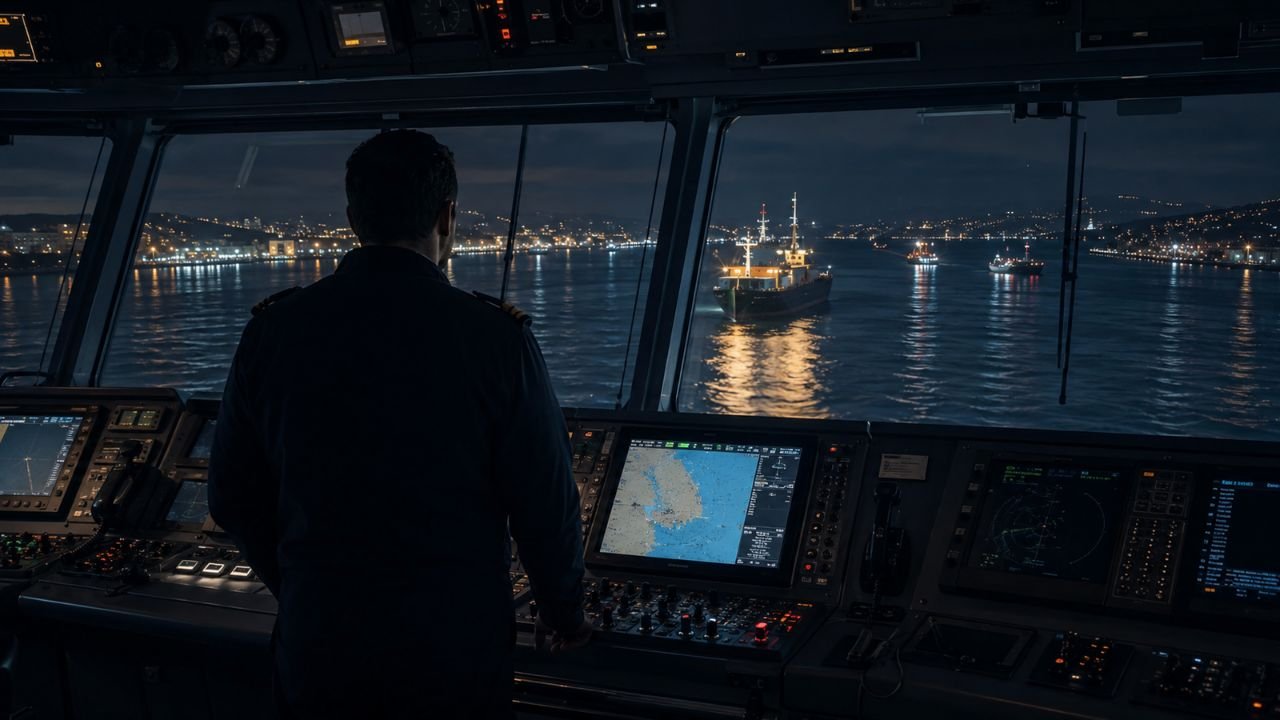
This is a different exercise entirely. The auditor sails with the vessel through a critical passage — port approach, straits transit, coastal waters — and observes the bridge team in real operational conditions. Watch handovers, calling the Master, COLREGS compliance, ECDIS use, radar cross-checks, BRM behaviours, communication with the Pilot — all of it is observed as it happens.
What this does well: it captures the dynamic of the bridge team in a way no document review can. A competent sailing auditor will notice things that never appear in the records — an OOW who defers to the Pilot without maintaining an independent plot, a watch handover conducted without a proper briefing, a Master who is present on the bridge but not functionally in command.
What this cannot fully escape is the Hawthorne Effect — the well-documented tendency for behaviour to change when people know they are being observed. The bridge team knows the audit is happening.
In my experience conducting sailing audits, the standard of bridge practice during an audit is rarely the standard of bridge practice at 0200 on a routine passage. This is not a criticism of crews — it is human nature, and the OCIMF guidance on proactive VDR use acknowledges it directly.
Stage 3 also has a practical constraint. For vessels with restrictive trading patterns — short sea voyages, frequent port calls, or schedules that make physical sailing attendance difficult to arrange — achieving a meaningful sailing audit within the two-year window requires deliberate planning.
Stage 4: Annual Sailing Audit — and When VDR Counts
TTMSA 5.4.1 raises the interval from two years to 12 months. Every vessel in the fleet must be audited while on passage at intervals not exceeding 12 months. That is the primary distinction from Stage 3 — not who conducts it, but how frequently it must happen.
The audit itself may be conducted by a company representative, as per 5.3.3, or by an independent specialist contractor. TMSA 5.4.1 does not mandate external-only. What it does require is that the fleet audit programme includes a combination of both — company audits alone are not sufficient to satisfy Stage 4 intent.
Where Stage 4 introduces the VDR audit as a recognised alternative is specifically where physical sailing attendance within the 12-month window is impractical due to trading pattern. In that circumstance, TMSA explicitly permits an unannounced remote audit by an independent contractor, including VDR downloads, as a substitute.
Three words in that provision carry significant weight. Unannounced. Independent. Remote.
This is the only audit method that eliminates the Hawthorne Effect entirely — and why independent VDR audits produce findings that sailing audits sometimes miss.
Unannounced means the bridge team does not know the audit is happening at the time the data is captured. The VDR has already recorded what it recorded. There is no opportunity to prepare, to remind the second officer about calling conditions, or to ensure the ECDIS track looks tidy. What the VDR holds is what the bridge team actually did.
Independent means the contractor has no management relationship with the vessel. This is a specific requirement for the remote VDR substitution — unlike the sailing audit, which may be conducted internally, the VDR audit used in place of a sailing attendance must come from outside the company.
Remote means the audit can cover passages that would be physically impossible to attend — a Singapore Strait transit at 0400, a Malacca Strait passage during a period when the vessel traded continuously without scheduled port calls.
The OCIMF Guide to Best Practice for Navigational Assessments and Audits confirms this in Section 5.2: remote navigational assessments using VDR data are appropriate where trading pattern makes traditional assessment difficult, where companies want to assess the bridge team without observer influence, and to follow up on non-conformances identified during a traditional audit. The guidance is equally clear that VDR audits should not replace traditional sailing audits entirely — both serve different evidential purposes.
What Each TMSA Navigational Audit Method Can and Cannot See
The in-port verification checks whether the right documents exist. It does not observe operations.
The sailing audit observes operations, but the team knows it is being observed. It captures behaviour in audit conditions.
The VDR audit captures behaviour without observer influence. What it cannot do as effectively as a physical audit is assess subtler BRM dynamics — body language, authority gradients, informal communication patterns that are not captured in audio. A VDR audit of bridge audio, radar, ECDIS, and helm inputs reveals a great deal. It does not reveal everything.
This is why the OCIMF guidance, and TMSA itself, treats these methods as complementary rather than substitutes. A fleet navigational assurance programme built only on in-port verifications is not meeting the intent of Stage 3. A programme built only on VDR audits will not capture the full picture of bridge team dynamics. A programme that combines a regular in-port verification, a periodic sailing audit, and an annual independent VDR audit addresses what each of the others misses.
Why This Matters for TMSA Submission
When a company submits its TMSA self-assessment, the questions in Element 5 are not asking whether audits happened. They are asking whether the company has a structured, documented programme — with reports, corrective actions, trend analysis, and evidence that findings are being used to improve navigational standards fleet-wide.
An in-port verification with no sailing audit component will not support a Stage 3 submission. A sailing audit programme that has not been extended to include independent external audits — or an independent VDR audit where sailing attendance is not practical — will not support Stage 4.
The practical question for any DPA managing a tanker fleet is not whether to conduct navigational audits. It is whether the combination of audits in place actually demonstrates what TMSA Stage 4 is asking you to demonstrate.
What We Do
We conduct independent VDR-based navigational audits for tanker operators working towards TMSA Stage 3 and Stage 4 compliance. The audit covers a critical passage — port approach, straits transit, or pilotage — using recorded VDR data including bridge audio, radar replay, ECDIS track, and helm inputs. The analysis is conducted against the vessel’s own SMS, OCIMF BPG, and SIRE 2.0 standards. Every audit produces a written report with referenced findings and corrective action guidance.
If physical sailing attendance is required, we offer that through our physical inspections service.
If you are preparing a TMSA submission and want to understand whether your current audit programme supports the stage you are targeting, contact us.
More from the HSEQ Series
→ Explore our HSEQ Outsourcing Service — Get HSEQ Outsourcing Support
- TMSA Compliance: A Practical Guide to All 13 Elements, and Where DryBMS Fits
- The DryBMS Audit Planning and Close Out Standard: What Excellence Actually Requires
- The DryBMS Engine Room and Bunkering Standard: What Excellence Actually Requires
- The DryBMS Risk Assessment Standard: What Excellence Actually Requires
- The DryBMS Mooring and Anchoring Standard: What Excellence Actually Requires
- The DryBMS Cargo and Ballast Standard: What Excellence Actually Requires
- TMSA Self Assessment: Declare What You Can Sustain, Not What You Aspire To
- The Audit Is Closed. The Problem Isn’t.
- The Ship’s Navigational Audit Is Your First Line of Defence. Most Fleets Don’t Treat It That Way.
- The TMSA Safety Audit: What Element 9 Stage 4 Actually Requires
- The TMSA Engine Room Audit: What Element 4 Stage 4 Actually Requires
- The TMSA Mooring Audit: What Stage 4 Requires for Element 6A
- The TMSA Cargo Audit: What Stage 4 Requires for Element 6