
Mooring operations kill people. That is not a dramatic framing — it is the operational context that makes Element 6A of TMSA 3 different from almost every other audit requirement. The fatality statistics from snap-back incidents, winch failures, and line parting events are what sit behind OCIMF’s decision to require a physical attendance audit for mooring — not a remote review, not a document check. Someone qualified has to be on deck.
This article explains what the TMSA mooring audit requires at each stage and what an auditor is actually looking for when they attend.
Why Element 6A Exists as a Separate Requirement
TMSA Element 6 covers cargo, ballast, and mooring operations as a combined area. Element 6A was developed to give mooring its own structured set of KPIs, separate from cargo handling, because the risk profile is distinct.
Mooring injuries and fatalities occur not because crews do not know the procedures. They occur because the gap between what the procedure says and what happens on deck during an actual berthing operation is rarely visible from the office. A mooring audit under Element 6A addresses that gap directly.
The Stage 4 requirement — KPI 6A.4.3 — requires that a physical attendance mooring audit be carried out annually by a suitably qualified and experienced company representative. There is no remote equivalent. SIRE 2.0 Question 3.2.7 mirrors this requirement directly, confirming the cross-reference to TMSA 6A.4.3 as conditional and rotational. RightShip RISQ Section 10 assesses mooring station condition, equipment compliance, and operational readiness during physical vessel attendance. The audit frameworks align on this point because the evidence cannot be gathered any other way.
What Each Stage Requires
Stage 1 establishes that documented procedures exist for mooring and anchoring operations across all vessel types — covering roles and responsibilities, toolbox talk requirements, risk assessment, mooring arrangements, and equipment maintenance in the planned maintenance system including winch brake testing. Stage 2 requires those procedures to be detailed and risk-assessed for each specific mooring type the fleet undertakes — conventional berths, buoy mooring, SPMs, tandem, double-banking, STS, and DP operations each addressed separately — with a complete records trail covering line certification, identification and tagging of all equipment, inspection intervals, and end-for-ending dates.
Stage 3 adds the requirement for measures that optimise onboard mooring arrangements. KPI 6A.3.1 requires that procedures identify personnel requirements at each mooring location — a designated person in charge, minimum numbers at each station, toolbox talk requirements before operations, minimum training and experience requirements, and supervision of third-party personnel. KPI 6A.3.2 requires mooring reviews to identify hazards associated with mooring lines and potential equipment failure within the mooring area, use of non-slip coatings in mooring areas, and modifications to mooring equipment based on mooring reviews and lessons learned from incidents and near-miss reports. KPI 6A.3.4 requires a process ensuring that all mooring equipment and fittings comply with the latest industry guidance. This is the direct reference point for MEG4 — OCIMF’s Mooring Equipment Guidelines, 4th Edition. A fleet that cannot demonstrate its mooring equipment was specified, selected, and is being maintained in accordance with MEG4 cannot satisfy Stage 3 under this KPI.
Stage 4, through KPI 6A.4.3, requires that comprehensive audits of all fleet vessels are completed annually by a suitably qualified and experienced company representative, and that the audit specifically observes mooring operations. The audit scope covers: operational practices and compliance with industry guidelines and company procedures; skills and proficiency levels of personnel; leadership and effectiveness of the mooring team during all stages of the operation; the opportunity to promote robust practices and good seamanship; identifying additional training needs whether individual, vessel, or fleet-wide; and supervision of junior officers and the training of cadets. The audit is followed by a report where corrective actions are assigned, verified, and closed out in a specified time period. There is no remote or document-based equivalent for this KPI. Observation of operations is a stated requirement.
KPI 6A.4.2 additionally requires that all available means are used to ensure vessels can safely moor at terminals being visited for the first time — including reference to industry publications, port agent information, OCIMF’s Marine Terminal Information System (MTIS), company records from previous fleet vessel visits, and mooring analysis software to ensure berth compatibility. This is a Stage 4 requirement that many fleets treat as routine good practice rather than a specific evidenced obligation.
What the Auditor Is Looking at on Deck
A TMSA mooring audit must be conducted annually for every vessel in the fleet. It is not a paperwork exercise. The physical attendance component exists because the condition of mooring equipment, the layout of the mooring station, and the behaviour of the crew during operations cannot be assessed remotely.
The auditor will look at mooring line certificates, confirming that every rope and wire in use — including spares — has a valid certificate from the manufacturer and that the Line Design Break Force does not exceed 105 per cent of the vessel’s Ship Design Minimum Breaking Load. Lines without certificates must not be carried on board. That requirement is not aspirational; it is an inspection finding if it is not met.
Beyond the certificates themselves, the auditor will look for evidence that a Line Management Plan is in place and being actively used on board. MEG4 requires operators to maintain an LMP covering procurement, maintenance schedules, inspection records, wear zone management, and retirement criteria for every mooring line and tail. RISQ Question 10.1 checks the LMP against INTERTANKO’s guidance and records a finding if it does not meet the requirements or if there is no evidence it is being implemented. An LMP filed ashore and unknown to the officers on board does not satisfy this requirement. The physical identification system linking individual lines to their certificates is what the LMP is supposed to maintain — and this is where the gap most commonly appears. The certificates may be correctly filed and the LMP may exist as a document, but the physical link between them breaks down between inspections, particularly on vessels with high crew turnover or frequent port calls. The auditor asks which certificate corresponds to which line on the aft winch drum. If nobody can answer, that is a finding regardless of how complete the filing system looks ashore.
At company level, the Mooring System Management Plan — MEG4’s goal-based framework covering the full lifecycle of mooring equipment from design through retirement — should be available, subject to document control, and backed up ashore. An auditor operating at Stage 4 level will expect to see evidence of both the MsMP at fleet level and the LMP actively implemented on board.
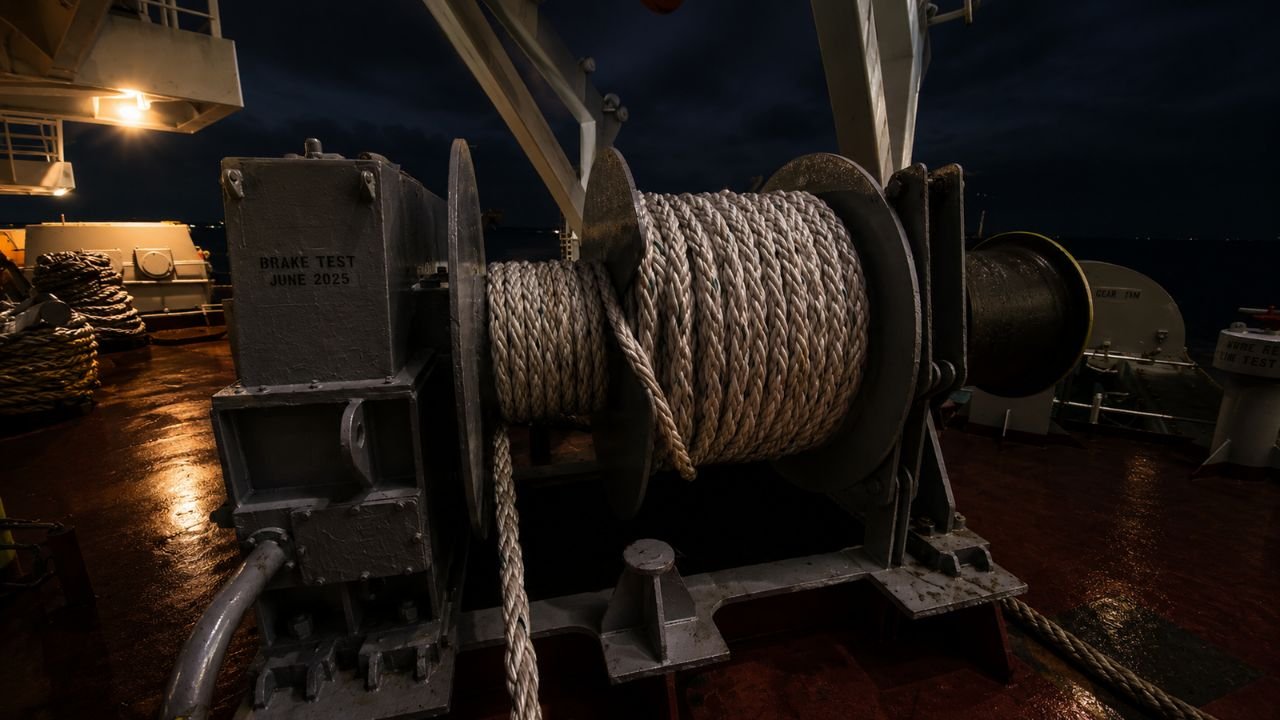
Winch condition is assessed directly. Brake drums are checked for corrosion, pitting, and rust scale. Brake linings are examined for wear against the minimum thickness specified by the manufacturer. MEG4 specifies that the winch brake should be set to render at 60 per cent of the Ship Design MBL. Following each brake test, the winch drum must be marked to confirm the brake is applied to the same torque during every subsequent mooring operation — the marking device must allow further tightening in emergency conditions and must remain in good condition between tests. Annual brake testing is the minimum standard recommended by both MEG4 and RightShip. Clutch operation, lever markings showing direction of operation for both heaving in and paying out, and the condition of drum ends are all part of the assessment. Ropes must never be left on drum ends when not under tension and must always be laid up on the bitts.
Snap-back zones are a specific area of focus. OCIMF’s position — reflected in both MEG4 and RISQ guidance — is that the entire mooring deck should be treated as a potential snap-back zone. Painting demarcated snap-back areas on deck can create a false sense of security. The auditor will look at whether crew understand this, whether the mooring station is clearly signed as a hazardous area, and whether the deck surface is free of trip hazards, oil contamination, and poor lighting. Mooring decks naturally contain multiple trip hazards — save-alls, windlass platforms, forecastle access hatches, bitts, pedestal fairleads, cleats — that are easily missed when all surfaces are painted the same colour. Physical hazards must be highlighted separately.
Stopper use is checked in practice, not just on paper. The type of stopper matters. Polyamide, polypropylene, and polyethylene mix lines are not suitable. High-modulus synthetic fibre ropes are generally too slippery to function as stoppers. The standard is a polyester stopper, used in double configuration, approximately two metres in effective length from the securing point, thinner than the mooring line, and about half its breaking strength. When laying up a line on the bitts, the first two turns are taken directly around the first post before the rope is laid up in a figure eight. Once the rope is secured on the bitts, the stopper is released.
Heaving lines are included in scope. The monkey’s fist — or alternative soft pouch — must not exceed 0.5 kg total weight and must not contain any weighting material other than rope or fast-draining pea shingle. Shackles, bolts, and nuts used as weights are a direct finding.
Where Most Fleets Fall Short
In my experience attending mooring audits and reviewing mooring-related findings across fleets, the gaps are consistent. They are rarely the obvious ones.
The LMP exists and the certificates are filed — but the physical identification system linking individual lines to specific certificates has broken down between inspections. Lines have been moved between stations, end-for-ended, or rotated to spares and back. The LMP was not updated to track those movements. The auditor asks which certificate corresponds to which line on the aft winch drum. Nobody can answer.
Winch brake condition is recorded as satisfactory in the PMS. The brake drum, when inspected, shows significant rust scale and the brake lining is at or below the manufacturer’s minimum thickness. The PMS entry reflects when the check was last signed off, not what the brake actually looks like.
Snap-back awareness is demonstrated through signage and a painted zone on deck. The crew, when asked, can point to the marked area. They cannot explain why the entire deck — not just the painted zone — is a danger area, or what the consequence of a line parting at full load would be.
The mooring procedure references generic guidance on line loads and snap-back zones. The vessel has a specific terminal arrangement that differs from the generic diagram in the SMS. The risk assessment has not been updated to reflect how this vessel actually moors at its regular terminals.
These are not unusual findings. They are what a physical attendance audit surfaces that no remote review of documentation would reach.
The Physical Attendance Requirement Is Not Bureaucratic
It is worth being direct about this. Some companies treat the TMSA mooring audit as a compliance box to be ticked — arrange an attendance, generate a report, close the findings. That approach satisfies the KPI 6A.4.3 requirement at Stage 4 level, but it does not address the operational risk that the requirement exists to manage.
The auditor attending a mooring operation is watching how the crew behave when a line is under load, whether the officer in charge of the mooring party is in a position to see what is happening across all stations, whether communication between the bridge and the mooring deck is clear, and whether the decision to hold, ease, or surge a line is being made by someone who understands the consequence of getting it wrong.
That observation cannot be replicated by reviewing a checklist after the fact. It cannot be inferred from a maintenance record. It requires attendance.
What to Have Ready Before an Audit
If you are preparing a vessel for a TMSA mooring audit, the documentation trail should include: the Line Management Plan, current and actively implemented on board covering all lines and tails in service with a physical identification system linking each line to its certificate; the Mooring System Management Plan at company level under document control with a backup copy ashore; valid certificates for every mooring rope and wire on board; winch maintenance records showing brake test results against the 60 per cent Ship Design MBL rendering standard with drum marking confirmed; a vessel-specific mooring risk assessment reflecting actual terminal configurations, reviewed following any relevant incident or near-miss; records of mooring-related near-miss reports and the lessons-learned response; and evidence that snap-back zone awareness has been covered in on-board safety briefings, not just through deck signage.
Line inspection records should reflect MEG4’s three-tier framework — a deployment inspection at every mooring operation, a routine inspection at 250 mooring hours or six months whichever occurs first, and a detailed inspection at 1,000 mooring hours or special survey. Retirement records should confirm that lines were withdrawn before residual strength fell below 75 per cent of Ship Design MBL.
The physical condition of the mooring stations — cleanliness, lighting, highlighted trip hazards, non-slip deck treatment, and correct stopper types in use — will be assessed directly. Documentation alone does not satisfy a physical attendance audit.
This Is Part of a Larger Assurance Picture
The TMSA mooring audit sits within a broader HSEQ assurance framework. If you have read about the navigational audit requirements under Element 5A or the cargo audit requirements under Element 6, the structure here will be familiar — staged requirements building from documented procedures to active evidence of practice, with the highest stage requiring direct observation by a qualified person.
Mooring is where that requirement is most operationally significant, because the consequences of getting it wrong are immediate, severe, and do not wait for the next inspection cycle.
If you need a qualified person to conduct a TMSA mooring audit for your fleet, contact us.
More from the HSEQ Series
→ Explore our HSEQ Outsourcing Service — Get HSEQ Outsourcing Support
- TMSA Compliance: A Practical Guide to All 13 Elements, and Where DryBMS Fits
- The DryBMS Audit Planning and Close Out Standard: What Excellence Actually Requires
- The DryBMS Engine Room and Bunkering Standard: What Excellence Actually Requires
- The DryBMS Risk Assessment Standard: What Excellence Actually Requires
- The DryBMS Mooring and Anchoring Standard: What Excellence Actually Requires
- The DryBMS Cargo and Ballast Standard: What Excellence Actually Requires
- TMSA Self Assessment: Declare What You Can Sustain, Not What You Aspire To
- The Audit Is Closed. The Problem Isn’t.
- The Ship’s Navigational Audit Is Your First Line of Defence. Most Fleets Don’t Treat It That Way.
- The TMSA Safety Audit: What Element 9 Stage 4 Actually Requires
- The TMSA Engine Room Audit: What Element 4 Stage 4 Actually Requires
- The TMSA Cargo Audit: What Stage 4 Requires for Element 6
- TMSA Navigational Audit: What Each Stage Actually Requires