
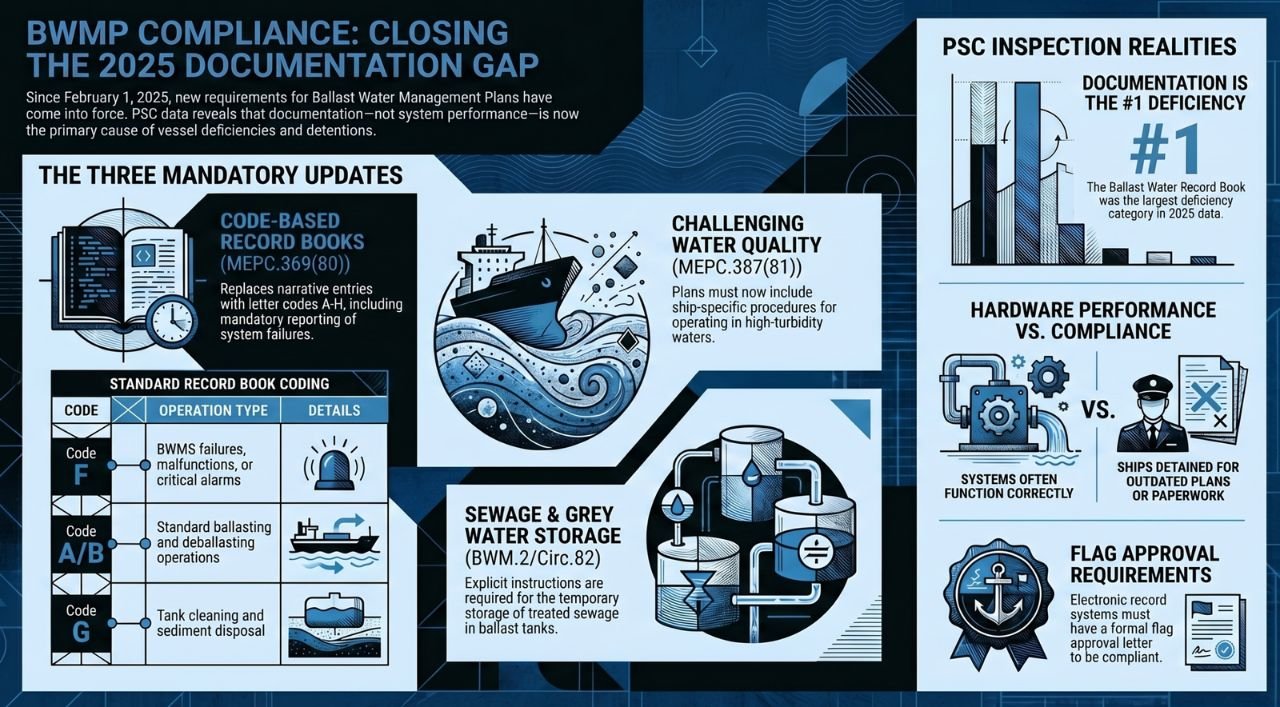
The BWMP new requirements that came into force on 1 February 2025 are not yet reflected in a significant number of plans currently on board. The PSC Concentrated Inspection Campaign that ran from September to November 2025 focused exclusively on ballast water management — and the results confirmed what I had already been seeing in SMS documentation reviews: ships still operating on plans that had not been updated to meet the current standard.
The Ballast Water Record Book was the single largest deficiency category in Paris MoU data through 2025. Not the treatment system. Not the sampling points. The record book — a documentation issue. That tells you precisely where the problem sits.
This article sets out what changed, when it came into force, and what your BWMP must now contain if it was not updated after 1 February 2025.
The BWMP New Requirements: What Changed and When
Three instruments came into force or were adopted in a short window.
MEPC.369(80), adopted in July 2023, entered into force on 1 February 2025. It replaced the Ballast Water Record Book format entirely.
MEPC.387(81), adopted in March 2024, introduced interim guidance on ships operating in Challenging Water Quality (CWQ) conditions. This guidance is expected to be incorporated into the approved BWMP.
BWM.2/Circ.82 introduced guidance on the temporary storage of treated sewage and grey water in ballast tanks — an operational scenario that most older plans did not address at all.
If your BWMP was approved before February 2025 and has not been updated since, it is likely missing all three.
Gap One: The Record Book Format Changed
The most visible change under MEPC.369(80) is the replacement of the old narrative format with a code-based system using letter codes A through H. Each code corresponds to a specific type of ballast water operation — A for ballasting, B for deballasting, C for exchange or in-tank treatment, D for port reception facility operations, E for accidental or exceptional discharge, F for BWMS failures and inoperabilities, G for tank cleaning and sediment disposal, and H for additional operational procedures and general remarks.
Code F is significant. It is the first time the record book has required a dedicated entry category for BWMS failures — including malfunctions, shutdowns, and critical alarms that may indicate non-compliance with the D-2 standard. The entry must record the time and location of failure, the operation being carried out, a description of the issue, and when the system was returned to operational status. The old format had no equivalent entry.
Ships still using the old physical record book are non-compliant. So are ships using an electronic record system that has not been updated and formally approved by flag — a deficiency that PSC found repeatedly during the CIC, with the absence of a flag approval letter being one of the most commonly recorded findings.
The BWMP must reference and reflect the updated Appendix II format. Any instructions in the plan relating to how entries are to be made must be updated to align with the code structure. That is not a minor administrative change — it affects the section of the plan that the Chief Officer works from daily.
The regulators are now checking whether the documentation and the crew knowledge match the system that is installed — not just whether the system runs.
Gap Two: Challenging Water Quality Procedures Are Missing from Most Plans
MEPC.387(81) is not optional guidance. Administrations are expected to ensure that approved BWMPs incorporate its requirements — specifically, that the plan contains ship-specific procedures for operating in conditions where the BWMS cannot function as designed.
Challenging Water Quality is defined as uptake water with parameters — primarily high total suspended solids or turbidity — that cause a properly installed and maintained type-approved BWMS to become temporarily inoperable. Temperature and salinity alone do not define CWQ.
A BWMP that addresses CWQ under MEPC.387(81) must include a ship-specific definition of operational demand — the minimum BWMS flow rate below which cargo operations cannot practicably continue, which must not exceed 50% of the system’s treatment rated capacity.
It must include a table of CWQ triggers drawn from the BWMS manufacturer’s OMSM, identifying the critical alarms that signal an operational limitation has been reached. The plan must also set out the alternatives to bypass that are to be attempted before the system is bypassed, the procedure for bypass itself including which officer is designated to authorise it, a decontamination procedure to restore D-2 compliance following a bypass event, and the communication requirement to notify the next port State before arrival if bypass has occurred.
When I reviewed and updated a BWMP for a client earlier this year, none of this was present in the approved plan that was submitted to us. The CWQ section had to be built from scratch — incorporating the OMSM trigger table from the installed treatment system, establishing ship-specific flow rate thresholds, and drafting the full decontamination procedure as a new appendix. This is not a small revision. For most ships, it represents a material change to the plan.
Gap Three: Treated Sewage and Grey Water in Ballast Tanks
BWM.2/Circ.82 introduced guidance on an operational scenario that has always existed in practice but was rarely documented: the temporary storage of treated sewage and/or grey water in ballast tanks when port reception facilities are inadequate and the ship has no alternative.
The BWMP should now specify which tanks may be designated for this purpose, the operational procedures to follow before, during and after the temporary storage, the daily generation estimates to factor into planning, and what must be recorded in the BWRB when a tank is in non-ballast use. Any discharge from a tank used for sewage or grey water storage must comply with MARPOL Annex IV — not the BWM Convention — and the plan must make this distinction explicit to the crew.
The guidance also addresses coating condition. Ballast tanks used for sewage storage should be subject to periodic inspection, and the plan should include measures to prevent coating damage from the different chemistry involved.
This section may appear minor. In practice, it closes a gap that port State control can and does identify — particularly on vessels that have stored sewage in ballast tanks and made no BWRB entry, because the old plan gave them no instruction to do so.
What PSC Found — and What It Means for Your Documentation
The PSC CIC results from 2025 show that the primary area of non-compliance was documentation and familiarity, not treatment system performance. The record book, the management plan, and crew knowledge of both were the dominant deficiency categories. The BWMS itself generated the highest number of detainable deficiencies overall, but a substantial proportion of those related to record-keeping of malfunctions — which is precisely what Code F now addresses.
A ship whose treatment system is functioning correctly but whose BWMP has not been updated, whose record book entries remain in the old format, and whose crew cannot explain the CWQ procedures, carries a compliance risk that the system’s operational performance cannot resolve. The inspection is no longer focused on whether the water meets D-2 at the point of discharge. It is focused on whether the documentation, the plan, and the crew all reflect the same current reality.
If your BWMP was approved before February 2025, the question is not whether it needs updating. The question is how much of it needs to be rewritten.
More from the Amendment Log
- MSC-MEPC.5/Circ.17: What the New Remote Survey and Audit Guidance Actually Allows
- MSC.1/Circ.1704: What the New Bridge Software Maintenance Guidelines Cover, and What They Don’t
- SOLAS Pilot Transfer Arrangements 2028: What Ship Managers Need to Know
- ECDIS Performance Standards 2026: What MSC.530(106)/Rev.1 Actually Changes
- The PFOS Ban Is in Force. The Survey Clock Is Already Running.
- Your STS operations manual references a guide that no longer exists in its old form
- The Lifting Appliances Manual: What the Regulation Requires, and What Actually Gets It Through Survey
- SOLAS II-1/3-13: What Ship Managers Need to Know About the New Lifting Appliance Requirements