
The first article in this series set out what SOLAS Regulation II-1/3-13 requires across a fleet — which equipment is in scope, what the compliance deadlines are, and where the documentation gaps tend to appear. This article goes one level deeper, into the SOLAS lifting appliances manual itself.
Since 1 January 2026, every vessel subject to SOLAS II-1/3-13 is required to have a maintenance manual and an operations manual on board for each lifting appliance. The regulation does not specify a single combined format, but in practice most companies and class societies expect a single vessel-specific document that addresses both. What that document contains, and how it is built, is where most companies run into difficulty.
What follows is drawn from direct experience building these manuals — not a theoretical walkthrough, but a working account of what the regulation actually requires and where the complexity consistently sits.
What a SOLAS Lifting Appliances Manual Must Actually Contain
The guidelines issued under MSC.1/Circ.1663 set out minimum content requirements for both the maintenance manual and the operations manual. They are not short lists.
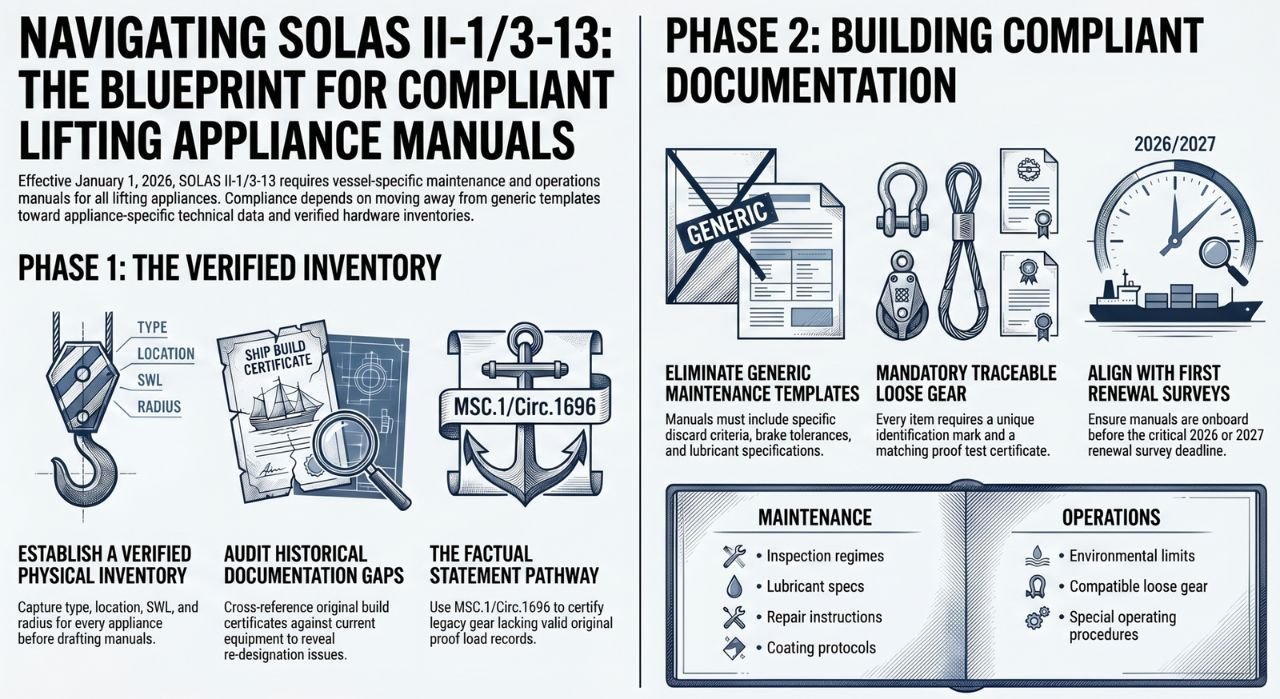
The maintenance manual must include, for each appliance: a description of the required inspection regime and maintenance schedules specific to that appliance; checklists; a list of key tools; instructions for routine repairs; technical maintenance information; lubricant and oil specifications; slewing bearing maintenance procedures where applicable; lists of replaceable parts and their replacement procedures; sources of spare parts; model forms for recording inspections; operational test procedures including pre- and post-operational checks; a list of components requiring particular attention; recommended intervals for replacement and overhaul; coating and corrosion protection protocols; and procedures for appliances that are idle for extended periods.
The operations manual must include, for each appliance: design, operational, and environmental limitations; compatible loose gear; safety instructions; and operating procedures including any special procedures.
That is not a checklist that can be filled in generically. Both documents must be appliance-specific. The maintenance schedules for a hose handling crane are not the same as those for an engine room overhead travelling crane. The operating procedures for a provision davit are not interchangeable with those for a deck crane. A document that treats all appliances identically will not satisfy a competent class surveyor.
The Inventory Comes Before the Manual
The single most important step before writing a word of the manual is establishing a verified inventory of every lifting appliance on board. This is not the same as reviewing the existing register or asking the Chief Officer for a list.
The inventory must capture the name and type of each appliance, its location by frame number or area, its SWL, its operating radius or span, its installation date, and its current certificate status. Where maker documentation exists — original build certificates, manufacturer’s inspection records, previous load test certificates — each item must be cross-referenced against those documents and any discrepancies noted.
In practice, this step reveals more compliance issues than any other part of the process. Appliances that have been re-designated over the years, sub-SWL units without any valid proof load record, equipment with function-test-only certificates that have been incorrectly treated as full load test compliance — these are consistent findings. The inventory is where that picture becomes visible.
Why Generic Templates Fall Short
There are template documents available that claim to satisfy the SOLAS II-1/3-13 maintenance and operations manual requirement. Most of them fail for the same reason: they do not contain the appliance-specific technical data that the regulation requires.
A maintenance manual that lists inspection items generically — “check wire rope condition,” “verify safety devices are functional” — without specifying the discard criteria applicable to that rope type, the brake gap tolerances specific to that crane’s electromagnetic brake, or the lubricant specifications and quantities for each oiling point, does not meet the MSC.1/Circ.1663 standard. A class surveyor conducting a thorough examination will expect to see that specificity. If it is not in the manual, the manual is not compliant.
For new equipment, the manufacturer’s documentation is the primary source. The manual is built around it, with the regulatory framework overlaid. For older equipment, the process is considerably more demanding.
The Legacy Gear Problem — From the Inside
A vessel built and delivered in the mid-2000s is a typical case. Its lifting appliances include equipment commissioned at delivery, equipment that has changed hands across ownership transitions, and equipment for which the original maker’s documentation is partial or absent.
For the main cranes, manufacturer’s records and prior class certificates provide a credible foundation. For a number of sub-1,000 kg appliances — provision davits, pump room davits, pilot ladder davits — the historical record is often shipyard inspection certificates that recorded function tests rather than full proof load tests. These appliances are covered under flag state guidance for sub-1,000 kg equipment, which requires SMS management rather than full five-yearly load test certification. But they still require SWL documentary evidence, they still require their details to appear in the lifting appliance inventory, and they still require their inspection and maintenance to be addressed in the manual.
For any appliance without valid certificates under a prior international instrument, the Factual Statement pathway under MSC.1/Circ.1696 provides the compliance route. The Factual Statement confirms a load test and thorough examination were conducted, calculates the test load from a company-nominated SWL, and is issued by the vessel’s Recognised Organisation. It does not validate the nominated SWL — that responsibility sits with the company — but it satisfies the SOLAS II-1/3-13.2.4 requirement and must be attached to the Register of Lifting Appliances.
What the Factual Statement route requires is that the company has nominated an SWL, has arranged the load test and thorough examination through their RO, and has the competent person available to issue the statement. None of that happens automatically, and for vessels approaching their first renewal survey, this work needs to be in progress now.
The Loose Gear Section
The loose gear section of the manual is the area most commonly either missing entirely or reduced to a generic list that does not satisfy the certification requirement.
Every item of loose gear used with an in-scope lifting appliance must have a proof test certificate traceable to that specific item by its unique identification mark or serial number. Every item must be permanently marked with its unique identification and its SWL. The manual must include a loose gear inventory that captures the description, distinguishing mark, SWL, proof load, test date, certificate reference, and certifying body for each item.
This creates a documentation task that is consistently underestimated. A hose handling crane on a product tanker may have a load block, multiple wire ropes, and associated rigging — each requiring its own traceable certificate. Where those certificates exist only in historical ILO form, they are acceptable until they expire under the transitional provisions. Where they do not exist, or where items are unmarked, those items cannot lawfully be used and must be segregated.
What Gets a Manual Through Survey
The documents a class surveyor will check on a lifting appliance survey are specific: the Register of Ship’s Lifting Appliances and Cargo Handling Gear, the certificates of test and thorough examination for each appliance and each item of loose gear, and the maintenance and operations manual. If the manual contains generic content, missing appliance data, or incomplete loose gear certification, those gaps will be identified.
What passes survey is a manual built from the vessel’s actual documentation — maker certificates, load test records, previous class certificates, manufacturer specifications — with the regulatory framework applied correctly to each appliance based on its installation date, SWL, and flag state. It is a document that requires research, not just formatting.
For vessels under ClassNK, the surveyor will also check whether maintenance and inspection records are being maintained in a form acceptable to the Administration, and whether the PMS reflects the annual thorough examination interval now required under the regulation.
A Note on Timing
The first renewal survey trigger is the critical deadline for any fleet working towards a compliant SOLAS lifting appliances manual.
For vessels whose next renewal survey falls in 2026, the manual should already be on board. For those surveying in 2027, there is time — but the inventory and documentation audit should be underway, particularly for any appliance that will need the Factual Statement pathway, as arranging load testing and thorough examination through an RO takes lead time.
If you would like VragaMarine’s assistance with a lifting appliances compliance review, documentation audit, or manual preparation, get in touch through the contact page.
More from the Amendment Log
- MSC-MEPC.5/Circ.17: What the New Remote Survey and Audit Guidance Actually Allows
- MSC.1/Circ.1704: What the New Bridge Software Maintenance Guidelines Cover, and What They Don’t
- SOLAS Pilot Transfer Arrangements 2028: What Ship Managers Need to Know
- ECDIS Performance Standards 2026: What MSC.530(106)/Rev.1 Actually Changes
- The PFOS Ban Is in Force. The Survey Clock Is Already Running.
- Your STS operations manual references a guide that no longer exists in its old form
- The Ballast Water Management Plan Has Three New Requirements. Is Yours Current?
- SOLAS II-1/3-13: What Ship Managers Need to Know About the New Lifting Appliance Requirements